


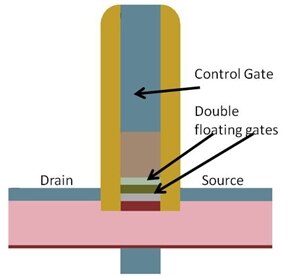
Researchers from North Carolina State University have developed a new device that represents a significant advance for computer memory, making large-scale ‘server farms’ more energy efficient and allowing computers to start more quickly. Ordinarily, there are two types of computer memory devices. Slow memory devices are used in persistent data storage technologies such as flash drives which allow us to save information for extended periods of time, and are therefore called nonvolatile devices. Fast memory devices allow our computers to operate quickly, but aren’t able to save data when the computers are turned off. The necessity for a constant source of power makes them volatile devices. That’s all about to change now that a research team from NC State has developed a single ‘unified’ device that can perform both volatile and nonvolatile memory operation and may be used in the main memory. “Our device is called a double floating-gate field effect transistor (FET). Existing nonvolatile memory used in data storage devices utilizes a single floating gate, which stores charge in the floating gate to signify a 1 or 0 in the device – or one ‘bit’ of information. By using two floating gates, the device can store a bit in a nonvolatile mode, and/or it can store a bit in a fast, volatile mode – like the normal main memory on your computer,” said Dr. Paul Franzon, a professor of electrical and computer engineering at NC State. The double floating-gate FET could have a significant impact on a number of computer problems. For example, it would allow computers to start immediately, because the computer wouldn’t have to retrieve start-up data from its hard drive, the data could be stored in its main memory. More information will be published in the research paper entitled “Computing with Novel Floating-Gate Devices,” Feb. 10 in IEEE’s Computer.
Eavesdropper
