I've only supported one: Gadget Factory's Papilio DUO FPGA development board. This was a low-risk campaign. I already had a Gadget Factory Papilio One, which I still recommend as an excellent FPGA development board, particularly for beginners. So I already knew Gadget Factory was for real.
It was also low-risk because Gadget Factory had already launched several boards and knew what problems to expect. The board design was already solid and had been prototyped by the time the Kickstarter began. Basically, Gadget Factory needed the Kickstarter to get enough up-front money to build a large number of boards. The schedule was realistic and only slipped by a month. I backed the DUO because I didn't have a Spartan-6 board yet and it was clear that the Spartan-3E and -3A were no longer the "sweet spot" in Xilinx's offerings. I figured I'd better get some experience with Spartan-6, and Papilio DUO was a way to get a Spartan-6 board at a discount (I got the early-bird price) and support Gadget Factory, which has a very nice open-source business model.
The DUO I received is of excellent quality and works perfectly. However, other Kickstarters haven't gone as well. Be careful if they haven't completed the prototype and if they've never manufactured product in quantity. You'll be paying for their learning experience and the finished product may have problems.
I may back another Kickstarter in the future if I really like the product. I'll even consider backing a high-risk product if the idea is so compelling that I feel it's worthy of support even if I never receive an actual reward.
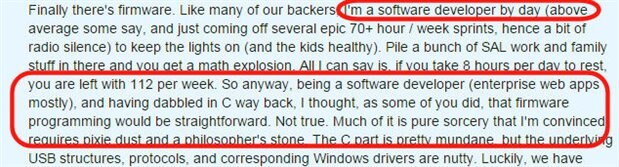
Kings Assembly - A keyboard project delayed by more than a year, still not delivered. This comment by the creator is interesting:
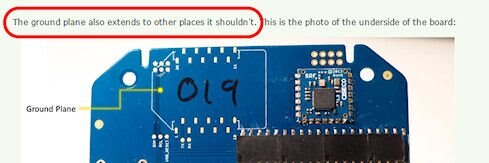
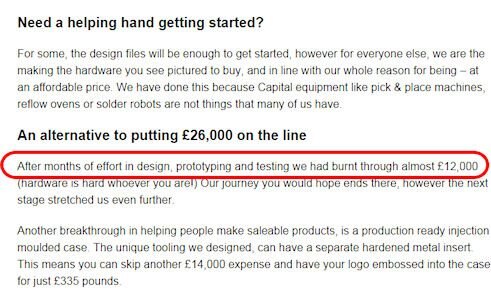
OpenPi - A Kickstarter aimed at those wanting to start their own businesses based around the Pi Compute Module. However it is delayed - and often businesses won't have the time to wait. Maybe delayed because they had to spend time redesigning the board. Valid points were raised on Element 14 about the design. Here is just one of the points raised:
(I wonder, did they not spot these issues before burning through £12,000):
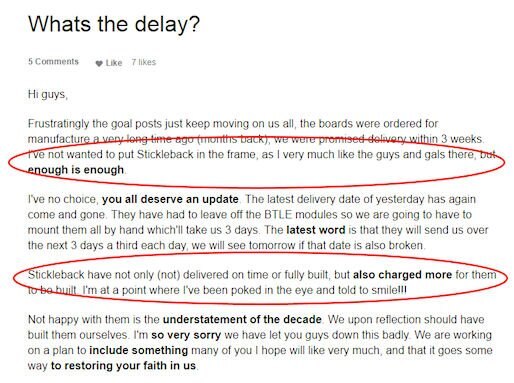
We didn't get any thanks for it!
Anyway currently they are blaming a third party (Stickleback).
I suppose one has to look at it as a way of finding capital for their project, and it's more-so a "donation" to their cause with the "possibility" of getting something back. Venture capitalists, flush with cash, will always choose and pick the projects which seem the most promising and profitable to back in the hopes of a return. Likewise, Kickstarter backers tend to choose and pay based on what they are "loosely" promised. As it all comes with no guarantee, it's a really risky proposition for the more substantial amounts you might be tempted to invest, so in principle, I have avoided most of them. The products which are really good will probably not need to go the Kickstarter route anyway, and those that do succeed will always be available after their launch (even if it is, a little more expensive, it will probably be a little more refined as well). So aside from missing out on day #1 "first generation" bleeding edge pains, and a small discount, you're really not missing out on much by not backing a campaign.
In truth, I think I might have only two items that had come from after a crowdfunding campaign had been successful, but aside from those, I'd have to say that the crowdfunding system tends to lead to a very mixed bag when it comes to quality of delivered goods and value for money.
Looking at some of the postings, as well as some projects that have been referred to me over time, it doesn't take much of a science background to see that some things just don't add up, be it thermodynamically, or from a practical electronics sense. In fact, I'm convinced the whole Kickstarter (and Indiegogo amongst others) business is often a game of marketing and viral advertising reach. Projects do as much as they can to grab exposure and pledges, by throwing a lot of money into visual design and "marketing", rather than "meat". This includes vague and misleading or selective truths in their campaign material to make things seem unrealistically good. The layperson is unlikely to be able to distinguish a well-dressed lie from truth, and will also get fleeced. This is highly attractive to the companies, as if they are successful, it is almost "risk free" money - it's not theirs, they are free to fail with the money, and if things get too bad they will just "forget it ever happened", change names and move on.
There has been a little bit done to close down the truly impossible, but it seems that all of this crowdfunding continues to run rampant because the platforms which enable it always take a cut of all the pledged money, with no risk even if the project fails. The better projects might offer a partial refund, but when the money's spent ... the money's spent!
You have represented perfectly what I think of Kickstarter projects. The first, is the one where everything shows crap and sensless. Why? Because it is sensless
The second is the most insidious, I think, there are lot of projects that can "wow"investors and founders: no product (or product without content it is the same) with a super clean marketing image. Can't be missed a 3D model (rotating please), a great promo video where users can't live without the produce, not technology explained buy what does it matter? No matter at all...
Frankly what leave me without words in these projects is how their creators can trust in themselves ... This is a mystery for me.
can't be a warranty the fact that KS projects are refunded if money goal is not reached?
Then, perfectly agree on all you wrote, and
The products which are really good will probably not need to go the Kickstarter route anyway, and those that do succeed will always be available after their launch (even if it is, a little more expensive, it will probably be a little more refined as well).
it is one of the reasons I don't trust in this process.
Personally, the goal-not-reached refund is more so to protect projects from trying to fulfill too few orders with too little money. Much of the economics relies on economies of scale, which can only arise if you're building 10,000, or 100,000 units or more. As a result, if you don't reach the minimum number, everyone gets their money back - that's a good thing I suppose, as the project wouldn't have had a chance to build 10 units at the same per-unit cost.
But this doesn't stop many projects from either being naive and inexperienced, and underestimating their costs dramatically, resulting in project failure. Another thing is it won't save you from well-marketed lies which are impossible to achieve but the organization hasn't received enough "uproar" to outright cancel their crowdfund campaign and refund the money. With enough marketing, and a low-enough target, once exceeded, you pretty much get the money. Good projects deliver, and then become viable companies, and sell products outside of the whole crowdfunding system, whereas the bad projects tend to delay, delay again, come up with excuses, and burn through the money.
Aside from that, there are sometimes truly worthy projects (very rarely) but because of a lack of marketing and virality - maybe they're quite boring or have much smaller potential markets. Sadly, those projects often end up trying to find venture capital through other means, and their founders often feel slightly discouraged by it.