Hi Cabe,
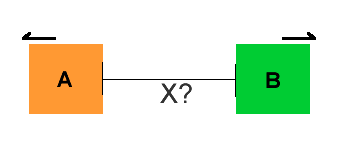
A very simple approach is to set up two laser pointers set up to hit the same spot at only the correct distance. As you move one box towards the other, the two laser spots will converge. If you move them away, the spots diverge. The approach is simple, you can reset the distance to just about any range where the laser spots are still visible and best of all, its nearly fool proof.
By the way, the British used a similar system to set the altitude for thier bombers when they bombed the Ruhr river dams in Germany.
Thanks
DAB
Hi Cabe,
A very simple approach is to set up two laser pointers set up to hit the same spot at only the correct distance. As you move one box towards the other, the two laser spots will converge. If you move them away, the spots diverge. The approach is simple, you can reset the distance to just about any range where the laser spots are still visible and best of all, its nearly fool proof.
By the way, the British used a similar system to set the altitude for thier bombers when they bombed the Ruhr river dams in Germany.
Thanks
DAB
Hey DAB
I like this approach! This way the lasers can be mounted on the extreme of the outside of block A and the stability of block B is not as much a problem.
The distance is simple to calculate (displacement of dots). However, there is no way to calculate the negative, since a distance beyond the convergence of the dots will be the same result as the positive. For a little more sophistication a linear diode array mounted on block B would provide a direct readout of distance.
Bill
DAB
Another thought... if plus/minus is imporant , two different color lasers and filters on the linear arrays would allow diferentation of plus & Minus.
Hi Bill,
It would be easier to just use a video camera and compare the dot positions from frame to frame. That way you get both position and direction for each laser pointer. Remember, Keep It Simple if you want something to work.
Thanks,
DAB