element14 Community
element14 Community
    Register Log In
  • Site
  • Search
  • Log In Register
  • Community Hub
    Community Hub
    • What's New on element14
    • Feedback and Support
    • Benefits of Membership
    • Personal Blogs
    • Members Area
    • Achievement Levels
  • Learn
    Learn
    • Ask an Expert
    • eBooks
    • element14 presents
    • Learning Center
    • Tech Spotlight
    • STEM Academy
    • Webinars, Training and Events
    • Learning Groups
  • Technologies
    Technologies
    • 3D Printing
    • FPGA
    • Industrial Automation
    • Internet of Things
    • Power & Energy
    • Sensors
    • Technology Groups
  • Challenges & Projects
    Challenges & Projects
    • Design Challenges
    • element14 presents Projects
    • Project14
    • Arduino Projects
    • Raspberry Pi Projects
    • Project Groups
  • Products
    Products
    • Arduino
    • Avnet & Tria Boards Community
    • Dev Tools
    • Manufacturers
    • Multicomp Pro
    • Product Groups
    • Raspberry Pi
    • RoadTests & Reviews
  • About Us
  • Store
    Store
    • Visit Your Store
    • Choose another store...
      • Europe
      •  Austria (German)
      •  Belgium (Dutch, French)
      •  Bulgaria (Bulgarian)
      •  Czech Republic (Czech)
      •  Denmark (Danish)
      •  Estonia (Estonian)
      •  Finland (Finnish)
      •  France (French)
      •  Germany (German)
      •  Hungary (Hungarian)
      •  Ireland
      •  Israel
      •  Italy (Italian)
      •  Latvia (Latvian)
      •  
      •  Lithuania (Lithuanian)
      •  Netherlands (Dutch)
      •  Norway (Norwegian)
      •  Poland (Polish)
      •  Portugal (Portuguese)
      •  Romania (Romanian)
      •  Russia (Russian)
      •  Slovakia (Slovak)
      •  Slovenia (Slovenian)
      •  Spain (Spanish)
      •  Sweden (Swedish)
      •  Switzerland(German, French)
      •  Turkey (Turkish)
      •  United Kingdom
      • Asia Pacific
      •  Australia
      •  China
      •  Hong Kong
      •  India
      • Japan
      •  Korea (Korean)
      •  Malaysia
      •  New Zealand
      •  Philippines
      •  Singapore
      •  Taiwan
      •  Thailand (Thai)
      • Vietnam
      • Americas
      •  Brazil (Portuguese)
      •  Canada
      •  Mexico (Spanish)
      •  United States
      Can't find the country/region you're looking for? Visit our export site or find a local distributor.
  • Translate
  • Profile
  • Settings
Embedded and Microcontrollers
  • Technologies
  • More
Embedded and Microcontrollers
Embedded Forum Transistor heating up
  • Blog
  • Forum
  • Documents
  • Quiz
  • Polls
  • Files
  • Members
  • Mentions
  • Sub-Groups
  • Tags
  • More
  • Cancel
  • New
Join Embedded and Microcontrollers to participate - click to join for free!
Actions
  • Share
  • More
  • Cancel
Forum Thread Details
  • State Verified Answer
  • Replies 6 replies
  • Answers 2 answers
  • Subscribers 474 subscribers
  • Views 1397 views
  • Users 0 members are here
  • transistor
  • embedded
  • Design
  • electronics
Related

Transistor heating up

icongdo
icongdo over 10 years ago

Hi Everyone!


I am new to this site and have just gotten into electronics recently. I aspire to work as an embedded software engineer one day. I am currently a web developer and graduated with a Computer Science degree so I've gotten the software down.


Recently I have picked up a few books and started out with the Arduino. I am still getting used to hardware side which takes me back to my question.


I have been playing with transistors but its given me different results each time. Sometimes it will work, sometimes it will not. Can someone clear it up for me.

Below is the simple set up. The other day it worked just fine but today without the base receiving current from the base the motor still moved, slowly and transistor started heating up. I understand the fan isn't valued for 16 V but

it seemed like the transistor can handle that current.

Link to transistor datasheet : http://www.farnell.com/datasheets/1845309.pdf
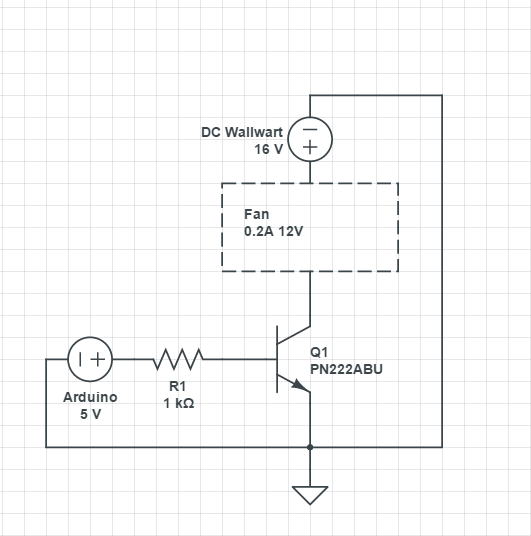
 

image


Thanks in advance!

  • Sign in to reply
  • Cancel

Top Replies

  • johnbeetem
    johnbeetem over 10 years ago +3 verified
    Three comments: 1. A single 2222 may be a little weak for this application. With 1K base resistor you're getting 4 mA current from base to emitter, which the transistor amplifies by a factor of 40 or so…
  • icongdo
    icongdo over 10 years ago in reply to johnbeetem +2
    Just got home and started to play with the toys. Thanks for the replies you guys. Newbie mistake. The NPN transistor was plugged in backwards.. It was drawing current onto itself and was heating up. Thanks…
  • clem57
    0 clem57 over 10 years ago

    This is a NPN transistor which needs a resistor on the base which you have and a resistor on the collector which is missing. This limits the current on the collector and would be the reason for the heat on the transistor. It is not the voltage, but the current flowing causing the heat issue. Please review NPN Transistor Tutorial - The Bipolar NPN Transistor carefully to understand how the electrical flows work.

    Clem

    • Cancel
    • Vote Up 0 Vote Down
    • Sign in to reply
    • Verify Answer
    • Reject Answer
    • Cancel
  • icongdo
    0 icongdo over 10 years ago in reply to clem57

    I was under the impression that the load ( fan ) itself reduce current on the collector's end.


    Edit: Also I was replicating this previous set up discussed earlier but with a different load and collector voltage. Help with 3v dc motor


    That example worked for me but I was trying different inputs. I removed the dc motor, capacitor, and reversed diode. The fan came from a cpu which I believe has those components in them.

    With that setup, there wasn't a resistor on the collector's end?

    • Cancel
    • Vote Up 0 Vote Down
    • Sign in to reply
    • Verify Answer
    • Cancel
  • clem57
    0 clem57 over 10 years ago in reply to icongdo

    Yes the fan has a load but not the same as a dc motor in the example. This is like saying a beetle and a truck have the same affect in an accident. Work in this field has many details to understand just like the web. I am sure subtle differences in browsers can affect web code. Study Ohm's law first and you can see that math is the key here.

    Clem

    • Cancel
    • Vote Up 0 Vote Down
    • Sign in to reply
    • Verify Answer
    • Reject Answer
    • Cancel
  • johnbeetem
    0 johnbeetem over 10 years ago

    Three comments:


    1.  A single 2222 may be a little weak for this application.  With 1K base resistor you're getting 4 mA current from base to emitter, which the transistor amplifies by a factor of 40 or so resulting in 160mA, which is less than the 200mA required by the fan.  So you might want to reduce 1K down to 750 or so to get more margin.  I don't know how much current the Arduino can source: see what voltage you are actually getting at the Arduino pin.  If it can't source much current, try a Darlington pair instead of a single NPN transistor: http://en.wikipedia.org/wiki/Darlington_transistor

    A Darlington pair has two stages of current boost, so you can use a very small current to switch a very large current.


    2.  You need a Flyback Diode: http://en.wikipedia.org/wiki/Flyback_diode

    Let's say you've successfully turned on the fan with the transistor.  The fan is an inductor with 200 mA or so running through it.  Inductors cannot change current flow instantaneously.  When you turn off the transistor, the current has to go somewhere so it charges up the stray capacitance at the transistor's collector to a really high voltage, which shorts out your transistor.  If you've been burning through transistors, this is why.


    The flyback diode goes across the motor from NPN collector to your +16V supply.  When the transistor shuts off and the collector voltage starts to rise, the flyback diode switches on and provides a safe place for the motor's current to go.


    3.  IMO you don't need a collector resistor.  The fan motor provides enough of a voltage drop.

    • Cancel
    • Vote Up +3 Vote Down
    • Sign in to reply
    • Reject Answer
    • Cancel
  • icongdo
    0 icongdo over 10 years ago in reply to johnbeetem

    Just got home and started to play with the toys.

    Thanks for the replies you guys. Newbie mistake. The NPN transistor was plugged in backwards.. It was drawing current onto itself and was heating up. Thanks for the insights though.


    John Beetem wrote:


    Three comments:


    1.  A single 2222 may be a little weak for this application.  With 1K base resistor you're getting 4 mA current from base to emitter, which the transistor amplifies by a factor of 40 or so resulting in 160mA, which is less than the 200mA required by the fan.  So you might want to reduce 1K down to 750 or so to get more margin.  I don't know how much current the Arduino can source: see what voltage you are actually getting at the Arduino pin.  If it can't source much current, try a Darlington pair instead of a single NPN transistor: http://en.wikipedia.org/wiki/Darlington_transistor

    A Darlington pair has two stages of current boost, so you can use a very small current to switch a very large current.


    Regarding the 1k resistor. I believe the datasheets stated current gain of min 150 and max 300 for Ic = 150mA which the fan actually stated .16A. That was bad on my part.

    Thanks for such great feedback though. You live and you learn. I am so glad I found this community.

    • Cancel
    • Vote Up +2 Vote Down
    • Sign in to reply
    • Verify Answer
    • Cancel
  • majorkuso
    0 majorkuso over 10 years ago in reply to icongdo

    Glad to hear you got it working the transistor has to be able to handle the current with the fan in series with the collector and emitter you can add the current flowing through that junction as well as the current through the base and emitter junction too, in order to get a rough total current through transistor.

    • Cancel
    • Vote Up 0 Vote Down
    • Sign in to reply
    • Verify Answer
    • Cancel
element14 Community

element14 is the first online community specifically for engineers. Connect with your peers and get expert answers to your questions.

  • Members
  • Learn
  • Technologies
  • Challenges & Projects
  • Products
  • Store
  • About Us
  • Feedback & Support
  • FAQs
  • Terms of Use
  • Privacy Policy
  • Legal and Copyright Notices
  • Sitemap
  • Cookies

An Avnet Company © 2025 Premier Farnell Limited. All Rights Reserved.

Premier Farnell Ltd, registered in England and Wales (no 00876412), registered office: Farnell House, Forge Lane, Leeds LS12 2NE.

ICP 备案号 10220084.

Follow element14

  • X
  • Facebook
  • linkedin
  • YouTube