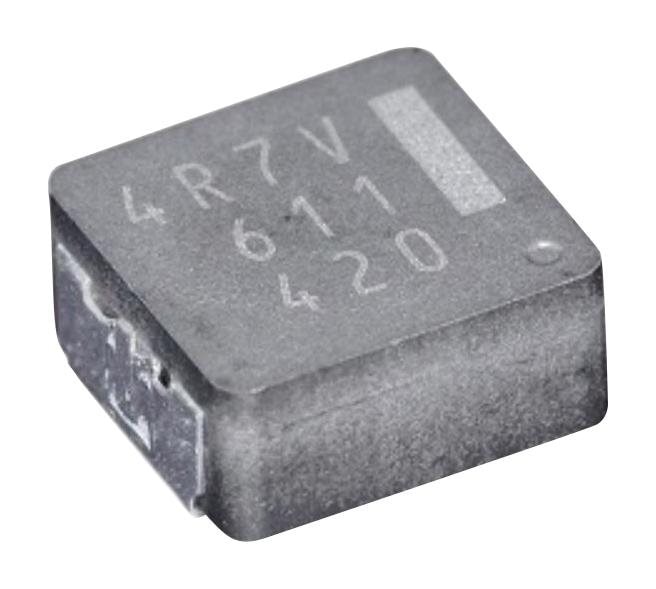
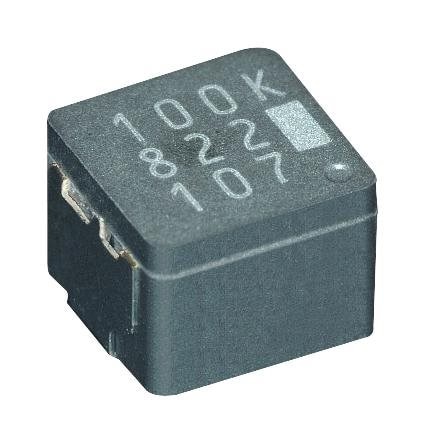
Electrification, autonomy, and smart vehicle architectures have transformed automotive power electronics design. Every subsystem—from high-frequency DC-DC converters and ADAS computing units to battery management systems (BMS) and onboard chargers (OBC)—is continually redesigned for higher efficiency, lower noise, greater miniaturization, and uncompromising reliability in harsh environments. In this evolving landscape, power inductors have become a critical component of every power stage, enabling efficient DC-DC conversion, noise filtering, stable current regulation, and high-frequency switching.
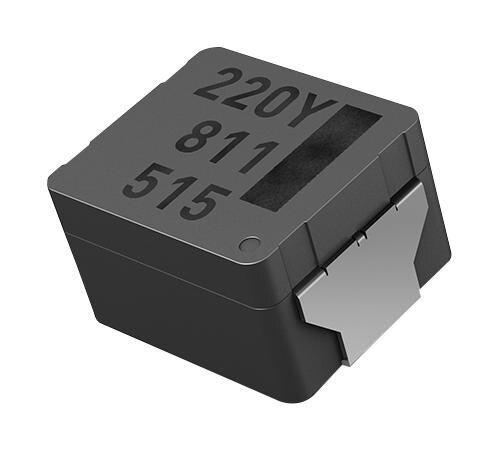
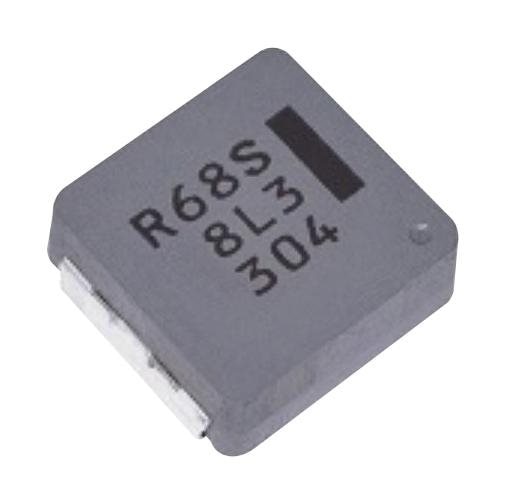
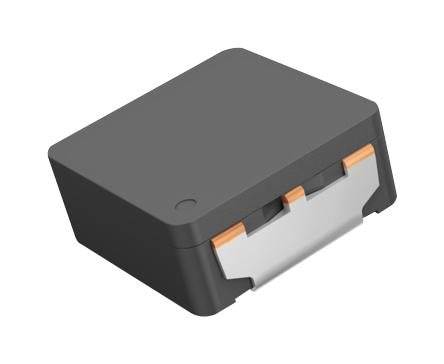
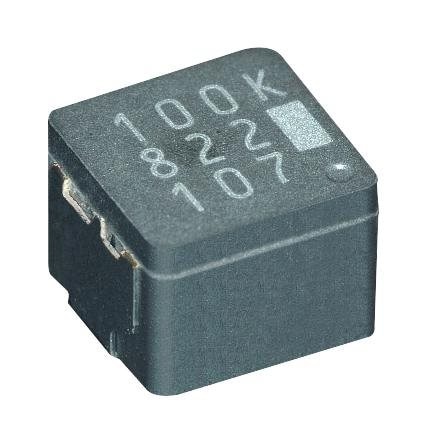
Panasonic addresses these challenges with Automotive-Grade Power Choke Coils (PCCs) featuring Metal Composite (MC) technologies, dust cores, and proprietary high-vibration structures. These PCCs outperform standard ferrite inductors by delivering low loss, high vibration resistance, and full AEC-Q200 compliance. These PCCs offer superior reliability for EV/HEV converters, ADAS ECUs, zone controllers, BMS units, and other high-stress automotive systems.
This guide covers:
- The key power challenges in modern automotive electronics.
- How Panasonic’s PCC technologies address the power challenges.
- The role and advantages of each PCC series.
- How to choose the right PCC for specific automotive applications.
What Are Power Inductors and Why Are They Essential in Modern Automotive Systems?
Power inductors (also called coils or chokes) store energy in a magnetic field and regulate current flow in electronic circuits. These passive components are commonly used in DC-DC converters, power supplies, motor control, lighting, and noise-filtering applications. They stabilize power delivery, reduce high-frequency noise, and enhance overall efficiency.
Power inductors are essential in automotive systems because they smooth and regulate electrical currents, filter noise, and enable efficient power conversion. These components are integrated into onboard chargers, DC-DC converters, traction inverters, and vehicle ECUs, where they regulate battery voltage and ensure stable power delivery. As automotive systems demand higher efficiency, smaller footprints, and enhanced electrical performance, superior inductors are becoming increasingly vital to system reliability and overall efficiency.
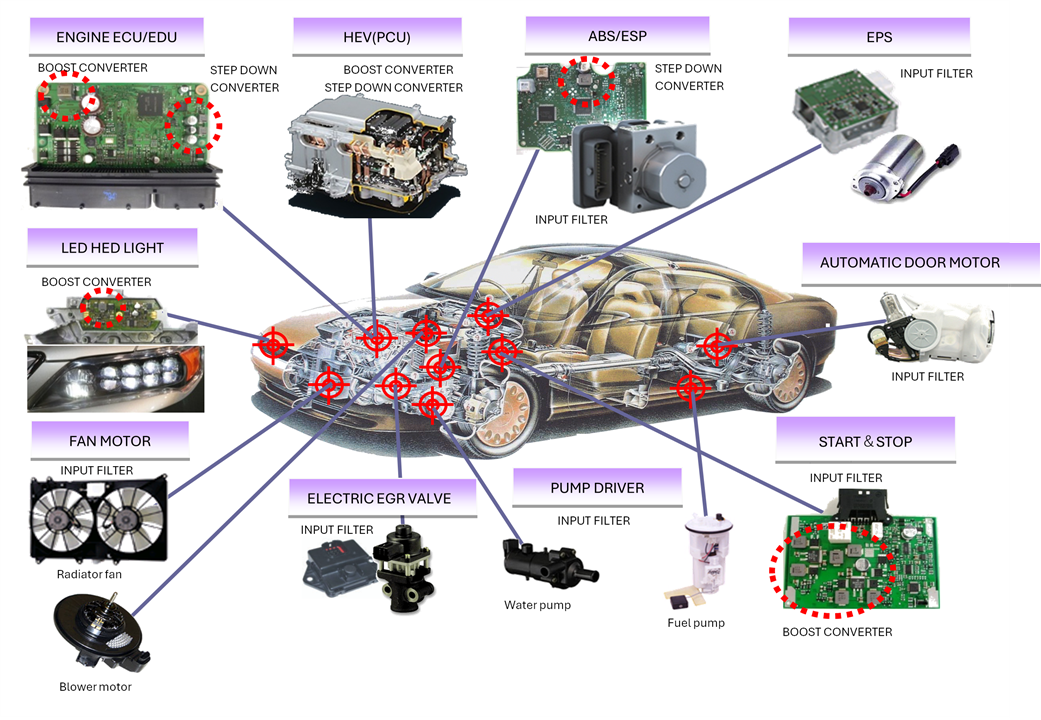
Fig 1. Application overview of power inductors in automotive (source: Panasonic)
Overview of Common Challenges in Automotive Power Electronics
Automotive design engineers face unique constraints that exceed those of most consumer or industrial electronics. Key issues include:
High-temperature operation and thermal cycling stress: Automotive power electronics frequently operate in extreme thermal environments, where under-hood temperatures may reach 125°C. Power inductors must maintain electrical performance at junction temperatures of 150–180°C while managing additional self-heating from both DC copper losses (I²R) and AC core losses (hysteresis and eddy currents). Additionally, real-world drive cycles repeatedly swing from −40°C to over 125°C, creating mechanical stress that causes microcracks, debonding, and insulation breakdown in standard inductors.
Extreme vibration and mechanical fatigue: Automotive ECUs mounted near engines, inverter, compressor, and chassis areas face extreme vibration and shock levels, often reaching 30–50G across wide frequency ranges. These harsh forces can crack cores, break winding joints, and lift solder connections in conventional inductors.
High ripple currents and saturation behavior: Modern automotive DC-DC converters generate high ripple currents, often 30–60 per cent of the rated DC current, with peak conditions far exceeding steady-state levels. Conventional ferrite inductors struggle in these conditions, showing hard saturation, sharp inductance drop, thermal buildup, and unstable converter performance. In applications like 48 V to 12 V converters delivering 150 A, ripple currents can reach 90 A peak-to-peak, pushing inductors toward failure. These stresses demand inductors with soft saturation characteristics and stable inductance under high ripple and heavy DC bias.
Electromagnetic compatibility: Automotive systems must meet strict EMC standards like CISPR 25 and ISO 11452, as high-frequency switching in DC-DC converters (300 kHz to 2 MHz) can create harmonics that interfere with radios, sensors, and wireless functions. Poorly designed inductors worsen conducted and radiated noise, disrupt radar and camera systems, and introduce acoustic buzz from magnetostriction.
Efficiency and low core loss: Automotive power supplies aim for 95–97% efficiency, leaving very limited loss budgets for magnetics. In a 3 kW 48 V-to-12 V converter, only about 20–30 W can be allocated to the inductor after MOSFET losses. This demands inductors with low AC losses, low DCR, and stable impedance across temperature and DC bias. High-frequency switching makes these requirements even more critical, ensuring minimal energy loss, cooler operation, and maximum ECU efficiency.
Space and weight constraints: Modern automotive ECUs, domain controllers, and ADAS modules are increasingly compact, with tight PCB space and aggressive miniaturization targets. Designers need smaller inductors that maintain high current capability, low DCR, and strong saturation performance. With camera modules as small as 40 × 40 × 15 mm and boards packed with hundreds of components, every cubic millimeter counts—making high-density, space-efficient inductors essential.
Reliability and durability: Automotive inductors must meet strict AEC-Q200 standards, ensuring long-term stability, strong solder joints, and robust terminal strength under heat, vibration, and thermal shock. With requirements like multi-reflow endurance, humidity bias testing, and MTBF targets exceeding one million hours, reliability is just as critical as electrical performance in modern automotive systems.
Panasonic’s Technology Advantages
Panasonic has developed Power Choke Coil (PCC) solutions specifically engineered to address these automotive challenges through advanced material science and optimized mechanical design.
Metal Composite (MC) Core Technology: Panasonic’s Fe-based MC cores use uniformly insulated iron particles to create a distributed air-gap structure, delivering controlled permeability, reduced flux concentration, and superior saturation performance compared to gapped ferrite cores. They deliver high saturation flux density (typically 1.5-1.6 T compared to 0.4 T for ferrites), offering higher energy storage than ferrites and enabling smaller footprints or higher current capability. Their distributed‐gap structure ensures predictable inductance with 70–85% retention under DC bias, while high-temperature materials maintain magnetic stability up to 160°C with low TCL. Optimized particle insulation and binder systems minimize hysteresis, eddy current, and residual losses, ensuring low core loss from 300 kHz to 2 MHz.
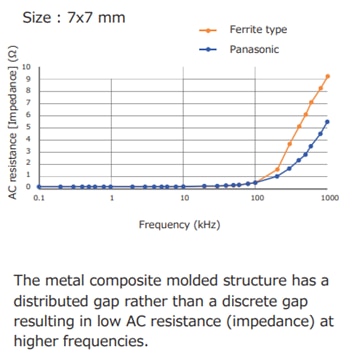
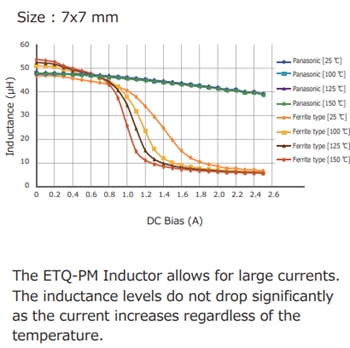
Fig 2. Frequency characteristics of AC resistance and the effect of DC bias current on induction (source: Panasonic)
Dust Core Technology (Soft Saturation Characteristics): Panasonic’s dust-core technology delivers smooth soft-saturation, high ripple-current tolerance, and stable inductance under wide current swings—far superior to ferrite. This core provides a gradual saturation characteristic, meaning the inductance rolls off slowly as DC bias increases. This is crucial for reliable operation in power factor correction (PFC) circuits, LED drivers, and DC-DC boost topologies where instantaneous current spikes are common. Combined with robust molded construction, hard-coat wire, caulking terminals, low-center-of-gravity design, and 50G vibration validation, PCC inductors offer exceptional durability for harsh, high-vibration power applications.
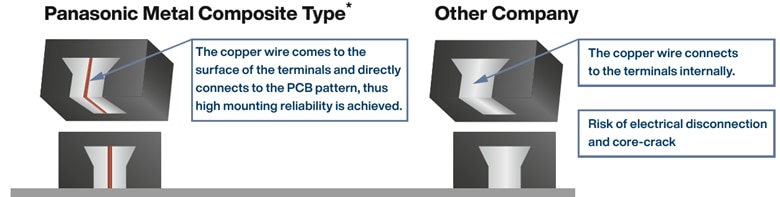
Fig 3. Panasonic vs others: Terminal coating design that prevents disconnection & core cracks (source: Panasonic)
Winding Optimization for Low DC Resistance: Panasonic PCCs cut DCR through smart winding design: larger or rectangular conductors for lower resistance, fewer turns enabled by high-Al MC cores, and optimized 2–3 layer winding patterns that limit wire length, reduce AC losses, improve SRF, and keep current density thermally safe even at high currents.
Mechanical and Reliability Testing: Panasonic validates PCC durability with rigorous mechanical tests—30–50G vibration under load, 1000+ extreme thermal cycles, solder-joint aging checks, and high-voltage withstand verification. Post-stress inspections confirm stable DCR, intact insulation, and no structural fatigue, exceeding AEC-Q200 requirements for long-term automotive reliability.
Acoustic Noise Reduction Through Distributed Gap Design: Panasonic’s MC distributed-gap cores reduce acoustic noise by eliminating the single-gapped ferrite region where magnetostriction concentrates. Instead, nanoscale gaps disperse mechanical stress, preventing coherent vibration. As a result, MC-core PCCs typically drop inductor noise from 40–55 dB to an inaudible range of 20–30 dB, enabling quieter, placement-agnostic high-frequency designs.

Fig 4. Ferrite vs Panasonic MC inductors: Acoustic noise comparison (source: Panasonic)
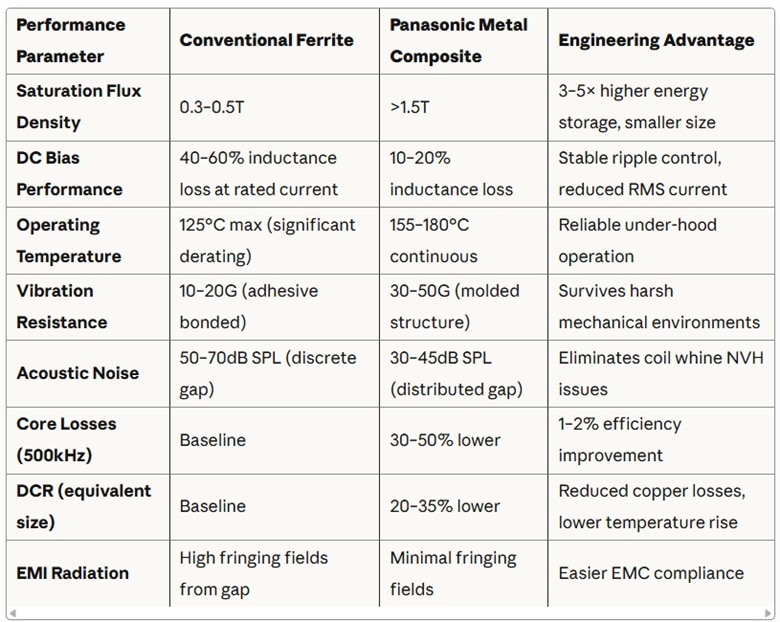
Table 1. Comparison chart: Panasonic PCC vs. Conventional Ferrite Inductors
Product Series Breakdown (Engineering-Focused Portfolio):
Panasonic’s PCC lineup includes several series, each designed to address specific automotive design needs. The overview below looks past basic datasheet specs to explain why each series is built the way it is, where it fits best, and what performance tradeoffs engineers should expect.
- High vibration acceleration-resistant – MS series: The MS Series (PCC-M0854MS, PCC-M1050MS) is a robust surface-mount device (SMD) inductor engineered specifically for harsh automotive environments, featuring a metal composite core (MC) that delivers exceptional vibration tolerance of 50 G or higher, even at elevated temperatures up to 150°C. Key advantages include:
- 50 G vibration acceleration resistance: Molded, integrated MC-core construction.
- High heat tolerance: –40 °C to +150 °C (up to +180 °C short-duration) for under-hood reliability.
- Excellent inductance stability: Maintains performance under high bias current and temperature rise.
- Low audible noise: Gapless metal-composite magnetic structure.
- Low DCR / low core loss: Ensures efficiency in high-frequency converters.
- Shielded SMD design: Minimizes EMI in dense automotive power stages.
Its monolithic construction and terminal design, which includes a caulking structure, make it more resistant to vibrational forces than standard metal composite coils. This specialization makes it ideal for Engine Control Units (ECUs) and sensors that are mounted directly onto the engine or powertrain system.
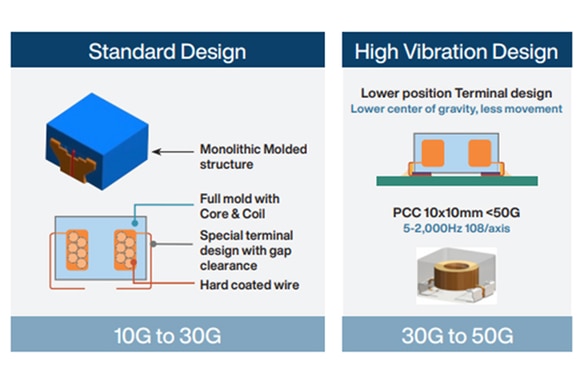
Fig 5. High-vibration automotive inductor design: Panasonic’s robust structure for 30g–50g performance (source: Panasonic)
2) Large current power choke coil for automotive-MF series: The MF series (e.g., PCC-M1280MF, PCC-M150MF) is designed for applications requiring the maximum current handling capability within a compact surface-mount package. Additionally, it achieves superior inductance stability under heavy bias currents and temperature swings, as well as low eddy-current losses for enhanced efficiency. Its key features include:
- Large current capacity: Up to 53 A (M1280MF) and 87 A (M15A0MF) without saturating.
- High thermal endurance: Reliable continuous operation up to 160 °C (and 180 °C short-term) including self-heating.
- Strong vibration resistance: Designed for 30 G automotive vibration, suitable for under-hood or engine-mounted ECUs.
- Low loss and stable inductance: Ferrous-alloy core delivers stable inductance under heavy DC bias and broad temperature range, while the gapless MC structure avoids audible buzzing.
- Surface-mountable and compact: SMD form factor enables direct mounting on space-limited automotive PCBs.
It is effective in high-power systems, such as 48V mild-hybrid systems, high-current DC/DC converters, and inverters for electric and hybrid vehicle powertrains.
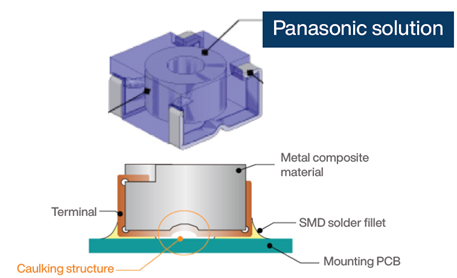
Fig 6. Panasonic’s automotive-grade high-current inductors (source: Panasonic)
3) Power choke coil for automotive Dust core: Panasonic’s Dust-Core Power Choke Coil (Automotive MC type, e.g. PCC-D1413H series) uses a distributed-gap dust-core structure combining dust iron core technology with edgewise rectangular wire winding to achieve ultra-low loss characteristics in high-current automotive applications. Its key features include:
- High heat resistance: Operates reliably up to 150 °C, including self-heating, ideal for engine-bay and under-hood environments.
- Compact SMD package: Typical size 14.7 × 13.2 × 13.1 mm, suitable for space-constrained automotive ECUs.
- High bias-current handling & inductance stability: Ferrous-alloy dust core keeps inductance stable under heavy DC load, essential for power supplies and injection-driver circuits.
- Low-loss, high-efficiency design: Dust core plus edgewise rectangular-wire winding reduces core loss and DC resistance, improving converter efficiency.
- Vibration resistance: Designed for 5 Hz–2 kHz vibration at 30 G, robust enough for harsh automotive mechanical environments.
- Shielded construction & AEC-Q200 qualified: Meets automotive EMC and reliability standards.
This Dust-Core MC coil is ideal for fuel-injection drivers, high-current DC/DC converters, and other demanding automotive power subsystems.
4) Power choke coil for automotive-H series: The H-series MC power choke coils (e.g., PCC-M0530M-H, PCC-M0630M-H) use a metal composite core in a low-profile SMD package to deliver high-frequency, high-reliability performance for vehicle power systems. Its key features include:
- Low core loss at high switching frequencies (> 2 MHz): Ideal for modern DC/DC and inverter circuits.
- High heat resistance: Rated for operation up to +150 °C, including self-heating, supporting automotive under-hood and high-power environments.
- Compact, low-profile SMD form (≤ 3 mm height): Helps save PCB space in dense ECUs and modules.
- High reliability and vibration resistance: Panasonic’s integral molded MC construction makes it suitable for harsh automotive conditions.
- Stable inductance under high DC bias & wide temperature range: Ferrous-alloy MC core maintains performance under load and thermal stress.
- Low audible noise: Gapless MC core design eliminates the buzzy sound common in ferrite-based inductors.
- Low winding resistance & low core losses: Ensures high efficiency and supports high-current, high-frequency automotive power circuits.
- Shielded construction and full automotive qualification (AEC-Q200 compliant): Meeting rigorous automotive EMC and reliability standards.
They are ideal for space-constrained, high-frequency DC/DC converters, power-supply filters, and other automotive power modules requiring resilience under heat, vibration, and high current.
5) Power choke coil for automotive-LE series: The LE series (e.g. PCC-M0648M-LE / PCC-M0748M-LE) uses a metal-composite (MC) core in a shielded SMD package and is designed for high reliability and compact, heat- and vibration-resistant operation in automotive power systems. Key features include:
- Low DC resistance and low loss: Minimizes conduction and core losses for efficient power use.
- High heat resistance: Rated for continuous operation up to 150 °C (including self-heating), with short-term use up to 180 °C possible, ideal for under-hood or high-temperature ECUs.
- High bias current & inductance stability: The MC core’s ferrous alloy maintains stable inductance even under high DC bias and temperature variation.
- Excellent thermal and temperature stability: Inductance remains stable over a broad temperature range, ensuring predictable behaviour across automotive conditions.
- Low audible noise (“buzz”): The gapless MC structure avoids magnetostriction-induced vibration and noise common in ferrite inductors.
- Shielded SMD construction, high reliability, and AEC-Q200 qualification: Ensures compliance with automotive standards for quality, vibration resistance, and environmental robustness.
Due to its compact SMD form, high heat tolerance, low loss, and stable inductance under bias, as well as resistance to vibration and noise, the LE-series choke coil is ideal for DC-DC converters, filters, and power rails in space-constrained ECUs.
6) Power choke coil for automotive-LL series: The LL series (e.g. PCC‑M0750M‑LL) uses a metal-composite core and surface-mount (SMD) package to deliver a low-loss, low-DC-resistance power choke optimized for compact, high-efficiency automotive power circuits. Key features include:
- Low DC resistance & low loss: Very low DCR and minimal core loss improve converter efficiency and reduce heat generation.
- High thermal endurance: Rated for operation up to +155 °C (self-heating included), and short-term up to 180 °C, making it robust for under-hood and high-temperature environments.
- Compact low-profile SMD design: Maximum 5.0 mm height and small footprint (e.g. 7.0 × 7.9 × 5.0 mm) ideal for space-constrained ECUs and power modules.
- High bias-current stability: Ferrous-alloy MC core maintains stable inductance under high DC load current, supporting reliable high-current operation.
- Low audible noise (“buzz”) and shielded construction: Gapless MC core and full shielding minimize magnetostriction-induced vibration and EMI, ensuring quiet and clean power delivery.
- AEC-Q200 qualified & high reliability: Built to meet strict automotive standards for environmental stress, vibration resistance, and long-term operational stability.
The LL series is ideal for modern automotive DC/DC converters, power rails, and compact ECU power supplies. Its small size, low loss, thermal robustness, and stable, quiet performance make it a strong match for EV/HEV power systems, infotainment supply rails, and other demanding onboard electronics.
7) Power choke coil for automotive-LP series: The LP series (e.g. PCC-M0530M-LP, PCC-M0630M-LP, PCC-M0840M-LP, PCC-M1040M-LP) uses a metal-composite core and a low-profile surface-mount (SMD) package to deliver high heat resistance, stable inductance under high current, and high reliability for automotive power systems. Key features include:
- High heat resistance: Rated for continuous operation up to 155 °C (self-heating included), with possible short-term use to 180 °C, ideal for under-hood or high-temperature ECUs.
- Very low profile: Just 3 mm max height for PCC-M0530M/0630M-LP and 4 mm max height for PCC-M0840M/1040M-LP, saving valuable PCB real estate in compact modules.
- Surface-mount (SMD) type: Enables automated assembly and efficient PCB layout in modern automotive ECUs.
- High bias-current handling & inductance stability: Ferrous-alloy MC core ensures stable inductance even under heavy DC load, supporting reliable power delivery.
- Low audible noise (“buzz”): The gapless MC structure reduces magnetostriction-induced vibration and acoustic noise, critical in cabin-sensitive environments.
- Low-loss, efficient design: Low DC resistance of windings plus low eddy-current loss in the core improve overall power conversion efficiency.
- Shielded construction & AEC-Q200 qualified: Meets stringent automotive reliability and EMI/EMC standards.
Thanks to its compact SMD form factor, thermal robustness, low-loss and stable magnetic performance under current and temperature stress, and resistance to vibration and noise, the LP-series choke coil is ideal for space-constrained DC-DC converters, power-supply filters, and high-current rails in modern EV/HEV systems, ECUs, infotainment modules, and other densely packed automotive electronics.
8) Power choke coil for automotive-M series: Panasonic’s M series (e.g. PCC-M0530M, M0630M, M0854M, M1050M etc.) implements a metal-composite (MC) core in a shielded surface-mount package, optimized for automotive DC/DC converters and power rails requiring robust high-temperature, high-current performance. Key features include:
- High heat resistance: Rated for continuous operation up to 150°C (including self-heating), with short-term tolerance potentially up to 180°C.
- High bias-current capability: Excellent inductance stability under DC load thanks to ferrous-alloy MC core, making it suitable for high-current DC/DC and power-supply applications.
- Temperature stability: Inductance remains stable across a wide operating temperature range, ensuring predictable performance under thermal stress.
- Low audible noise: The gapless MC core design avoids magnetostriction-induced buzzing, a common noise issue in ferrite inductors.
- High efficiency: Low DC resistance windings and low eddy-current core losses boost power conversion efficiency and reduce heat generation.
- High reliability and vibration resilience: Integral construction enhances vibration tolerance and ensures mechanical robustness under automotive stress.
- AEC-Q200 compliant and shielded construction: Designed to meet automotive reliability and EMC standards for harsh vehicle environments.
Because of its high heat tolerance, stable inductance under load and temperature, low loss, low noise, and strong mechanical resilience, the M-series choke coil is ideal for automotive DC/DC converters, onboard power supplies, and high-current power rails.
Panasonic automotive power choke coils (PCCs) - Application matrix:
Panasonic PCCs are optimized for the full spectrum of automotive power electronics.
|
Automotive application |
Key Requirements |
Recommended Panasonic PCC series |
|
EV/HEV DC-DC converters |
High Isat, low DCR, thermal stability |
MF |
|
ADAS compute modules, camera ECUs, radar/lidar processing |
Low height, low noise, compact form factor |
LE/LP |
|
Battery Management Systems (BMS) |
High thermal stability, reliability |
H/M |
|
LED drivers and lighting control |
High ripple absorption, boost regulation |
D |
|
Motor Drivers & Inverters MF, MS |
High current, vibration resistance |
MF |
|
OBC/charging modules |
High efficiency, thermal endurance |
LL |
|
Infotainment & body electronics |
General-purpose inductance, stable performance |
M |
|
Zone controllers & central domain controllers |
Miniaturized, EMC-friendly, low profile |
LE/LP |
Summary: Why Choose Panasonic Power Choke Coils?
Panasonic Power Choke Coils combine advanced Metal Composite and Dust Core materials with low-loss, low-DCR designs to deliver superior DC bias stability, high efficiency, and 150–180°C thermal endurance. With AEC-Q200 reliability, 50G vibration resistance, and a broad lineup for every ECU domain, PCCs ensure long-life, compact, high-performance power delivery for modern automotive electronics.
FAQs
What makes Panasonic’s Metal Composite (MC) PCCs superior to traditional ferrite inductors?
Panasonic PCCs use Metal Composite (MC) and Dust Core technologies that deliver higher saturation flux (>1.5T vs ~0.4T for ferrite), gradual soft saturation for ripple handling, and superior thermal stability up to 180°C. Unlike ferrite inductors, PCCs maintain inductance under DC bias, reduce acoustic noise, and withstand extreme vibration (30–50G).
Which PCC series should I choose for high-vibration automotive environments?
For environments such as engine compartments, pumps, compressors, and chassis ECUs, Panasonic’s MS Series is optimized with reinforced molded structures and enhanced terminal strength. These inductors provide up to 50G vibration resistance, ensuring long-term reliability under mechanical stress.
Which PCC series is recommended for high-ripple current applications, such as PFC or boost stages in EV charging modules?
The D Series (Dust Core, e.g., PCC-D1413H) excels here with its soft-saturation characteristic—a gradual B-H curve (μ_eff linear drop from 1.5 T to 1.0 T over 20–100 A bias)—handling >50% ripple without abrupt clipping or THD >5%. It supports 25+ A Irms with low ACR (6.9 mΩ at 20 kHz), reducing voltage ripple by 30% and enabling >97% efficiency in resonant topologies, unlike hard-saturation MC or ferrites.
For space-constrained ADAS modules, what advantages do the low-profile LE and LP series provide?
The LE (e.g., PCC-M0648M-LE, 4.8 mm height) and LP Series (e.g., PCC-M0530M-LP, 3.0 mm height) solve miniaturization challenges with gapless MC cores delivering >10 A Isat in <5 mm profiles, while thick-walled molding ensures 30G vibration tolerance and <5% voiding for mechanical stability. They cut board space by 30% versus taller alternatives, with shielded designs suppressing EMI by 15 dB, ideal for camera/radar ECUs requiring low-height ripple filtering (<2 mVpp) at f_sw >500 kHz.
Are Panasonic PCCs compliant with automotive reliability standards?
Yes. All PCCs are AEC-Q200 qualified, ensuring long-term stability, solder joint reliability, and terminal strength. They undergo rigorous thermal cycling, vibration acceleration, and voltage withstand testing to meet automotive-grade reliability requirements.
How does Panasonic ensure long-term reliability for automotive applications?
Panasonic PCCs undergo rigorous reliability and qualification tests including thermal shock, vibration acceleration, high-temperature storage, load-life endurance, and mechanical strength validation. The combination of molded construction, high-temperature wire coatings, and robust core materials ensures long operating life under EV/HEV conditions.
What key factors should engineers consider when selecting a PCC for zone controllers or BMS applications?
Prioritize inductance (0.2–220 μH for ripple <10% at f_sw 50 kHz–2 MHz), Irms/Isat (>1.5x peak with 40 K derating), DCR (<10 mΩ for >98% eff), and mechanical specs (MS for 50G vibration in BMS; M/LL for <10G in zones). Choose MC for high-bias stability, Dust Core for ripple-heavy loads; apply thermal derating (e.g., 70% Irms at 105°C ambient) based on PCB θ_ja. Use Panasonic's parametric tools to match EMI shielding needs in multi-rail 48V architectures.
About the Sponsor
Panasonic Ind ustry strive for continuous innovation and share the company’s mission and vision - shaping the future for the better. To take engineering to the next level, Panasonic Industry researches, produces and supplies technologies for a vast range of industries. For more information, click here.