element14 Community
element14 Community
    Register Log In
  • Site
  • Search
  • Log In Register
  • Community Hub
    Community Hub
    • What's New on element14
    • Feedback and Support
    • Benefits of Membership
    • Personal Blogs
    • Members Area
    • Achievement Levels
  • Learn
    Learn
    • Ask an Expert
    • eBooks
    • element14 presents
    • Learning Center
    • Tech Spotlight
    • STEM Academy
    • Webinars, Training and Events
    • Learning Groups
  • Technologies
    Technologies
    • 3D Printing
    • FPGA
    • Industrial Automation
    • Internet of Things
    • Power & Energy
    • Sensors
    • Technology Groups
  • Challenges & Projects
    Challenges & Projects
    • Design Challenges
    • element14 presents Projects
    • Project14
    • Arduino Projects
    • Raspberry Pi Projects
    • Project Groups
  • Products
    Products
    • Arduino
    • Avnet & Tria Boards Community
    • Dev Tools
    • Manufacturers
    • Multicomp Pro
    • Product Groups
    • Raspberry Pi
    • RoadTests & Reviews
  • About Us
  • Store
    Store
    • Visit Your Store
    • Choose another store...
      • Europe
      •  Austria (German)
      •  Belgium (Dutch, French)
      •  Bulgaria (Bulgarian)
      •  Czech Republic (Czech)
      •  Denmark (Danish)
      •  Estonia (Estonian)
      •  Finland (Finnish)
      •  France (French)
      •  Germany (German)
      •  Hungary (Hungarian)
      •  Ireland
      •  Israel
      •  Italy (Italian)
      •  Latvia (Latvian)
      •  
      •  Lithuania (Lithuanian)
      •  Netherlands (Dutch)
      •  Norway (Norwegian)
      •  Poland (Polish)
      •  Portugal (Portuguese)
      •  Romania (Romanian)
      •  Russia (Russian)
      •  Slovakia (Slovak)
      •  Slovenia (Slovenian)
      •  Spain (Spanish)
      •  Sweden (Swedish)
      •  Switzerland(German, French)
      •  Turkey (Turkish)
      •  United Kingdom
      • Asia Pacific
      •  Australia
      •  China
      •  Hong Kong
      •  India
      • Japan
      •  Korea (Korean)
      •  Malaysia
      •  New Zealand
      •  Philippines
      •  Singapore
      •  Taiwan
      •  Thailand (Thai)
      • Vietnam
      • Americas
      •  Brazil (Portuguese)
      •  Canada
      •  Mexico (Spanish)
      •  United States
      Can't find the country/region you're looking for? Visit our export site or find a local distributor.
  • Translate
  • Profile
  • Settings
Experts, Learning and Guidance
  • Technologies
  • More
Experts, Learning and Guidance
Ask an Expert Forum Opamp Protection Diodes - can someone confirm my thinking
  • Blog
  • Forum
  • Documents
  • Leaderboard
  • Files
  • Members
  • Mentions
  • Sub-Groups
  • Tags
  • More
  • Cancel
  • New
Join Experts, Learning and Guidance to participate - click to join for free!
Actions
  • Share
  • More
  • Cancel
Forum Thread Details
  • Replies 10 replies
  • Subscribers 302 subscribers
  • Views 4712 views
  • Users 0 members are here
Related
See a helpful answer?

Be sure to click 'more' and select 'suggest as answer'!

If you're the thread creator, be sure to click 'more' then 'Verify as Answer'!

Opamp Protection Diodes - can someone confirm my thinking

Andrew J
Andrew J over 5 years ago

I've been putting some thinking into protecting opamp inputs from over voltage and could do with someone confirming my thinking on this.  I'm going to assume that this is a complex topic but as naive as ever I want to try and keep it simple if at all possible!  I'm working on the basis of a transitive ESD event of 1kV over a number of ns and a stress event of 50V over a number of ms


image

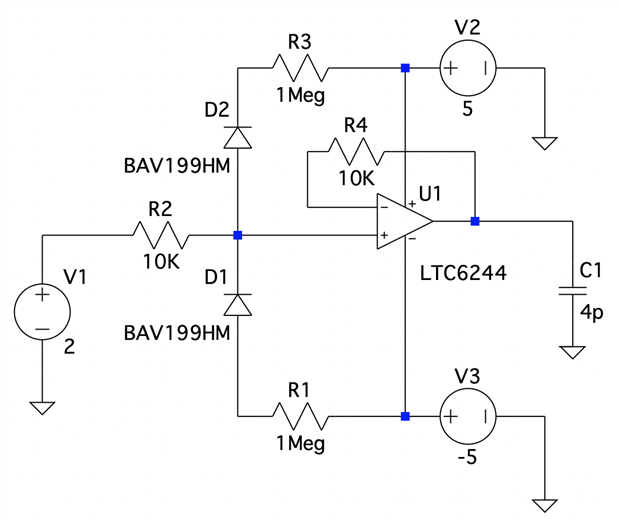
Example circuit: I actually have a BAV199 dual diode and TI OPA192 Opamp; input will be 0-2V.  C1 represents the capacitance on a ADC pin with high impedance input.  That has a LSB of 62.5uV and INL of 20.1uV.  This opamp doesn't have the typical internal ESD diodes and using a proprietary means of over voltage protection up to the common mode range (V+ - V-) so 10V in this case.


Under normal operation, at peak voltage input of 2V, there is a reverse voltage on the diode D1 of 7V and a leakage shown by this graph:
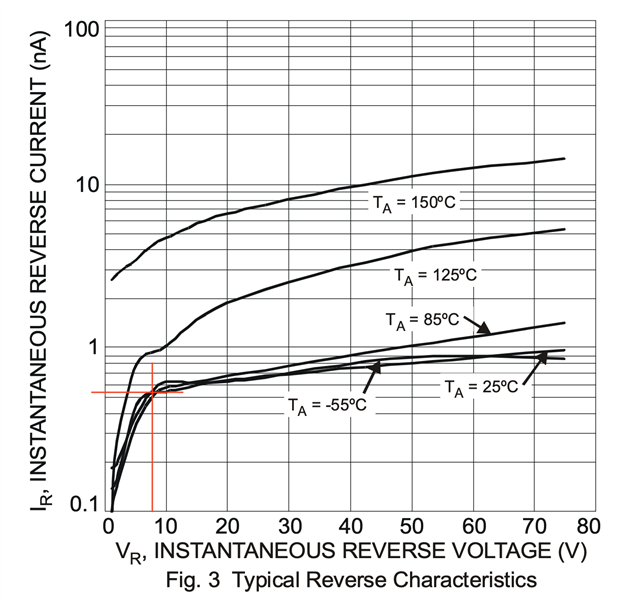
image

Leakage current = 0.55nA or 550pA which seems to be good to quite a high temperature

That would induce a voltage drop of 5.5uV across R2.  This would increase the opamp offset voltage from typical 8uV to 13.5uV (or max 50uV to 55.5uV.)  This is less than 1LSB of the ADC so seems like a reasonable approach to protect the Opamp and, possibly, the ADC.


But...


Those diodes, once they start conducting will push current into the voltage sources which are linear regulators and cannot sink current so may well end up toast - cheaper than the opamps - but also may just end up out of regulation and become over voltage suppliers themselves.  If I put a TVS or even a Zener on the regulator output that would just contribute additional and higher leakage current.


Could I put, say, a 1Mohm resistor between each diode and regulator to current limit and thus help with preventing the regulator going out of regulation but without affecting them under normal operating scenarios?  Also is it worth protecting the inverting input of the OpAmp with a resistor - with the architecture of this opamp not having internal protection diodes it may not add anything except additional noise?
image

The choice of 10K for R2, with matching resistance for R4, is a tradeoff of current limiting into the opamp at 50V (0.25W) and additional noise (12.9nV/ √Hz )on a signal under normal circumstances.  With a 50V over voltage scenario, that's excessive voltage at the non-inverting input but only 5mA.  There will be things here that I'm unaware of so it may be that the better approach is just to go with current limiting and forget the diode protection; within my understanding it seems like a reasonable approach that won't have too much of an impact on the signal quality in relation to the ADC.

  • Sign in to reply
  • Cancel

Top Replies

  • jc2048
    jc2048 over 5 years ago +4
    What's the context in which you're trying to protect the input? The datasheet for the OPA192 says it's good to 4kV from the usual body model as per various JEDEC standards. It doesn't say how the protection…
  • dougw
    dougw over 5 years ago +3
    The most common ESD source for electronics is the human body which has a capacitance of about 200pf. If discharging this 200pf charged to 1000V to an uncharged 200nf capacitor should raise its voltage…
  • michaelkellett
    michaelkellett over 5 years ago in reply to Andrew J +2
    If you can it's a really good idea to put a cap from the input pin to ground - 100nF is a reasonable value if all you care about is EMC. In real life you often don't want a huge input shunt capacity. A…
Parents
  • jc2048
    jc2048 over 5 years ago

    What's the context in which you're trying to protect the input?


    The datasheet for the OPA192 says it's good to 4kV from the usual body model as per various JEDEC standards. It doesn't say how the protection works, but you can take it that it does. That's similar to many other chips and is OK for handling an assembled board in a manufacturing environment. You could probably kill an input in a home environment by handling the board [particularly if your environment is hot and dry and you have nylon carpets and wear synthetic fabrics], but that also applies to all the SBCs you have.


    A few random thoughts on your various questions


    - the BAV199 diodes are very low leakage but not stunningly fast [compared to a switching diode like a 1N4148 that is]. BAV199 recovery time is 3.5us, 1N4148 is more like 2 or 3ns. They might do. How did you come to choose them?

    - both diodes leak, so there's leakage current down both diodes and the resistor will only see a proportion depending on the voltage and how well the diodes match

    - the 1M resistors are a waste of time - please don't do that

    - with a scheme like this, the energy from the ESD event ends up in the decoupling capacitors. There's not too much of it and the voltage shouldn't move too far, but if it looks like a problem then you'll need to catch the rail with a zener or TVS or do something else to deal with it (as you point out, the regulators themselves don't stop the rail from exceeding the normal output voltage). [I'm speaking here from the point of view of a digital designer used to planes and extensive distributed decoupling to tie planes hard together. Things might be a bit different with analogue design and need more care.]

    - if you were to put some resistance between the diodes and the input then you'll end up with two stages of protection, with the external diodes taking the brunt of it and the internal doing the rest, which might be worth looking at

    - I think you might first want to reconsider what you're doing with the input before designing the protection. You seem to be asking for an input that has an input resistance of 10 to the power 13 [or whatever it is for a CMOS op amp], is very low noise [over what bandwidth?], works with signal voltages down in the uV area, and can stand being zapped or connected momentarily to 50V. Not sure you'll get all of those. [You've created a conflict between the requirement for low noise and what you need to do to deal with overload/protection. The route out is probably to move away from working with a very high impedance input.]

    • Cancel
    • Vote Up +4 Vote Down
    • Sign in to reply
    • Cancel
  • Andrew J
    Andrew J over 5 years ago in reply to jc2048

    Thanks Jon.


    I chose the BAV199 because it's low leakage; other potential choices had higher leakage.  The BAV199 are available in a dual diode package so I assume they would be well matched.


    The overall context that I am aiming for initially is to provide a buffer into an ADC from a sense resistor used in a DC load but I was also trying to think of it in use cases that may be a bit different (the ADC could take up to 2.048V on its input.)  So sticking to that scenario, the input voltage from a sense resistor might be 0.5V but if the driving Mosfet failed, there might be 50V generated on the input and I wanted to steer that away from the input pins; I was aiming for as little impact on the signal as possible, hence the low leakage.  I'm thinking here of what happened to "the breadboard" Peter with his (and Jan's) DC load that fried when the MOSFET failed - there was quite some discussion about the inclusion of 100K resistors and subsequently the impact they could be having on the opamps and signals.  It seemed to me that protecting against over current problems was one issue and protecting against over voltage another.  In the DC load scenario I would also expect to have some upstream protection against this (fuse, diodes and so on).  Do I really need to be concerned about uV level signals, no not really because I'm never going to be working at those levels.  I had just thought about doing it with as little impact as possible.


    the 1M resistors are a waste of time - please don't do that

    Yes, I obviously didn't pay enough attention to the Spice output. 


    The ESD circuit is intended for out-of-circuit protection and is intended to remain inactive during normal operation.  For in circuit protection, the datasheet suggests the use of TVS diodes but they have quite high leakage and capacitance.  I'm less worried about ESD as I take precautions when handling the board and it isn't something I've ever had an issue with (yet!) 

    • Cancel
    • Vote Up +1 Vote Down
    • Sign in to reply
    • Cancel
  • michaelkellett
    michaelkellett over 5 years ago in reply to Andrew J

    If you can it's a really good idea to put a cap from the input pin to ground - 100nF is a reasonable value if all you care about is EMC.

    In real life you often don't want a huge input shunt capacity.

    A series R and the two diodes is a good compromise.

    I usually use a dual diode in an SC70 type package -NXP sell nice fast ones with usually acceptable leakage.


    What abuse you design your inputs to stand depends a lot on the application.

    General purpose test gear like DMMs and scopes needs to cope with at least 50V DC (for minutes at least) and ideally mains AC.

    But many fancy HF probes for scopes will smoke with more than a few volts DC.

    Anything on a car must stand 16kV sparks on all the inputs (to pass official tests - lots of cheap things aren't that tough and often get away with it.)

    Something with a plug on it that is only going to mate with the right other thing (like USB) only needs to cope with fingers, as mentioned by Doug.


    MK

    • Cancel
    • Vote Up +2 Vote Down
    • Sign in to reply
    • Cancel
  • Andrew J
    Andrew J over 5 years ago in reply to michaelkellett

    Did you mean something like this Nexperia 1PS301 Michael?  It has a much better recovery time but worse leakage current, probably somewhat <30nA at 7.5V. 


    General purpose test gear like DMMs and scopes needs to cope with at least 50V DC (for minutes at least)

    That's it, although not minutes as I'd turn it off PDQ.  Would reverse recovery time matter in such a scenario?  I could easily fit a 100nF cap on the input along with the series resistor and diode pair; it's a DC path so I don't suppose a LPF would hurt?


    • Cancel
    • Vote Up 0 Vote Down
    • Sign in to reply
    • Cancel
  • michaelkellett
    michaelkellett over 5 years ago in reply to Andrew J

    The part I use is NUP1301UNUP1301U which has similar leakage current to the 1PS301 but lower capacitance.


    If you are only measuring low frequencies then a big shunt capacitor is a good plan - never let any signal into

    your circuit that you don't need !


    Reverse recovery time won't matter in an LF or DC application.

    MK

    • Cancel
    • Vote Up +1 Vote Down
    • Sign in to reply
    • Cancel
  • Andrew J
    Andrew J over 5 years ago in reply to michaelkellett

    Thanks Michael

    • Cancel
    • Vote Up 0 Vote Down
    • Sign in to reply
    • Cancel
Reply
  • Andrew J
    Andrew J over 5 years ago in reply to michaelkellett

    Thanks Michael

    • Cancel
    • Vote Up 0 Vote Down
    • Sign in to reply
    • Cancel
Children
No Data
element14 Community

element14 is the first online community specifically for engineers. Connect with your peers and get expert answers to your questions.

  • Members
  • Learn
  • Technologies
  • Challenges & Projects
  • Products
  • Store
  • About Us
  • Feedback & Support
  • FAQs
  • Terms of Use
  • Privacy Policy
  • Legal and Copyright Notices
  • Sitemap
  • Cookies

An Avnet Company © 2026 Premier Farnell Limited. All Rights Reserved.

Premier Farnell Ltd, registered in England and Wales (no 00876412), registered office: Farnell House, Forge Lane, Leeds LS12 2NE.

ICP 备案号 10220084.

Follow element14

  • X
  • Facebook
  • linkedin
  • YouTube