element14 Community
element14 Community
    Register Log In
  • Site
  • Search
  • Log In Register
  • Community Hub
    Community Hub
    • What's New on element14
    • Feedback and Support
    • Benefits of Membership
    • Personal Blogs
    • Members Area
    • Achievement Levels
  • Learn
    Learn
    • Ask an Expert
    • eBooks
    • element14 presents
    • Learning Center
    • Tech Spotlight
    • STEM Academy
    • Webinars, Training and Events
    • Learning Groups
  • Technologies
    Technologies
    • 3D Printing
    • FPGA
    • Industrial Automation
    • Internet of Things
    • Power & Energy
    • Sensors
    • Technology Groups
  • Challenges & Projects
    Challenges & Projects
    • Design Challenges
    • element14 presents Projects
    • Project14
    • Arduino Projects
    • Raspberry Pi Projects
    • Project Groups
  • Products
    Products
    • Arduino
    • Avnet & Tria Boards Community
    • Dev Tools
    • Manufacturers
    • Multicomp Pro
    • Product Groups
    • Raspberry Pi
    • RoadTests & Reviews
  • About Us
  • Store
    Store
    • Visit Your Store
    • Choose another store...
      • Europe
      •  Austria (German)
      •  Belgium (Dutch, French)
      •  Bulgaria (Bulgarian)
      •  Czech Republic (Czech)
      •  Denmark (Danish)
      •  Estonia (Estonian)
      •  Finland (Finnish)
      •  France (French)
      •  Germany (German)
      •  Hungary (Hungarian)
      •  Ireland
      •  Israel
      •  Italy (Italian)
      •  Latvia (Latvian)
      •  
      •  Lithuania (Lithuanian)
      •  Netherlands (Dutch)
      •  Norway (Norwegian)
      •  Poland (Polish)
      •  Portugal (Portuguese)
      •  Romania (Romanian)
      •  Russia (Russian)
      •  Slovakia (Slovak)
      •  Slovenia (Slovenian)
      •  Spain (Spanish)
      •  Sweden (Swedish)
      •  Switzerland(German, French)
      •  Turkey (Turkish)
      •  United Kingdom
      • Asia Pacific
      •  Australia
      •  China
      •  Hong Kong
      •  India
      • Japan
      •  Korea (Korean)
      •  Malaysia
      •  New Zealand
      •  Philippines
      •  Singapore
      •  Taiwan
      •  Thailand (Thai)
      • Vietnam
      • Americas
      •  Brazil (Portuguese)
      •  Canada
      •  Mexico (Spanish)
      •  United States
      Can't find the country/region you're looking for? Visit our export site or find a local distributor.
  • Translate
  • Profile
  • Settings
Experts, Learning and Guidance
  • Technologies
  • More
Experts, Learning and Guidance
Ask an Expert Forum Learning to use an oscilloscope and an old floppy drive
  • Blog
  • Forum
  • Documents
  • Leaderboard
  • Files
  • Members
  • Mentions
  • Sub-Groups
  • Tags
  • More
  • Cancel
  • New
Join Experts, Learning and Guidance to participate - click to join for free!
Actions
  • Share
  • More
  • Cancel
Forum Thread Details
  • Replies 17 replies
  • Subscribers 301 subscribers
  • Views 5438 views
  • Users 0 members are here
Related
See a helpful answer?

Be sure to click 'more' and select 'suggest as answer'!

If you're the thread creator, be sure to click 'more' then 'Verify as Answer'!

Learning to use an oscilloscope and an old floppy drive

opalko
opalko over 4 years ago

Hi folks, as my previous posts indicate, I am new to this stuff.image I bought a Siglent SDS1202X-E when it was on sale and have been trying to teach myself the basics of it (probably not very well).


As it is, I have an old Atari 810 disk drive (Tandon) that is not working and one of the things I keep hearing is to test the drive speed.  The field service manual for the drive says:

Set Frequency Counter Controls to the following settings:

A. 10k Resolution or 1 Second Sample Time

B. X1 attenuation or Maximum sensitivity

C. X1 Probe (preferred)

When the frequency counter is properly adjusted, a 60.2 KHz reading should be seen on counter.


I guess the first question I should be asking is can I even use this scope to measure this?...


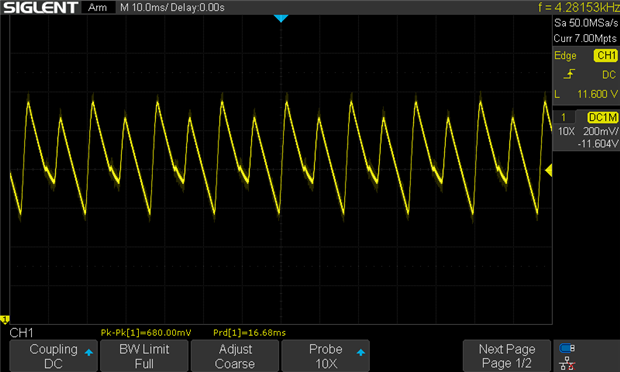
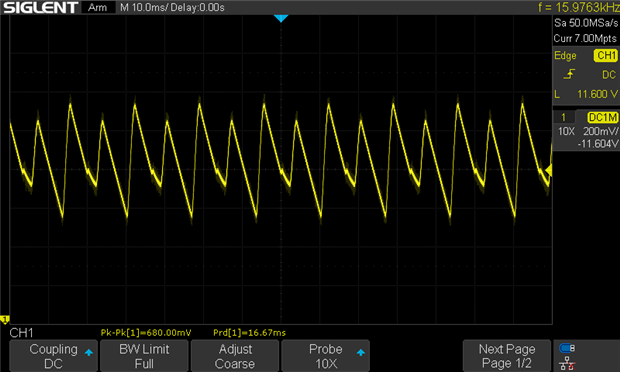
If I can, and I don't know if I am doing it correctly, I get what looks like varying frequency results without even adjusting the potentiometer that controls the drive speed.  When I hook everything up and hit "Measure", I get varying readings for the frequency as seen in screenshots below.  So,

  1. I am not doing something correctly with the scope (most likely) and/or
  2. I can't really use this scope to measure what needs to be measured (also likely) or
  3. the wild readings mean the potentiometer or something else is bad?


I will reiterate I am very new to this....

Thanks for any guidance on using this scope or repairing this drive...!


image

image

image

  • Sign in to reply
  • Cancel

Top Replies

  • genebren
    genebren over 4 years ago +5
    Robert, Your setup is pretty close to correct. You might need to raise the trigger voltage level up a bit (Yellow triangle on the far right side of the screen). The level is currently set at 11.6 volts…
  • shabaz
    shabaz over 4 years ago +4
    Also, I wonder if that's just a 12V rail, with no activity, because the 'scope says 680mV p-p, and the frequency looks close to mains frequency, if that's 10msec per division (I'm not familiar with Siglent…
  • shabaz
    shabaz over 4 years ago in reply to fmilburn +4
    Hi Frank, I think it's likely just mains ripple, because the 'm' should mean milli - I hope!
Parents
  • shabaz
    shabaz over 4 years ago

    Also, I wonder if that's just a 12V rail, with no activity, because the 'scope says 680mV p-p, and the frequency looks close to mains frequency, if that's 10msec per division (I'm not familiar with Siglent 'scope displays). No idea why f= is in kHz though, might be a configuration issue? I think it might be supply ripple, which might or might not be normal.


    The 'scope just displays the voltage as it changes over time, however because you can zoom and level-shift, and end up looking at a magnified portion, it's good to know approximately what waveform you expect to see, so that you have that context to better understand what the 'scope is displaying compared to what it should be displaying.

    • Cancel
    • Vote Up +4 Vote Down
    • Sign in to reply
    • Cancel
Reply
  • shabaz
    shabaz over 4 years ago

    Also, I wonder if that's just a 12V rail, with no activity, because the 'scope says 680mV p-p, and the frequency looks close to mains frequency, if that's 10msec per division (I'm not familiar with Siglent 'scope displays). No idea why f= is in kHz though, might be a configuration issue? I think it might be supply ripple, which might or might not be normal.


    The 'scope just displays the voltage as it changes over time, however because you can zoom and level-shift, and end up looking at a magnified portion, it's good to know approximately what waveform you expect to see, so that you have that context to better understand what the 'scope is displaying compared to what it should be displaying.

    • Cancel
    • Vote Up +4 Vote Down
    • Sign in to reply
    • Cancel
Children
  • fmilburn
    fmilburn over 4 years ago in reply to shabaz

    That is a good point. 


    Robert, see if you can display the settings for the time divisions on the screen.

    • Cancel
    • Vote Up +2 Vote Down
    • Sign in to reply
    • Cancel
  • opalko
    opalko over 4 years ago in reply to shabaz

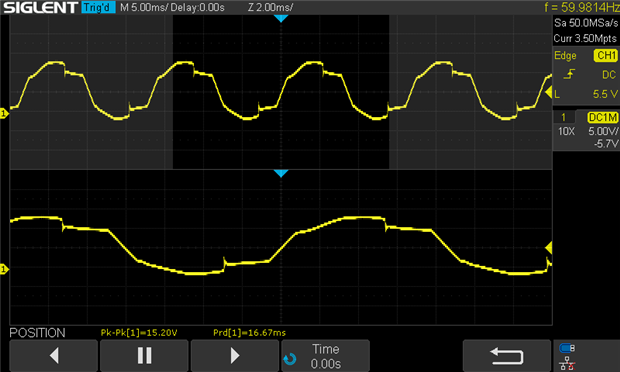
    Ugh..it would help if I read the service manual correctly.  "Use TP2 and 3".  I was on TP4.  When I use TP2 I get this:

    image

    • Cancel
    • Vote Up 0 Vote Down
    • Sign in to reply
    • Cancel
  • opalko
    opalko over 4 years ago in reply to opalko

    I haven't figured out how to make it the time division from peak to peak....aaaggghhh

    • Cancel
    • Vote Up 0 Vote Down
    • Sign in to reply
    • Cancel
  • fmilburn
    fmilburn over 4 years ago in reply to opalko

    Look up the section in the manual on using cursors image

    • Cancel
    • Vote Up +2 Vote Down
    • Sign in to reply
    • Cancel
  • opalko
    opalko over 4 years ago in reply to fmilburn

    Ohhh, thank you. (Reading PDF manuals onscreen are a PITA btw ) I don't understand why frequency is showing in Hz and manual says it should be kHz?..

    image

    • Cancel
    • Vote Up 0 Vote Down
    • Sign in to reply
    • Cancel
  • shabaz
    shabaz over 4 years ago in reply to opalko

    Hi Robert,


    As mentioned, you shouldn't be looking at the automated measurements such as Frequency, until you're comfortable with what you're looking at visually, the oscilloscope trace. And you need to get comfortable with the X and Y axes.

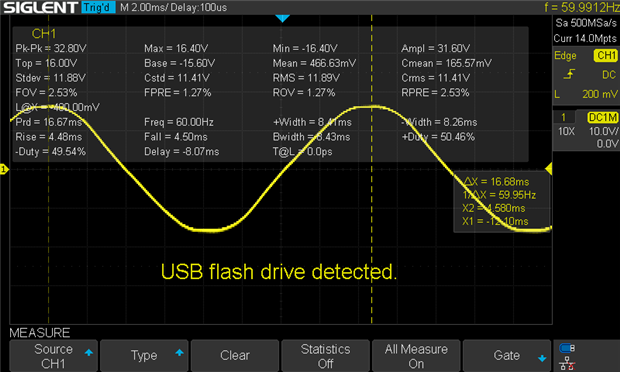
    Take a look at your screen:


    image


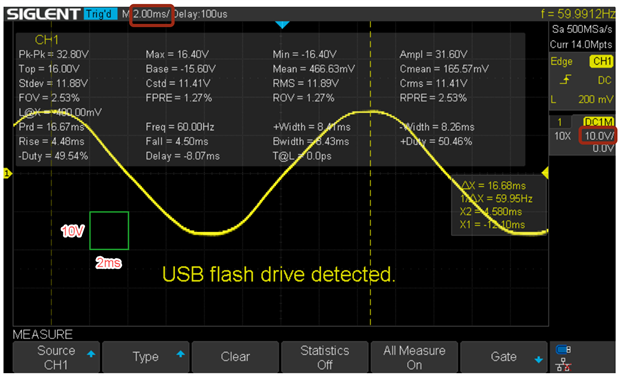
    The red highlighted bits indicate 2 milliseconds per division on the X-axis, and 10V per division on the Y axis. I've drawn a green box to show you one division, since they are faint lines on the screen.


    Now, you can look at the trace and do your own maths calculation for frequency. You can manually count how many divisions on the X-axis to go from one peak of the sinewave to the next. It's about 8 divisions.

    At 2 milliseconds per division, that means the period of the sinewave is about 16 milliseconds, which is 0.016 seconds.


    Now calculate the reciprocal of that (1/x) and you get 1 divided by 0.016 seconds which is 62.5 Hz. That's almost identical to what the automated frequency measurement at the top-right of your screen is indicating. So, in summary, without even looking at the automated frequency measurement, you can see for yourself that the signal is of approximately 60Hz simply by looking at the trace and counting squares on the X-axis, and doing a calculation with a calculator.


    I think you're going the wrong way about it if you expect the measurements to automatically indicate things. You need to first get the trace displayed as you expect. Then the automated measurement will be useful, because the measurement on it's own provides zero context. You have to look at the trace and see that it is what you expect to see, to get the context.


    Your signal is a 60 Hz sinewave. There is no reason for the 'scope to display it's frequency in kHz, because although you may have expected 60kHz or something else, that's not what is connected to the 'scope.


    Also, by looking at the Y-axis, you can see that the sinewave has a peak-to-peak span of about three squares, or 30V. That also agrees with the automated measurement. I'd conclude that you're looking at the output from an AC mains transformer perhaps, in a country with 60Hz mains frequency.


    There should be online video training on how to use oscilloscopes, and the manual should be read too. Otherwise, there can be a risk of damaging your 'scope unless you play safe and just explore low voltage battery-powered circuit for now. For example, build a 555 oscillator and use the oscilloscope to look at the signals from it. This is just an idea, others may have better suggestions.

    • Cancel
    • Vote Up +4 Vote Down
    • Sign in to reply
    • Cancel
  • opalko
    opalko over 4 years ago in reply to shabaz

    shabaz  wrote:


    As mentioned, you shouldn't be looking at the automated measurements such as Frequency, until you're comfortable with what you're looking at visually, the oscilloscope trace. And you need to get comfortable with the X and Y axes.

    Thank you.  I did get the divisions figured out before you sent this..  image

    There should be online video training on how to use oscilloscopes, and the manual should be read too.

    I have watched couple of them and how I got to this point image.  I am still working through the manual...


    Your signal is a 60 Hz sinewave. There is no reason for the 'scope to display it's frequency in kHz, because although you may have expected 60kHz


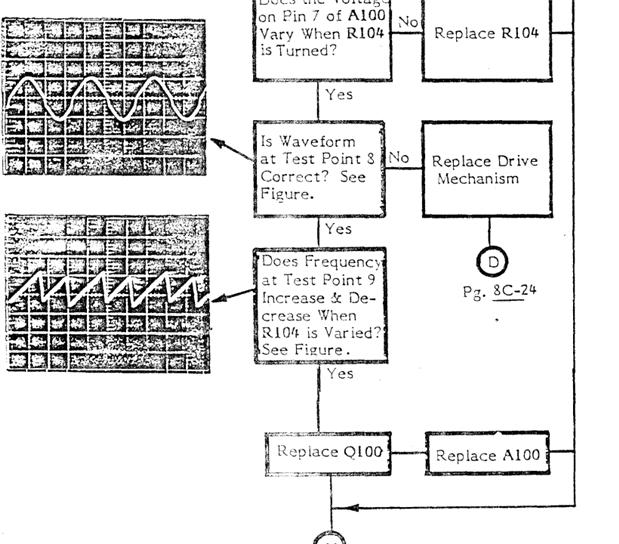
    I think this is what threw me off; I saw 60 and was thinking that was the correct 60.  My bad. It still doesn't show a change in frequency by varying R104 as the svc manual indicates on TP9 so something def wrong; unfortunately the "Yes" on the flowchart I think is supposed to be a "No" ..? which indicates replacing a chip that I don't think is available anymore: A100 or lCLM2917..

    image

    • Cancel
    • Vote Up +1 Vote Down
    • Sign in to reply
    • Cancel
  • shabaz
    shabaz over 4 years ago in reply to opalko

    Hi Robert,


    I don't know the answer to why you're not seeing the correct trace, but if it is 60 Hz, then it's extremely likely (99.99% confidence) to be the mains frequency. Since it is not possible for the mains frequency to be adjusted (it is what it is because it's due to the generator at the power station) so either the probe is in a different location to the flow chart, or incorrectly probing (e.g. perhaps the ground wire is not at the correct location either), or there's extremely severe multiple faults.

    • Cancel
    • Vote Up +2 Vote Down
    • Sign in to reply
    • Cancel
  • opalko
    opalko over 4 years ago in reply to shabaz
    so either the probe is in a different location to the flow chart, or incorrectly probing (e.g. perhaps the ground wire is not at the correct location either), or there's extremely severe multiple faults.


    Thanks, I do get both waveforms shown at each of those locations so I am pretty sure I am at least testing in the right places image .  I still am not clear as I said in my original post whether the frequency counter that the svc manual says to use to measure the frequency and my scope work the same way. It may be the drive speed is not off and I will  just need to find another working drive in order to swap components until I hit on what is wrong.

    • Cancel
    • Vote Up +2 Vote Down
    • Sign in to reply
    • Cancel
element14 Community

element14 is the first online community specifically for engineers. Connect with your peers and get expert answers to your questions.

  • Members
  • Learn
  • Technologies
  • Challenges & Projects
  • Products
  • Store
  • About Us
  • Feedback & Support
  • FAQs
  • Terms of Use
  • Privacy Policy
  • Legal and Copyright Notices
  • Sitemap
  • Cookies

An Avnet Company © 2026 Premier Farnell Limited. All Rights Reserved.

Premier Farnell Ltd, registered in England and Wales (no 00876412), registered office: Farnell House, Forge Lane, Leeds LS12 2NE.

ICP 备案号 10220084.

Follow element14

  • X
  • Facebook
  • linkedin
  • YouTube