element14 Community
element14 Community
    Register Log In
  • Site
  • Search
  • Log In Register
  • Community Hub
    Community Hub
    • What's New on element14
    • Feedback and Support
    • Benefits of Membership
    • Personal Blogs
    • Members Area
    • Achievement Levels
  • Learn
    Learn
    • Ask an Expert
    • eBooks
    • element14 presents
    • Learning Center
    • Tech Spotlight
    • STEM Academy
    • Webinars, Training and Events
    • Learning Groups
  • Technologies
    Technologies
    • 3D Printing
    • FPGA
    • Industrial Automation
    • Internet of Things
    • Power & Energy
    • Sensors
    • Technology Groups
  • Challenges & Projects
    Challenges & Projects
    • Design Challenges
    • element14 presents Projects
    • Project14
    • Arduino Projects
    • Raspberry Pi Projects
    • Project Groups
  • Products
    Products
    • Arduino
    • Avnet & Tria Boards Community
    • Dev Tools
    • Manufacturers
    • Multicomp Pro
    • Product Groups
    • Raspberry Pi
    • RoadTests & Reviews
  • About Us
  • Store
    Store
    • Visit Your Store
    • Choose another store...
      • Europe
      •  Austria (German)
      •  Belgium (Dutch, French)
      •  Bulgaria (Bulgarian)
      •  Czech Republic (Czech)
      •  Denmark (Danish)
      •  Estonia (Estonian)
      •  Finland (Finnish)
      •  France (French)
      •  Germany (German)
      •  Hungary (Hungarian)
      •  Ireland
      •  Israel
      •  Italy (Italian)
      •  Latvia (Latvian)
      •  
      •  Lithuania (Lithuanian)
      •  Netherlands (Dutch)
      •  Norway (Norwegian)
      •  Poland (Polish)
      •  Portugal (Portuguese)
      •  Romania (Romanian)
      •  Russia (Russian)
      •  Slovakia (Slovak)
      •  Slovenia (Slovenian)
      •  Spain (Spanish)
      •  Sweden (Swedish)
      •  Switzerland(German, French)
      •  Turkey (Turkish)
      •  United Kingdom
      • Asia Pacific
      •  Australia
      •  China
      •  Hong Kong
      •  India
      • Japan
      •  Korea (Korean)
      •  Malaysia
      •  New Zealand
      •  Philippines
      •  Singapore
      •  Taiwan
      •  Thailand (Thai)
      • Vietnam
      • Americas
      •  Brazil (Portuguese)
      •  Canada
      •  Mexico (Spanish)
      •  United States
      Can't find the country/region you're looking for? Visit our export site or find a local distributor.
  • Translate
  • Profile
  • Settings
Experts, Learning and Guidance
  • Technologies
  • More
Experts, Learning and Guidance
Ask an Expert Forum LED Indicator Lamps - Voltage Drop
  • Blog
  • Forum
  • Documents
  • Leaderboard
  • Files
  • Members
  • Mentions
  • Sub-Groups
  • Tags
  • More
  • Cancel
  • New
Join Experts, Learning and Guidance to participate - click to join for free!
Actions
  • Share
  • More
  • Cancel
Forum Thread Details
  • State Not Answered
  • Replies 4 replies
  • Subscribers 304 subscribers
  • Views 464 views
  • Users 0 members are here
Related
See a helpful answer?

Be sure to click 'more' and select 'suggest as answer'!

If you're the thread creator, be sure to click 'more' then 'Verify as Answer'!

LED Indicator Lamps - Voltage Drop

Former Member
Former Member over 12 years ago

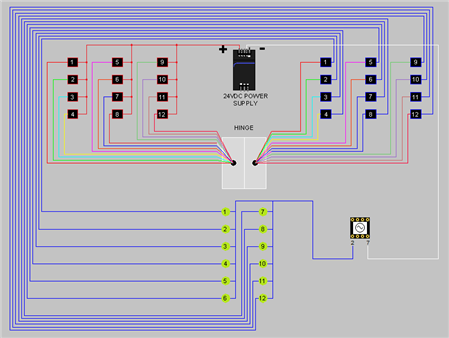
I'm trying to design a "tester" for checking continuity of "through wires" in an electric hinge we make.  The hinge will be mounted to a swing test stand and cycled repeatedly to test the integrity of the wires.  The wires in the hinge are about 24 or 26 AWG.   I am using a 2191U5-24V2191U5-24V LED indicator lamp (Chicago Miniautre Lighting - Newark PN# 88M9621) to see that the wire is "good".  On one side of the hinge (wire)  I am connecting to +24VDC through the use of a power supply.  The other side of the hinge (wire) connects to the RED lead on the LED, and finally the WHITE lead is connected to -24VDC.  No problem.


However, I need to connect as many as 12 wires for a total of 12 LED's and I need to power up a 24VDC Ice Cube relay (for breaking the "enable" on the motor for the hinge swinger).  It's been a long time since I was in electronics school, but it didn't take me long to remember VOLTAGE DROP.  With only 1 (one) LED connected in series to the positve for the coil on the relay, I don't have enough to pull the relay in.  I have only 6VDC.  I've tried connecting the lights in series and in parallel, but still don't end up with enough voltage to pull in the relay.  A PLC would solve the problem easily enough, but I was hoping to save cost.  Does anyone have any suggestions?

  • Sign in to reply
  • Cancel
  • Catwell
    0 Catwell over 12 years ago

    Don't draw power from the circuit being tested to check for continuity. Use an external power supply for it.


    Alternatively, you could make a microcontroller based circuit monitor. This might be the cheapest solution, with some PICs being less than 50 cents.

    All it would do is sample each wire and report back all it ok, or which is broken.


    C

    • Cancel
    • Vote Up 0 Vote Down
    • Sign in to reply
    • Verify Answer
    • Cancel
  • Former Member
    0 Former Member over 12 years ago

    I agree with Cabe that a Microcontroller is by far the easyiest way to go. you might could try a change in your thought process. Instead of having the led turn off for a broken wire have it come on via a parrallel wire feed through a current regulating diode for each wire. you would have to do the math and make sure that you couldnt drive the diode unless the wire is broken via a voltage control resistor on the input side of the wire. a plus to having the light come on is that you dont have to pay attention you just glance for a light. hope that this helps

    • Cancel
    • Vote Up 0 Vote Down
    • Sign in to reply
    • Verify Answer
    • Cancel
  • Former Member
    0 Former Member over 12 years ago in reply to Catwell

    I am using an external power supply for testing the wires.  The device being tested has nothing but the "through wires" in it that can be connected by user discretion.  Oh, how I so wanted to use a microcontroller for the process.  But a PLC that's less than 50 cents?  Did I read that right?  I have started using a "smart relay" microcontroller that is less that $100.00, but I've never seen or heard of one that cost less than fifty cents.  Could you elaborate on this? 


    Also, I've gotten some info from other sources about the use of "comparators" in the circuit.


    I'll attach a drawing of the circuit (as originally connected and not working) for reference:image

    • Cancel
    • Vote Up 0 Vote Down
    • Sign in to reply
    • Verify Answer
    • Cancel
  • Former Member
    0 Former Member over 12 years ago in reply to Former Member

    is not the whole plc that is inexpensive its the microconroller chip that is cheap u you would still need to buile a board of some configuration for it.

    I grabbed these specs off of mouser.com I have worked with them for years and they are usually pretty good this was $1.39

    Manufacturer: Freescale Semiconductor
    Core: ARM Cortex M0+
    Processor Series: Kinetis L
    Data Bus Width: 32 bit
    Maximum Clock Frequency: 48 MHz
    Program Memory Size: 8 KB
    Data RAM Size: 1 KB
    On-Chip ADC: Yes
    Operating Supply Voltage: 1.71 V to 3.6 V
    Operating Temperature Range: - 40 C to + 105 C
    Package / Case: QFN-24
    Mounting Style: SMD/SMT
    Packaging: Tray  
    Series: Kinetis L
    • Cancel
    • Vote Up 0 Vote Down
    • Sign in to reply
    • Verify Answer
    • Cancel
element14 Community

element14 is the first online community specifically for engineers. Connect with your peers and get expert answers to your questions.

  • Members
  • Learn
  • Technologies
  • Challenges & Projects
  • Products
  • Store
  • About Us
  • Feedback & Support
  • FAQs
  • Terms of Use
  • Privacy Policy
  • Legal and Copyright Notices
  • Sitemap
  • Cookies

An Avnet Company © 2025 Premier Farnell Limited. All Rights Reserved.

Premier Farnell Ltd, registered in England and Wales (no 00876412), registered office: Farnell House, Forge Lane, Leeds LS12 2NE.

ICP 备案号 10220084.

Follow element14

  • X
  • Facebook
  • linkedin
  • YouTube