element14 Community
element14 Community
    Register Log In
  • Site
  • Search
  • Log In Register
  • Community Hub
    Community Hub
    • What's New on element14
    • Feedback and Support
    • Benefits of Membership
    • Personal Blogs
    • Members Area
    • Achievement Levels
  • Learn
    Learn
    • Ask an Expert
    • eBooks
    • element14 presents
    • Learning Center
    • Tech Spotlight
    • STEM Academy
    • Webinars, Training and Events
    • Learning Groups
  • Technologies
    Technologies
    • 3D Printing
    • FPGA
    • Industrial Automation
    • Internet of Things
    • Power & Energy
    • Sensors
    • Technology Groups
  • Challenges & Projects
    Challenges & Projects
    • Design Challenges
    • element14 presents Projects
    • Project14
    • Arduino Projects
    • Raspberry Pi Projects
    • Project Groups
  • Products
    Products
    • Arduino
    • Avnet & Tria Boards Community
    • Dev Tools
    • Manufacturers
    • Multicomp Pro
    • Product Groups
    • Raspberry Pi
    • RoadTests & Reviews
  • About Us
  • Store
    Store
    • Visit Your Store
    • Choose another store...
      • Europe
      •  Austria (German)
      •  Belgium (Dutch, French)
      •  Bulgaria (Bulgarian)
      •  Czech Republic (Czech)
      •  Denmark (Danish)
      •  Estonia (Estonian)
      •  Finland (Finnish)
      •  France (French)
      •  Germany (German)
      •  Hungary (Hungarian)
      •  Ireland
      •  Israel
      •  Italy (Italian)
      •  Latvia (Latvian)
      •  
      •  Lithuania (Lithuanian)
      •  Netherlands (Dutch)
      •  Norway (Norwegian)
      •  Poland (Polish)
      •  Portugal (Portuguese)
      •  Romania (Romanian)
      •  Russia (Russian)
      •  Slovakia (Slovak)
      •  Slovenia (Slovenian)
      •  Spain (Spanish)
      •  Sweden (Swedish)
      •  Switzerland(German, French)
      •  Turkey (Turkish)
      •  United Kingdom
      • Asia Pacific
      •  Australia
      •  China
      •  Hong Kong
      •  India
      • Japan
      •  Korea (Korean)
      •  Malaysia
      •  New Zealand
      •  Philippines
      •  Singapore
      •  Taiwan
      •  Thailand (Thai)
      • Vietnam
      • Americas
      •  Brazil (Portuguese)
      •  Canada
      •  Mexico (Spanish)
      •  United States
      Can't find the country/region you're looking for? Visit our export site or find a local distributor.
  • Translate
  • Profile
  • Settings
Experts, Learning and Guidance
  • Technologies
  • More
Experts, Learning and Guidance
Ask an Expert Forum Trying to understand serial to parallel circuit
  • Blog
  • Forum
  • Documents
  • Leaderboard
  • Files
  • Members
  • Mentions
  • Sub-Groups
  • Tags
  • More
  • Cancel
  • New
Join Experts, Learning and Guidance to participate - click to join for free!
Actions
  • Share
  • More
  • Cancel
Forum Thread Details
  • State Not Answered
  • Replies 32 replies
  • Subscribers 301 subscribers
  • Views 9357 views
  • Users 0 members are here
Related
See a helpful answer?

Be sure to click 'more' and select 'suggest as answer'!

If you're the thread creator, be sure to click 'more' then 'Verify as Answer'!

Trying to understand serial to parallel circuit

opalko
opalko over 3 years ago

Hi again folks (after some time away!),
When I was a teen, I had an Atari 800 computer/ The Atari did not have a parallel port interface.  All they had were the joystick ports, which were serial.  A clever company came up with a serial->parallel port interface.  Me, not knowing much about electronics, could not figure out how they did this.  (PS -I still don't know much about electronics!!!).

Flash forward 40 years and this past week I decided to take apart the serial->parallel interface and reverse engineer this thing! I took apart and there are 2 chips - a 74LS14, and a 74LS164, a resistor and a capacitor. Next step was to draw the schematic, which I did with pencil and paper. This became messy, so I resorted to learning to use KiCad, and came up with the attached drawing. (see attachments)

I get what makes this work is the 74LS164 8 bit parallel-out serial shift register. I still don't really understand how it works though.  As I understand it, the data on this register may be read out in parallel (from all flip-flops) at once.
So some questions!

0) Can someone explain how this whole interface works!?

1) How is the data being read on the printer side?  Is the printer polling every data pin on the parallel port at once regardless of how many are actually being used?

2) Since there are really only 2 address data pins (3 & 5) being used here, it doesn't seem a vast improvement over serial?  But I guess because the Atari only has pins 1-4 for I/O and 1 of those sends the data to the 74LS164?

Thanks for any help understanding this.
Robert Opalko

PS There doesn't seem to be nearly as many members on this forum as there was in the past... Where did everyone go?

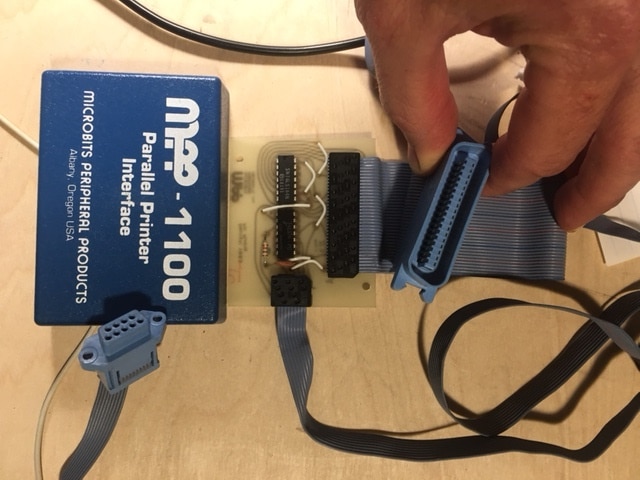
image
image
  • Sign in to reply
  • Cancel

Top Replies

  • phoenixcomm
    phoenixcomm over 3 years ago in reply to opalko +4
    try this link: computer.howstuffworks.com/parallel-port1.htm this says that IBM did it but in fact, It was Wang labs. and en.wikipedia.org/.../Centronics
  • phoenixcomm
    phoenixcomm over 3 years ago +4
  • dougw
    dougw over 3 years ago +3
    I don't get it either. A Centronics printer needs 8 data bits and some handshaking to work - this doesn't even have enough pins connected. On a Centronics connector all pins from 19-30 and 33 are ground…
  • airbornesurfer
    0 airbornesurfer over 3 years ago in reply to beacon_dave

    Ha! I'll throw it on the list ;)

    I still gotta finish that record player, first....

    • Cancel
    • Vote Up 0 Vote Down
    • Sign in to reply
    • Verify Answer
    • Cancel
  • beacon_dave
    0 beacon_dave over 3 years ago in reply to opalko
    opalko said:
    If I can get a program to just read my keypress and sending it out the Centronics side I will be thrilled...

    It looks like 'INPUT' and 'LPRINT' keywords in a loop in  Atari BASIC could perhaps get you most of the way there ?

    Atari BASIC keywords:
    https://en.wikipedia.org/wiki/Atari_BASIC#Keywords 

    The Atari 820 printer operators manual shows:

    10 PRINT "THE PRINT COMMAND COMES OUT HERE."
    20 LPRINT "THE LPRINT COMMAND COMES OUT HERE."

    as an example of sending text to the console and then to the printer. Just remember that the select and busy inputs will require to be set correctly to get the data to flow, as you won't have a physical printer connected.

    • Cancel
    • Vote Up +1 Vote Down
    • Sign in to reply
    • Verify Answer
    • Cancel
<
element14 Community

element14 is the first online community specifically for engineers. Connect with your peers and get expert answers to your questions.

  • Members
  • Learn
  • Technologies
  • Challenges & Projects
  • Products
  • Store
  • About Us
  • Feedback & Support
  • FAQs
  • Terms of Use
  • Privacy Policy
  • Legal and Copyright Notices
  • Sitemap
  • Cookies

An Avnet Company © 2026 Premier Farnell Limited. All Rights Reserved.

Premier Farnell Ltd, registered in England and Wales (no 00876412), registered office: Farnell House, Forge Lane, Leeds LS12 2NE.

ICP 备案号 10220084.

Follow element14

  • X
  • Facebook
  • linkedin
  • YouTube