element14 Community
element14 Community
    Register Log In
  • Site
  • Search
  • Log In Register
  • Community Hub
    Community Hub
    • What's New on element14
    • Feedback and Support
    • Benefits of Membership
    • Personal Blogs
    • Members Area
    • Achievement Levels
  • Learn
    Learn
    • Ask an Expert
    • eBooks
    • element14 presents
    • Learning Center
    • Tech Spotlight
    • STEM Academy
    • Webinars, Training and Events
    • Learning Groups
  • Technologies
    Technologies
    • 3D Printing
    • FPGA
    • Industrial Automation
    • Internet of Things
    • Power & Energy
    • Sensors
    • Technology Groups
  • Challenges & Projects
    Challenges & Projects
    • Design Challenges
    • element14 presents Projects
    • Project14
    • Arduino Projects
    • Raspberry Pi Projects
    • Project Groups
  • Products
    Products
    • Arduino
    • Avnet & Tria Boards Community
    • Dev Tools
    • Manufacturers
    • Multicomp Pro
    • Product Groups
    • Raspberry Pi
    • RoadTests & Reviews
  • About Us
  • Store
    Store
    • Visit Your Store
    • Choose another store...
      • Europe
      •  Austria (German)
      •  Belgium (Dutch, French)
      •  Bulgaria (Bulgarian)
      •  Czech Republic (Czech)
      •  Denmark (Danish)
      •  Estonia (Estonian)
      •  Finland (Finnish)
      •  France (French)
      •  Germany (German)
      •  Hungary (Hungarian)
      •  Ireland
      •  Israel
      •  Italy (Italian)
      •  Latvia (Latvian)
      •  
      •  Lithuania (Lithuanian)
      •  Netherlands (Dutch)
      •  Norway (Norwegian)
      •  Poland (Polish)
      •  Portugal (Portuguese)
      •  Romania (Romanian)
      •  Russia (Russian)
      •  Slovakia (Slovak)
      •  Slovenia (Slovenian)
      •  Spain (Spanish)
      •  Sweden (Swedish)
      •  Switzerland(German, French)
      •  Turkey (Turkish)
      •  United Kingdom
      • Asia Pacific
      •  Australia
      •  China
      •  Hong Kong
      •  India
      • Japan
      •  Korea (Korean)
      •  Malaysia
      •  New Zealand
      •  Philippines
      •  Singapore
      •  Taiwan
      •  Thailand (Thai)
      • Vietnam
      • Americas
      •  Brazil (Portuguese)
      •  Canada
      •  Mexico (Spanish)
      •  United States
      Can't find the country/region you're looking for? Visit our export site or find a local distributor.
  • Translate
  • Profile
  • Settings
Experts, Learning and Guidance
  • Technologies
  • More
Experts, Learning and Guidance
Ask an Expert Forum Polarized capacitors in series
  • Blog
  • Forum
  • Documents
  • Leaderboard
  • Files
  • Members
  • Mentions
  • Sub-Groups
  • Tags
  • More
  • Cancel
  • New
Join Experts, Learning and Guidance to participate - click to join for free!
Actions
  • Share
  • More
  • Cancel
Forum Thread Details
  • Replies 8 replies
  • Subscribers 303 subscribers
  • Views 1364 views
  • Users 0 members are here
Related
See a helpful answer?

Be sure to click 'more' and select 'suggest as answer'!

If you're the thread creator, be sure to click 'more' then 'Verify as Answer'!

Polarized capacitors in series

Psin545
Psin545 over 2 years ago

Hey everyone, 

Sorry if this is a stupid question, but my question today is regarding polarized capacitors in series. I’m just curious what, if anything, is happening to the positive and negative charges on the capacitors plates where the two capacitors would meet? 

Trying to take a stab at it, I picture the outermost plates begin to develop a net positive and net negative charge on their plates,, but I can’t visualize what would happen to any charges on the plates in the middle where the two capacitors meet. Would they have forces pushing and pulling on them keeping them in place? Sorry again if this seems stupid I just can’t visualize it. In my mind I’m picturing for example the side accumulating negative charges is repelling the negative charges on its other plate but then those charges would have negative charges pushing them away from the other “middle” plate of the other capacitor. But I feel like there is probably way more to it and that I’m approaching this the wrong way. 

  • Sign in to reply
  • Cancel

Top Replies

  • Jan Cumps
    Jan Cumps over 2 years ago in reply to javagoza +3
    javagoza said: When you connect several capacitors in series to a battery with voltage V, each of the capacitors acquires an identical charge Q. This is correct. And when in doubt, bring the multimeter…
  • javagoza
    javagoza over 2 years ago +1
    When you connect several capacitors in series to a battery with voltage V, each of the capacitors acquires an identical charge Q. The charge on the plate connected to the positive terminal of the battery…
  • colporteur
    colporteur over 2 years ago

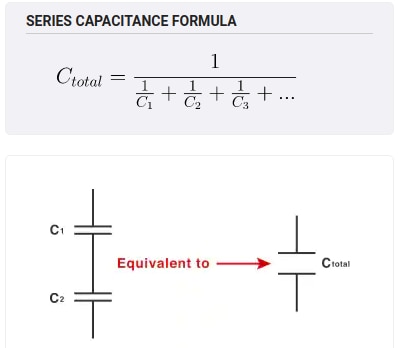
    image

    The value of capacitor in series follows a formula similar to resistors in parallel. In the above example two 10 microfarad capacitors in series is equivalent to one 5 microfarad capacitor.

    • Cancel
    • Vote Up 0 Vote Down
    • Sign in to reply
    • Cancel
  • javagoza
    javagoza over 2 years ago

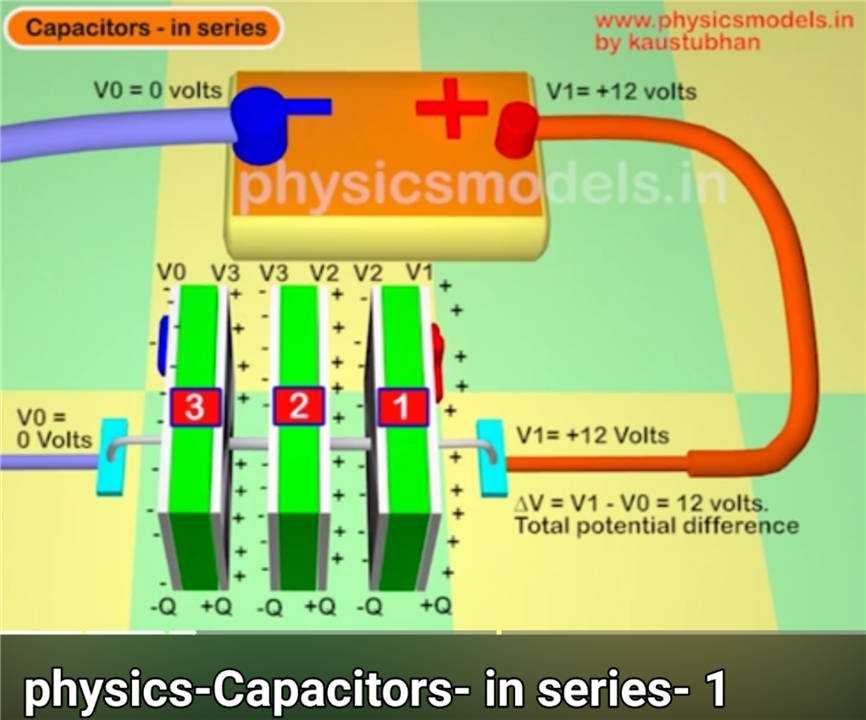
    When you connect several capacitors in series to a battery with voltage V, each of the capacitors acquires an identical charge Q. The charge on the plate connected to the positive terminal of the battery is +Q and the charge on the plate connected to the negative terminal is −Q. Charges are then induced on the other plates so that the sum of the charges on all plates and the sum of the charges on any pair of capacitor plates is zero. However, the potential drop V=Q/C on one capacitor can be different from the potential drop on another capacitor, because capacitors can generally have different capacitances. Generally, any number of series-connected capacitors is equivalent to a capacitor whose equivalent capacitance is less than the smallest of the capacitances in the series combination.

    • Cancel
    • Vote Up +1 Vote Down
    • Sign in to reply
    • Cancel
  • dougw
    dougw over 2 years ago in reply to colporteur

    Good question. javagoza is right about ideal capacitors.

    I assume the middle plates tend to drift to the voltage of whichever capacitor has the most leakage. Presumably if this causes the other capacitor's dielectric to start breaking down this would pull the voltage back more in the middle.

    • Cancel
    • Vote Up 0 Vote Down
    • Sign in to reply
    • Cancel
  • baldengineer
    baldengineer over 2 years ago

    I suspect you're confusing the arbitrarily named anode (+) and cathode (-) with electric charge. Those designations are relative to the direction of the electric field and less about the type of charge associated with them.

    First, recognize that everything has a capacitive element. So your visualization only works in non-existent ideal capacitors.
     
    For that reason, the charge has to be distributed among the plates. And if we know the applied voltage and the capacitance values, we can determine the effective charge since it is related to the strength of the electric field.

    Also, don't confuse "electrons" for the charge. Electrons are the carrier, not the charge. So electrons aren't accumulating anywhere. Charge, relative to the strength of the electric field, is.

    Last, for this discussion, it does not matter if the capacitors are polarized! Polarized capacitors are a property of the dielectric and the direction it grows. The net charge is the same whether it is a non-polarized or polarized capacitor because it is relative to the electric field. The only difference between the two is what happens to the dielectric when that field is applied. For example, the dielectric starts to break down with a "negative" electric field, in a polarized capacitor.

    • Cancel
    • Vote Up 0 Vote Down
    • Sign in to reply
    • Cancel
  • Jan Cumps
    Jan Cumps over 2 years ago in reply to javagoza
    javagoza said:
    When you connect several capacitors in series to a battery with voltage V, each of the capacitors acquires an identical charge Q.

    This is correct. And when in doubt, bring the multimeter out:

    You don't have permission to edit metadata of this video.
    Edit media
    x
    image
    Upload Preview
    image

    • Cancel
    • Vote Up +3 Vote Down
    • Sign in to reply
    • Cancel
  • Tallboyshort
    Tallboyshort over 2 years ago

    This is a lovely question most capacitors are already polarized like an anode or a cathode. Anode being positive and cathode being negative. You should not think of a capacitor as a battery because it seems like what you're describing would be something that would happen in a battery. 

    Essentially they don't hold the charge on opposite plates in the "middle" 

    Nrg is just moving back and forth.

    youtube.com/watch

    youtube.com/watch

    image

    • Cancel
    • Vote Up 0 Vote Down
    • Sign in to reply
    • Cancel
  • dougw
    dougw over 2 years ago in reply to Jan Cumps

    Nice looking supply. Presumably if you left the meter connected, the voltage would drift as the meter impedance discharged the cap.

    • Cancel
    • Vote Up 0 Vote Down
    • Sign in to reply
    • Cancel
  • Jan Cumps
    Jan Cumps over 2 years ago in reply to dougw
    dougw said:
    Nice looking supply.

    Not high tech. But highly helpful:  Humble LAB equipment: METEX MS-9150 4-in-1 Test Setup 

    • Cancel
    • Vote Up 0 Vote Down
    • Sign in to reply
    • Cancel
element14 Community

element14 is the first online community specifically for engineers. Connect with your peers and get expert answers to your questions.

  • Members
  • Learn
  • Technologies
  • Challenges & Projects
  • Products
  • Store
  • About Us
  • Feedback & Support
  • FAQs
  • Terms of Use
  • Privacy Policy
  • Legal and Copyright Notices
  • Sitemap
  • Cookies

An Avnet Company © 2025 Premier Farnell Limited. All Rights Reserved.

Premier Farnell Ltd, registered in England and Wales (no 00876412), registered office: Farnell House, Forge Lane, Leeds LS12 2NE.

ICP 备案号 10220084.

Follow element14

  • X
  • Facebook
  • linkedin
  • YouTube