element14 Community
element14 Community
    Register Log In
  • Site
  • Search
  • Log In Register
  • Community Hub
    Community Hub
    • What's New on element14
    • Feedback and Support
    • Benefits of Membership
    • Personal Blogs
    • Members Area
    • Achievement Levels
  • Learn
    Learn
    • Ask an Expert
    • eBooks
    • element14 presents
    • Learning Center
    • Tech Spotlight
    • STEM Academy
    • Webinars, Training and Events
    • Learning Groups
  • Technologies
    Technologies
    • 3D Printing
    • FPGA
    • Industrial Automation
    • Internet of Things
    • Power & Energy
    • Sensors
    • Technology Groups
  • Challenges & Projects
    Challenges & Projects
    • Design Challenges
    • element14 presents Projects
    • Project14
    • Arduino Projects
    • Raspberry Pi Projects
    • Project Groups
  • Products
    Products
    • Arduino
    • Avnet & Tria Boards Community
    • Dev Tools
    • Manufacturers
    • Multicomp Pro
    • Product Groups
    • Raspberry Pi
    • RoadTests & Reviews
  • About Us
  • Store
    Store
    • Visit Your Store
    • Choose another store...
      • Europe
      •  Austria (German)
      •  Belgium (Dutch, French)
      •  Bulgaria (Bulgarian)
      •  Czech Republic (Czech)
      •  Denmark (Danish)
      •  Estonia (Estonian)
      •  Finland (Finnish)
      •  France (French)
      •  Germany (German)
      •  Hungary (Hungarian)
      •  Ireland
      •  Israel
      •  Italy (Italian)
      •  Latvia (Latvian)
      •  
      •  Lithuania (Lithuanian)
      •  Netherlands (Dutch)
      •  Norway (Norwegian)
      •  Poland (Polish)
      •  Portugal (Portuguese)
      •  Romania (Romanian)
      •  Russia (Russian)
      •  Slovakia (Slovak)
      •  Slovenia (Slovenian)
      •  Spain (Spanish)
      •  Sweden (Swedish)
      •  Switzerland(German, French)
      •  Turkey (Turkish)
      •  United Kingdom
      • Asia Pacific
      •  Australia
      •  China
      •  Hong Kong
      •  India
      • Japan
      •  Korea (Korean)
      •  Malaysia
      •  New Zealand
      •  Philippines
      •  Singapore
      •  Taiwan
      •  Thailand (Thai)
      • Vietnam
      • Americas
      •  Brazil (Portuguese)
      •  Canada
      •  Mexico (Spanish)
      •  United States
      Can't find the country/region you're looking for? Visit our export site or find a local distributor.
  • Translate
  • Profile
  • Settings
Experts, Learning and Guidance
  • Technologies
  • More
Experts, Learning and Guidance
Ask an Expert Forum amplify small dc signal sitting on large dc offset
  • Blog
  • Forum
  • Documents
  • Leaderboard
  • Files
  • Members
  • Mentions
  • Sub-Groups
  • Tags
  • More
  • Cancel
  • New
Join Experts, Learning and Guidance to participate - click to join for free!
Actions
  • Share
  • More
  • Cancel
Forum Thread Details
  • Replies 19 replies
  • Subscribers 300 subscribers
  • Views 3481 views
  • Users 0 members are here
Related
See a helpful answer?

Be sure to click 'more' and select 'suggest as answer'!

If you're the thread creator, be sure to click 'more' then 'Verify as Answer'!

amplify small dc signal sitting on large dc offset

davebullockmbe
davebullockmbe over 2 years ago

Weekend brain teaser?

Hi experts,

I have a sensor that gives a varying dc output with sensed input.

My problem is that the sensor's output has a 'static' dc offset of around 1V d.c. but I need to use the sensor at the low end of it's range meaning that it's output will only swing a couple of millivolts d.c.

The couple of millivolts will then need to be amplified by something like x1000 to fully exercise an arduino ADC.

I am not sure how stable the 'static' dc offset is with time/temperature or how noisy the output is yet as I am just starting to tackle this problem.

Initially I am thinking differential amplifier and cancel the unwanted offset with a separate 1V input, but I imagine device dc drift will come into play?

Clearly it would be ideal if the dc offset could be tracked by the cancelling voltage but the 'wanted' dc signal will be cancelled too as they are both pretty static.

Before I spend time inventing the wheel or disappearing down rabbit holes.......

Has anyone solved any similar problems?

Discovered any suitable low drift devices etc.

Thanks in anticipation......

Dave

  • Sign in to reply
  • Cancel

Top Replies

  • dougw
    dougw over 2 years ago +4
    You could try either 1 or 2 sensors in a Wheatstone bridge configuration to minimize power supply and thermal fluctuations. Then a differential amp to amplify the low signal. Building on Shabaz' idea…
  • michaelkellett
    michaelkellett over 2 years ago +3
    By far the best way to characterise the device is with an optical chopper as suggested by Shabaz . The data sheet is very light on useful detail (which usually means that the useful details of the performance…
  • davebullockmbe
    davebullockmbe over 2 years ago in reply to anniel747 +3
    Hi anniel747 good question :-) The original ML8511 module came with the 'sort it out' challenge that I foolishly accepted. (It's a case of "If I were doing this again I wouldn't start from here!") However…
  • davebullockmbe
    davebullockmbe over 2 years ago

    The sensor is an ML8511 UVA sensitive device, although this problem could relate to any number of situations?

    • Cancel
    • Vote Up +1 Vote Down
    • Sign in to reply
    • Cancel
  • shabaz
    shabaz over 2 years ago

    The datasheet suggests that the offset is 1V to within +-50mV, so it might just be simplest to remove a fixed 1V offset and then only have a gain of 20, i.e. 2 mV +- 50 mV would fit in a 2V range for a high-res ADC. which could be (say) 24-bit since you mention the wanted signal is very static too. This might all be simpler than trying to sample-and-hold, although if there are periods where it's known that there is no input, (could even be a shutter, perhaps motor spun) then the sampling could be done frequently.

    If up to 16-bit is sufficient then ADS1115 or MCP3426 etc is very low-cost and has a built-in amplifier.

    Otherwise, I don't know how slowly-changing the signal is; is a filter ruled out?

    One method is a bit like a data slicer, i.e. using just an op-amp with a RC filter on one input, and the op-amp set to a gain. 

    • Cancel
    • Vote Up +2 Vote Down
    • Sign in to reply
    • Cancel
  • davebullockmbe
    davebullockmbe over 2 years ago in reply to shabaz

    Yes well I am just gathering ideas how to tackle the problem and the only tests I have carried out is to determine that very low levels of UVA can be detected/measured with the ML8511. 
    The main issue is that even attempting to test the linearity at low UV levels was hampered by the 1V offset overloading the measuring equipment.
    The choice of A/D is already decided as the code is written and operational using an arduino microprocessor and so I need to try to interface the ML8511 to this platform.
    It may be that just using a low noise differential amplifier will be OK but I just thought I would 'throw it open' to the community in case someone had encountered a similar problem and come up with a novel solution :-)

    Dave

    • Cancel
    • Vote Up 0 Vote Down
    • Sign in to reply
    • Cancel
  • anniel747
    anniel747 over 2 years ago in reply to davebullockmbe
    [deleted]
    • Cancel
    • Vote Up 0 Vote Down
    • Sign in to reply
    • Cancel
  • Jan Cumps
    Jan Cumps over 2 years ago in reply to anniel747

    Offset only affect the display. It doesn't improve accuracy or resolution.

    • Cancel
    • Vote Up 0 Vote Down
    • Sign in to reply
    • Cancel
  • shabaz
    shabaz over 2 years ago in reply to davebullockmbe

    I don't know how much money you have to throw at this task, but a method could be to turn it into AC, by using a mirror to bounce the UVC into the sensor. The mirror could be attached to a voice coil, deflecting it tens or hundreds of times a second (for instance).

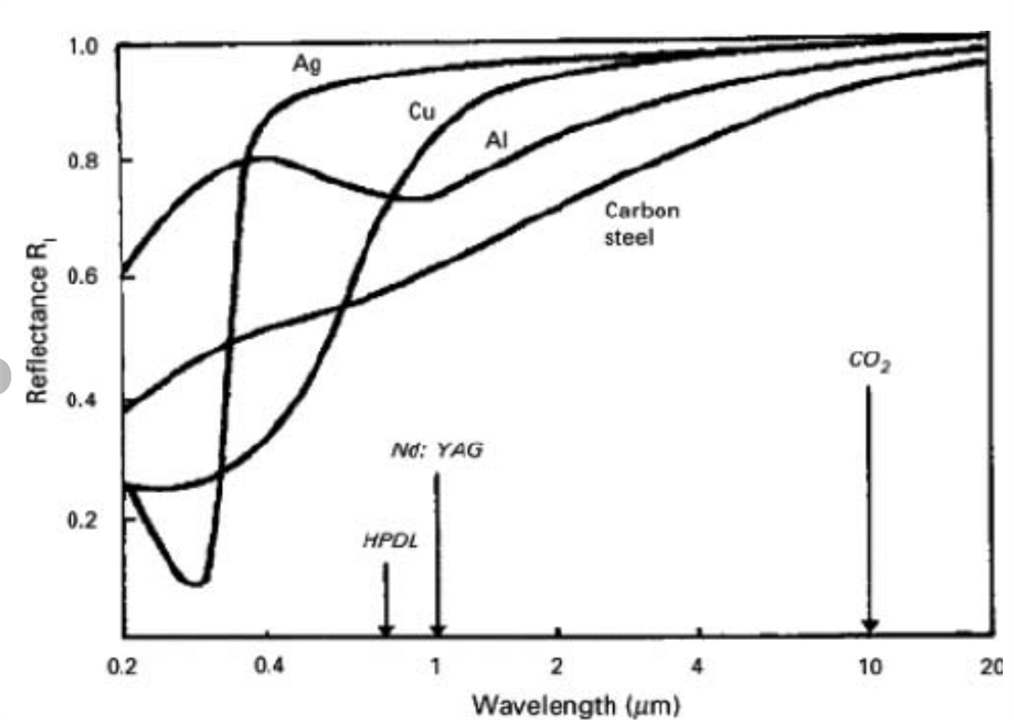
    A real mirror is several hundred $$$ but according to this chart (google images search) aluminium reflects very well, so a decent but still low-cost mirror might work reasonably well.

    image

    • Cancel
    • Vote Up +1 Vote Down
    • Sign in to reply
    • Cancel
  • dougw
    dougw over 2 years ago

    You could try either 1 or 2 sensors in a Wheatstone bridge configuration to minimize power supply and thermal fluctuations. Then a differential amp to amplify the low signal.

    Building on Shabaz' idea, maybe you could modulate the light source (with a shutter or encoder wheel). This would allow you to compare the UV reading to the no UV reading, regardless of drift of the offset.

    • Cancel
    • Vote Up +4 Vote Down
    • Sign in to reply
    • Cancel
  • shabaz
    shabaz over 2 years ago in reply to dougw

    And then for the ultimate performance (maybe overkill, but I don't know what the end use-case is) implement a lock-in amplifier (synchronous demodulator) either in the Arduino (likely hard if it's an Uno, but feasible in more powerful Arduinos theoretically) or externally. It's not difficult, but not a weekend project. But at least these AC conversion ideas open up the possibility of it, if it were ever required.

    • Cancel
    • Vote Up +1 Vote Down
    • Sign in to reply
    • Cancel
  • jc2048
    jc2048 over 2 years ago

    What do you see on pin 10 if you measure it? That's where the internal reference comes out to the smoothing cap. If you're lucky, it's the same as the offset. If not, you could probably scale it outside the chip to match whatever's going on inside.

    • Cancel
    • Vote Up +2 Vote Down
    • Sign in to reply
    • Cancel
  • shabaz
    shabaz over 2 years ago in reply to jc2048

    Well spotted! I was wondering where was the Vref out like any decent analog sensor should have. The datasheet mentions TR being Vref so it looks perfect.

    It seems some breakout boards for it, like Sparkfun, didn't think of bringing that out to a pin, but it could easily be wired by soldering onto the capacitor if this is a breadboard prototype etc.

    • Cancel
    • Vote Up +1 Vote Down
    • Sign in to reply
    • Cancel
>
element14 Community

element14 is the first online community specifically for engineers. Connect with your peers and get expert answers to your questions.

  • Members
  • Learn
  • Technologies
  • Challenges & Projects
  • Products
  • Store
  • About Us
  • Feedback & Support
  • FAQs
  • Terms of Use
  • Privacy Policy
  • Legal and Copyright Notices
  • Sitemap
  • Cookies

An Avnet Company © 2025 Premier Farnell Limited. All Rights Reserved.

Premier Farnell Ltd, registered in England and Wales (no 00876412), registered office: Farnell House, Forge Lane, Leeds LS12 2NE.

ICP 备案号 10220084.

Follow element14

  • X
  • Facebook
  • linkedin
  • YouTube