element14 Community
element14 Community
    Register Log In
  • Site
  • Search
  • Log In Register
  • Community Hub
    Community Hub
    • What's New on element14
    • Feedback and Support
    • Benefits of Membership
    • Personal Blogs
    • Members Area
    • Achievement Levels
  • Learn
    Learn
    • Ask an Expert
    • eBooks
    • element14 presents
    • Learning Center
    • Tech Spotlight
    • STEM Academy
    • Webinars, Training and Events
    • Learning Groups
  • Technologies
    Technologies
    • 3D Printing
    • FPGA
    • Industrial Automation
    • Internet of Things
    • Power & Energy
    • Sensors
    • Technology Groups
  • Challenges & Projects
    Challenges & Projects
    • Design Challenges
    • element14 presents Projects
    • Project14
    • Arduino Projects
    • Raspberry Pi Projects
    • Project Groups
  • Products
    Products
    • Arduino
    • Avnet & Tria Boards Community
    • Dev Tools
    • Manufacturers
    • Multicomp Pro
    • Product Groups
    • Raspberry Pi
    • RoadTests & Reviews
  • About Us
  • Store
    Store
    • Visit Your Store
    • Choose another store...
      • Europe
      •  Austria (German)
      •  Belgium (Dutch, French)
      •  Bulgaria (Bulgarian)
      •  Czech Republic (Czech)
      •  Denmark (Danish)
      •  Estonia (Estonian)
      •  Finland (Finnish)
      •  France (French)
      •  Germany (German)
      •  Hungary (Hungarian)
      •  Ireland
      •  Israel
      •  Italy (Italian)
      •  Latvia (Latvian)
      •  
      •  Lithuania (Lithuanian)
      •  Netherlands (Dutch)
      •  Norway (Norwegian)
      •  Poland (Polish)
      •  Portugal (Portuguese)
      •  Romania (Romanian)
      •  Russia (Russian)
      •  Slovakia (Slovak)
      •  Slovenia (Slovenian)
      •  Spain (Spanish)
      •  Sweden (Swedish)
      •  Switzerland(German, French)
      •  Turkey (Turkish)
      •  United Kingdom
      • Asia Pacific
      •  Australia
      •  China
      •  Hong Kong
      •  India
      • Japan
      •  Korea (Korean)
      •  Malaysia
      •  New Zealand
      •  Philippines
      •  Singapore
      •  Taiwan
      •  Thailand (Thai)
      • Vietnam
      • Americas
      •  Brazil (Portuguese)
      •  Canada
      •  Mexico (Spanish)
      •  United States
      Can't find the country/region you're looking for? Visit our export site or find a local distributor.
  • Translate
  • Profile
  • Settings
Experts, Learning and Guidance
  • Technologies
  • More
Experts, Learning and Guidance
Ask an Expert Forum Questions about Circuit for Project That Will Be Sent to the ISS
  • Blog
  • Forum
  • Documents
  • Leaderboard
  • Files
  • Members
  • Mentions
  • Sub-Groups
  • Tags
  • More
  • Cancel
  • New
Join Experts, Learning and Guidance to participate - click to join for free!
Actions
  • Share
  • More
  • Cancel
Forum Thread Details
  • Replies 1 reply
  • Subscribers 302 subscribers
  • Views 351 views
  • Users 0 members are here
Related
See a helpful answer?

Be sure to click 'more' and select 'suggest as answer'!

If you're the thread creator, be sure to click 'more' then 'Verify as Answer'!

Questions about Circuit for Project That Will Be Sent to the ISS

swankybarbecue4
swankybarbecue4 over 7 years ago

I am designing a circuit for a project that will be sent to the ISS; therefore, I want the circuit to be very reliable and efficient since the total current draw at any one time cannot exceed 500ma, I am hobbyist and had a few questions, so I figured it would be best to ask the experts.


A little background on the project:


The project will test the affect of reduced gravity on the Alzheimer's beta amyloid peptide. If the project results go our way, then this could lead the first treatment for Alzheimer's, which will be fantastic since it such a horrible disease. So we will have to send those affected to space, which would be super cool!


(My schematic is attached)


Question 1: Transistors

A) I want to ensure a long life span for each transistor. I have added a 1K resistor to the base of each transistor.

     i) Is this enough resistance?

     ii) How do I find the appropriate resistance for any application?

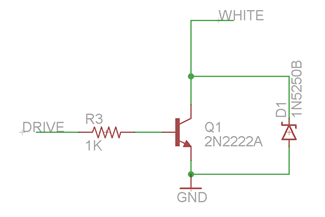
B) I have also read from this post that if you ad a zener diode as shown in the diagram below it can also benefit the protection of the transistor.

     i) Is this true?

     ii)What does the zener diode do?

C) When I use an NTE123AP transistor (the NTE version of a 3904) to switch my 3.0V vibration motors on and off, they turn off and on fine, but when I use one of the transistors to turn my laser diode off and on, the laser is dim.

     i) What causes this?

     i) Is this due the transistor's drop-out voltage?

D) Germanium diodes

     i) What are germanium diodes?

     ii) Would they better suit my application?

     iii) What are advantages/disadvantages of silicon and germanium when compared?
image

Question 2: Relays

A) To solve the dimming issue I had when powering my laser diode, I decided to have the transistors turn relays off and on, which in turn would switch my laser off and on (as shown in my schematic).

      i) Am I driving these relays in the most efficient manner?

      ii) Is it necessary to use a relay for the vibration motors?


Question 3: Additional Suggestions 

A) Any other tips, suggestions of how things differently, or rules of thumb that you think I should know about? I would greatly appreciate the feedback!


I really appreciate any help!


Cheers,


Merrick

Attachments:
image
  • Sign in to reply
  • Cancel

Top Replies

  • jw0752
    jw0752 over 7 years ago +2
    Hi Merrick, You will get better results in your switching circuits if you use the transistor in this configuration. It will act more like a switch. Click on the image for a larger view. I have also suggested…
  • jw0752
    jw0752 over 7 years ago

    Hi Merrick,


    You will get better results in your switching circuits if you use the transistor in this configuration. It will act more like a switch.


    image

    Click on the image for a larger view. I have also suggested a N Channel MOSFET alternative to the transistor which should save you some wasted power.

    If you use the MOSFETs I do not believe that you will need relays which should greatly reduce the weight and power consumption. Depending on the current needed by the motors you may need to upgrade my suggested MOSFETS as they are capable of only 200 mA continuous. I have shown the schematic with standard silicon general purpose diodes. If you want a slightly lower junction voltage you could use a schottky diode like a 1N5819. Germanium is not used in these applications to my knowledge. I also believe that this configuration of transistor and load will solve your dimming problem with the laser without need for a relay.


    John

    • Cancel
    • Vote Up +2 Vote Down
    • Sign in to reply
    • Cancel
element14 Community

element14 is the first online community specifically for engineers. Connect with your peers and get expert answers to your questions.

  • Members
  • Learn
  • Technologies
  • Challenges & Projects
  • Products
  • Store
  • About Us
  • Feedback & Support
  • FAQs
  • Terms of Use
  • Privacy Policy
  • Legal and Copyright Notices
  • Sitemap
  • Cookies

An Avnet Company © 2026 Premier Farnell Limited. All Rights Reserved.

Premier Farnell Ltd, registered in England and Wales (no 00876412), registered office: Farnell House, Forge Lane, Leeds LS12 2NE.

ICP 备案号 10220084.

Follow element14

  • X
  • Facebook
  • linkedin
  • YouTube