element14 Community
element14 Community
    Register Log In
  • Site
  • Search
  • Log In Register
  • Community Hub
    Community Hub
    • What's New on element14
    • Feedback and Support
    • Benefits of Membership
    • Personal Blogs
    • Members Area
    • Achievement Levels
  • Learn
    Learn
    • Ask an Expert
    • eBooks
    • element14 presents
    • Learning Center
    • Tech Spotlight
    • STEM Academy
    • Webinars, Training and Events
    • Learning Groups
  • Technologies
    Technologies
    • 3D Printing
    • FPGA
    • Industrial Automation
    • Internet of Things
    • Power & Energy
    • Sensors
    • Technology Groups
  • Challenges & Projects
    Challenges & Projects
    • Design Challenges
    • element14 presents Projects
    • Project14
    • Arduino Projects
    • Raspberry Pi Projects
    • Project Groups
  • Products
    Products
    • Arduino
    • Avnet & Tria Boards Community
    • Dev Tools
    • Manufacturers
    • Multicomp Pro
    • Product Groups
    • Raspberry Pi
    • RoadTests & Reviews
  • About Us
  • Store
    Store
    • Visit Your Store
    • Choose another store...
      • Europe
      •  Austria (German)
      •  Belgium (Dutch, French)
      •  Bulgaria (Bulgarian)
      •  Czech Republic (Czech)
      •  Denmark (Danish)
      •  Estonia (Estonian)
      •  Finland (Finnish)
      •  France (French)
      •  Germany (German)
      •  Hungary (Hungarian)
      •  Ireland
      •  Israel
      •  Italy (Italian)
      •  Latvia (Latvian)
      •  
      •  Lithuania (Lithuanian)
      •  Netherlands (Dutch)
      •  Norway (Norwegian)
      •  Poland (Polish)
      •  Portugal (Portuguese)
      •  Romania (Romanian)
      •  Russia (Russian)
      •  Slovakia (Slovak)
      •  Slovenia (Slovenian)
      •  Spain (Spanish)
      •  Sweden (Swedish)
      •  Switzerland(German, French)
      •  Turkey (Turkish)
      •  United Kingdom
      • Asia Pacific
      •  Australia
      •  China
      •  Hong Kong
      •  India
      •  Korea (Korean)
      •  Malaysia
      •  New Zealand
      •  Philippines
      •  Singapore
      •  Taiwan
      •  Thailand (Thai)
      • Americas
      •  Brazil (Portuguese)
      •  Canada
      •  Mexico (Spanish)
      •  United States
      Can't find the country/region you're looking for? Visit our export site or find a local distributor.
  • Translate
  • Profile
  • Settings
Industrial Automation
  • Technologies
  • More
Industrial Automation
Blog 3D printed hydrogel is self-adhesive, stackable like LEGO bricks
  • Blog
  • Forum
  • Documents
  • Quiz
  • Events
  • Polls
  • Files
  • Members
  • Mentions
  • Sub-Groups
  • Tags
  • More
  • Cancel
  • New
Join Industrial Automation to participate - click to join for free!
  • Share
  • More
  • Cancel
Group Actions
  • Group RSS
  • More
  • Cancel
Engagement
  • Author Author: Catwell
  • Date Created: 8 Apr 2019 3:18 PM Date Created
  • Views 715 views
  • Likes 6 likes
  • Comments 1 comment
  • materials
  • robotics
  • robot
  • on_campus
  • cabeatwell
  • school
  • university
  • innovation
Related
Recommended

3D printed hydrogel is self-adhesive, stackable like LEGO bricks

Catwell
Catwell
8 Apr 2019

image

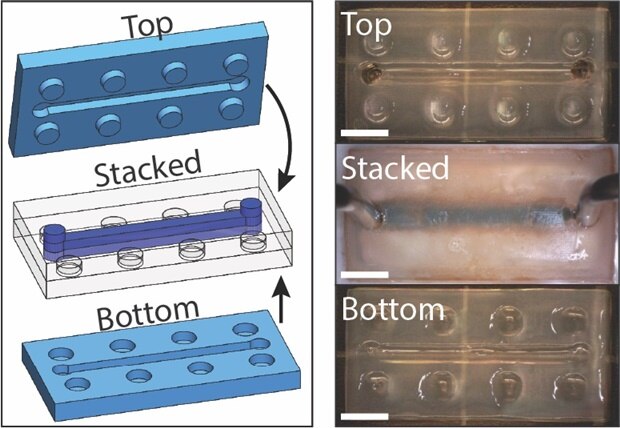
The Lego form helps the material stick together and create a tight seal (Photo from Brown University)


Researchers at Brown University recently developed a new kind of hydrogel material that can be used for various soft robotic applications. The hydrogel is a new type of dual polymer material with the ability to respond to its environment in dynamic ways. The components, patterned by a 3D printer, are able to bend, twist, and stick together in response to treatment with certain chemicals. The results were published in a paper for the journal Polymer Chemistry.


One polymer contains covalent bonds, which provides strength and structural integrity. The other polymer has ionic bonds, which allows more dynamic behaviors like bending and self-adhesion. When combined, the polymers create a material that is soft, strong and responsive, which is ideal for creating a soft, robotic grip. For one test, researchers 3D printed a soft gripper capable of actuating on demand to pick up small objects.


“Essentially, the one polymer provides structural integrity, while the other enables these dynamic behaviors like bending or self-adhesion,” said Thomas Valentin, a recently graduated Ph.D. student in Brown’s School of Engineering and the paper’s lead author. “So putting the two together makes a material that’s greater than the sum of its parts.”


To create the new material, researchers combined one covalently crosslinked polymer, called PEGDA, with a polymer that’s ionically crosslinked, called PAA. Since the PEGDA has strong covalent bonds, it holds the material together while the PAA’s ionic bonds make it responsive. When the material is placed in an ion-rich environment, it makes the PAA crosslink making it more rigid. When the ions are removed, the material softens and swells as the ionic bonds break. This process also allows the material to be self-adhesive.


Hydrogels are an ideal material for microfluidic devices, especially those used in biomedical testing. They’re soft and flexible like human tissue, and typically nontoxic. But they’re usually problematic since they’re difficult to pattern with the complex channels and chambers needed in microfluidics. One possible solution to this is by using the material to create stackable LEGO-like blocks. Because the new material is 3D printed, it can be shaped like a Lego brick, which can then be carefully assembled and tightly sealed together to create customized microfluidic devices, or lab-on-a-chip, systems that can be used for drug screening, cell cultures, and other applications. And the blocks can be stored for long periods of time and still be effective.


It sounds promising, but the material isn’t quite ready yet. Researchers are still working on the polymers to make them more durable and functional. Once they’ve improved the material, it could help make building soft robotic components and lab-on-a-chip significantly easier.


Have a story tip? Message me at: cabe(at)element14(dot)com

http://twitter.com/Cabe_Atwell

  • Sign in to reply
  • dubbie
    dubbie over 6 years ago

    Not a material I am familiar with but it looks interesting and using the LEGO shape is an interesting way of getting material sot stick together.


    Dubbie

    • Cancel
    • Vote Up 0 Vote Down
    • Sign in to reply
    • More
    • Cancel
element14 Community

element14 is the first online community specifically for engineers. Connect with your peers and get expert answers to your questions.

  • Members
  • Learn
  • Technologies
  • Challenges & Projects
  • Products
  • Store
  • About Us
  • Feedback & Support
  • FAQs
  • Terms of Use
  • Privacy Policy
  • Legal and Copyright Notices
  • Sitemap
  • Cookies

An Avnet Company © 2025 Premier Farnell Limited. All Rights Reserved.

Premier Farnell Ltd, registered in England and Wales (no 00876412), registered office: Farnell House, Forge Lane, Leeds LS12 2NE.

ICP 备案号 10220084.

Follow element14

  • X
  • Facebook
  • linkedin
  • YouTube