


Invented in the 80s by Charles Hull, 3D or three-dimensional printing is a technique of printing objects by mixing and shaping the desired material in layers that lead to a three-dimensional item. The story goes that Hull’s 3D printing at the time used a .stl file format to read information from a CAD file, then electronically fed it to the 3D printer. Today there are a number of techniques to 3D print, but it is the uses of that type of printing that could change the world as it is today. Among the numerous applications of 3D printing nowadays, the medical applications are expanding fast from the fabrication of tissue and organs, customization of prosthetics and implants, to pharmaceutical research on drug dosage. The most recent projects using 3D printing in medicine are to fix damaged cornea and to print a portion of the brain for surgical procedures.
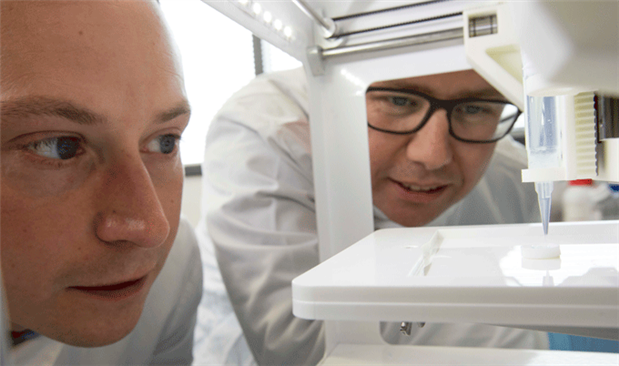
Swioklo and Connon in front of the 3D printer. (Image from Newcastle University’s Press Office page)
Two scientists of Newcastle University worked together to 3D print for the first time a human cornea. Their names are Dr. Steve Swioklo and Prof Che Connon. One of their reasons for choosing the cornea as the part of the human body to 3D print is that even though the cornea is essential for humans to have accurate sight, there is a shortage of cornea implants. Considering the millions of people who need such implants, the 3D printed cornea could save time and lives. The scientists assure that the technique and material the new implant is to make the implant easy to duplicate fast.
The technique appears quite simple. A healthy person donated corneal cells that the scientists mixed with collagen and alginate and create a paste. With a biologic printer, the paste or bio-ink is spread into the desired shape of a cornea. The printing process took no longer than ten minutes, and afterward the cells used in the paste just started multiplying and growing. Professor Connon who is expert in biologic tissue engineering explained that the new implant is revolutionary because the mixture of alginate and collagen maintain the life of the donated corneal cells. Also, the combination of collagen and alginate made it easy to mold the implant. The mix which they refer to as a hydrogel came to life as a result of the research team’s attempt to keep cells alive for an extended period of time. The scientists also believe that the time advantage the gel offers means that the body of the receiver of the implant will be able to build on the live cells without stress. More interestingly, the duo worked with Abigail Isaacson, an expert geneticist at Newcastle University, to customize the implant to the needs and likes of the receiver. The next step now for the new “piece of eye” is to get tested, and it could take a few more years before any patient would benefit from it.
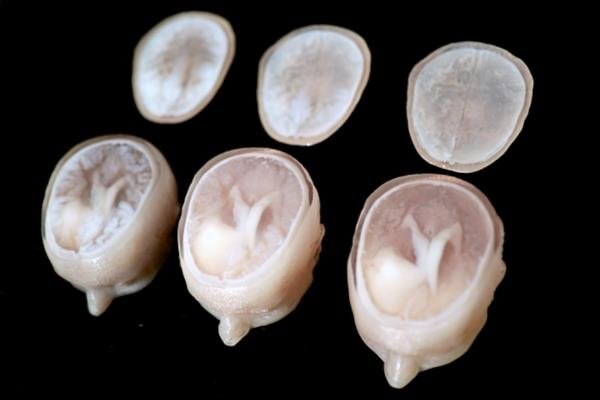
Keating’s brain with the tumor 3D printed. (Image from 3ders.org)
The eyes are not the only organs in the human body that could be getting a makeover in a few years. In the near future, the brain also might be treated better thanks to a new 3D printing technique that not only gives a better image of the brain than MRI or CT scan but can be obtained in a shorter period of time than previous 3D printed models of the brain.
It all started when a doctoral student of MIT, Steve Keating, was diagnosed with a brain tumor. After his surgery, Keating wanted to see a 3D version of his brain with the tumor to better understand his condition and what had taken place during the surgery. It quickly occurred to him that creating a 3D printed version of the images of the MRI was not an easy task. Not only was the endeavor going to take an impressive amount of time, but it was also going to be tedious due to the amount of details MRI and CT scan usually present.
However, working with a team of scientists from Harvard University’s Wyss Institute, Keating developed a printing technique using pieces of the MRI images in which the colors were broken down in finer shades and accentuated so that the printer could print with precision. It was like zooming into a picture and refocusing the lenses to see more details that would have escaped the eyes otherwise. As a result, Keating and the team obtain a 3D portion of his brain that was so detailed that one would feel inside the brain. The human eye could see the details even 9 inches away. The team applied the technique again on foot, and it took them only one hour to achieve the same result, for a job that would’ve taken 30 hours without their technique.
The hopes are that this new technique of printing medical images will be approved soon and adopted in all hospital so that every patient will have a better knowledge of his or her body and condition.
Have a story tip? Message me at: cabe(at)element14(dot)com