


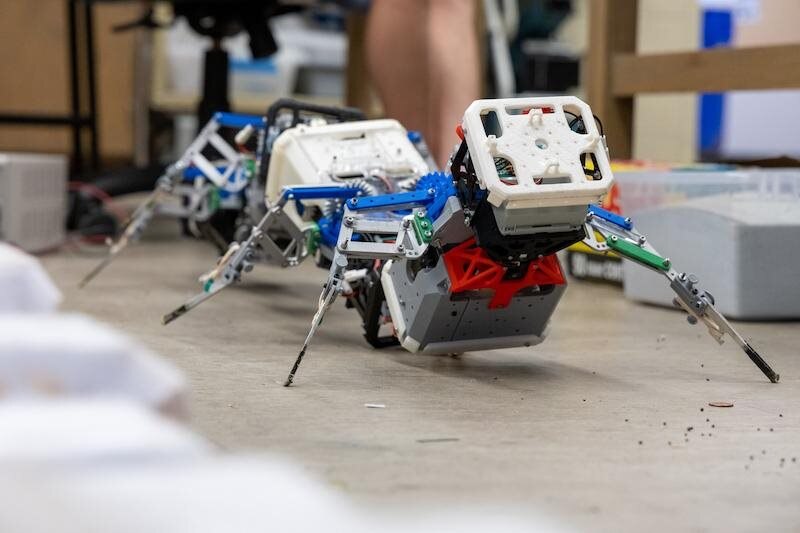
The team's robot crawls on uneven terrain like a centipede. (Image Credit: Georgia Institute of Technology)
Robots with two legs have a difficult time walking on uneven surfaces. That task gets easier for those with four or more legs. Georgia Institute of Technology researchers added multiple legs to a robot, allowing it to crawl over uneven terrain, cracks, and hills without relying on sensor systems for navigational support.
The team modeled this robot's motion in previous research. For this study, they developed a framework for their multi-leg crawling robot inspired by a communication theory by Claude Shannon. It hypothesizes that breaking up a signal into discrete, repetitive units as it passes between two points would prevent noise. "We were inspired by this theory, and we tried to see if redundancy could be helpful in matter transportation," Baxi Chong, a physics postdoctoral researcher, said.
Their robot features joined parts with two legs poking out from one segment, providing it with walking capabilities. While the robot is on the move, its legs touch the surface and relay terrain data to the other parts so they can change motion and position. The robot also underwent testing in a real-world environment to determine its walking speed, how well it performed on blocks, grass, and other surfaces, and how well it walked.
"One value of our framework lies in its codification of the benefits of redundancy, which lead to locomotor robustness over environmental contact errors without requiring sensing," the team wrote in the paper. "This contrasts with the prevailing paradigm of contact-error prevention in the conventional sensor-based closed-loop controls that take advantage of visual, tactile, or joint-torque information from the environment to change the robot dynamics."
The team also performed that experiment on robots with six, twelve, and fourteen legs. In the future, they want to use the best number of legs on their centipede-like robot for b smoother movements in a cost-effective approach. "With an advanced bipedal robot, many sensors are typically required to control it in real-time," Chong said. "But in applications such as search and rescue, exploring Mars, or even micro-robots, there is a need to drive a robot with limited sensing."
Have a story tip? Message me at: http://twitter.com/Cabe_Atwell