


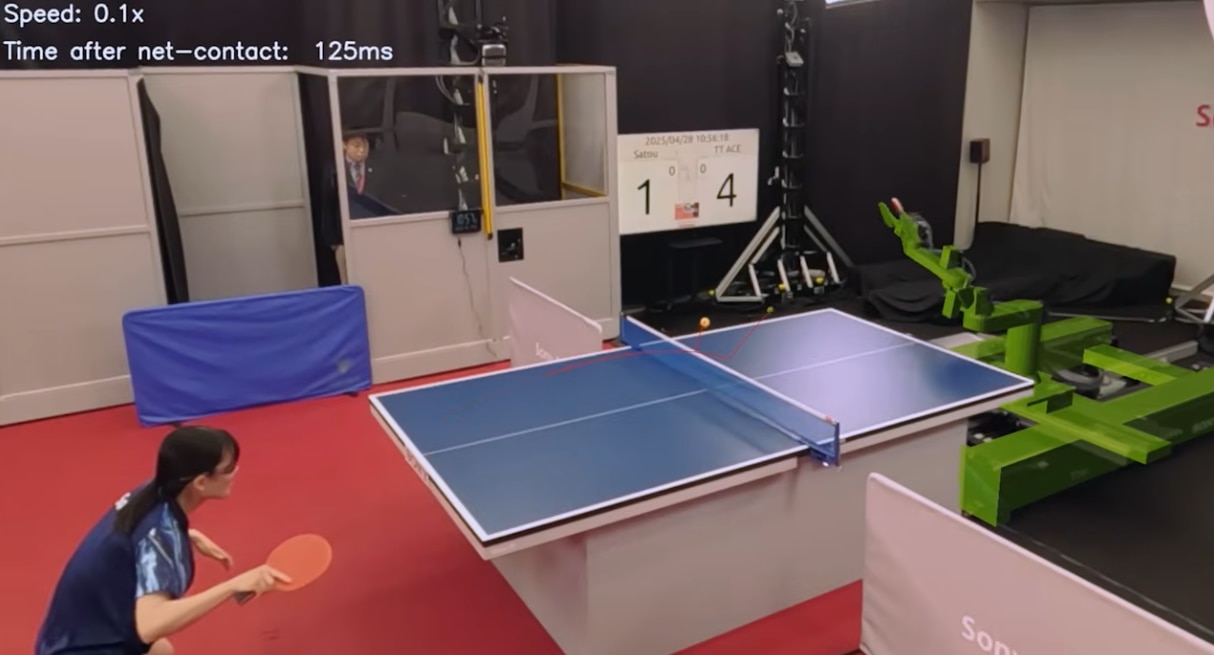
Sony AI’s Ace robot playing table tennis against a human player. (Image Credit: Sony AI/YouTube)
Sony’s AI robot Ace played a few matches of table tennis with elite players, often coming out on top. The achievement shows the advancements of AI and robotics, particularly in fast-paced environments involving real-time reactions and precise control. Robots haven’t mastered the art of table tennis as the sport requires rapid motion, spin, and split-second adjustments. This makes Ace’s ability to track and hit the ball even more impressive.
Playing under official competition rules, Ace performed at a high level, handling tricky spins, recovering difficult net shots, and executing a backspin stroke that a professional deemed impossible. The AI robot won three matches versus elite players and lost two professional matches, winning only one game across seven contests.
Usually, programs are trained on games like chess, poker, Go, and Breakout for decision-making in complex situations. And it’s more challenging to develop an intelligent robot, as those decisions must be turned into physical action by the machine.
Ace overcomes some of table tennis’s difficult challenges by using an eight-jointed arm attached to a movable base. This means the machine doesn’t need two legs for balance. It also uses multiple cameras surrounding the court, tracking where the ball goes and its spin from various directions.
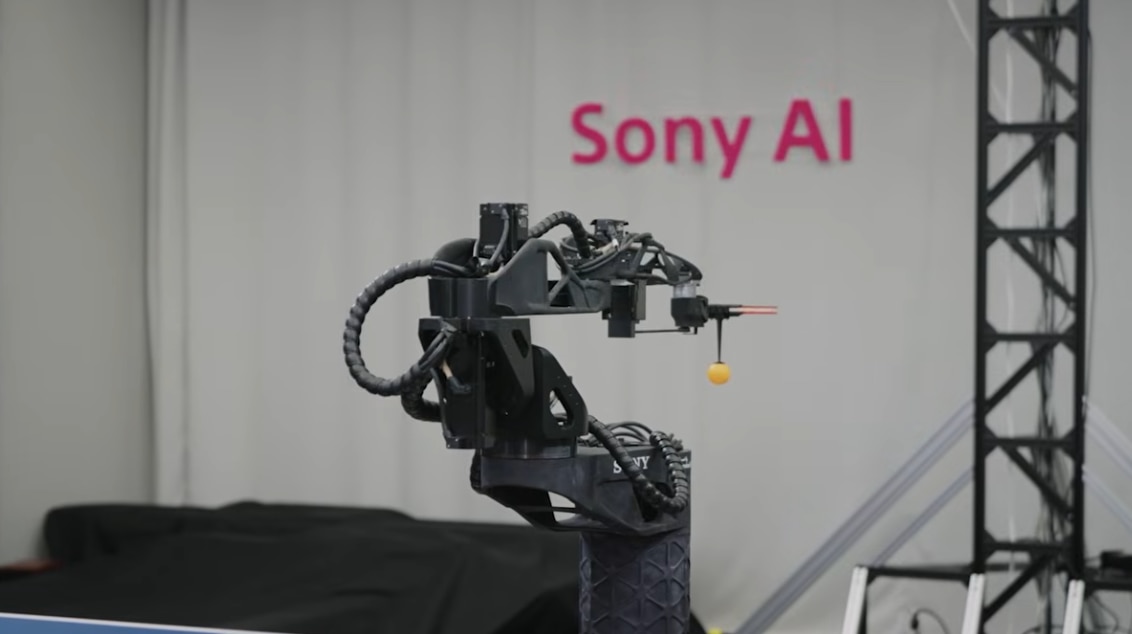
The AI robot uses an end effector with a racket and a cup that holds the ball. (Image Credit: Sony AI/YouTube)
“To match the speed of professional athletes, the robot hardware includes two prismatic and six revolute joints optimized for rapid lateral movement and striking precision, an end effector equipped with a racket, and a cup to hold the ball, facilitating one-armed serves,“ Sony AI wrote on its webpage.
Zooming in on the logo printed on the balls allows the camera system to calculate its spin and rotational axis within milliseconds before reaching Ace. The AI robot was trained to respond to different spins and choose the best shots. Researchers trained it on 3,000 hours of simulated gameplay. Meanwhile, it mastered certain techniques, such as serving, by adapting strategies of human players.
Ace got better at table tennis over time. At first, the robot struggled with slow, low-spin shots. It would hit them without much force, which resulted in a penalty during the match. Despite that drawback, it excelled in other aspects. For example, if the ball clipped the net, the robot reacted almost instantly when the trajectory changed.
In one rally, Ace pulled off a surprising move. It hit the ball early and performed a backspin. Kinjiro Nakamura said he didn’t think a move like that was possible. But now he’s convinced that human players could learn from the robot.
Playing against Ace is also pretty challenging. There’s no eye contact to make with the AI bot, and it doesn’t have body language and won’t crack under pressure, especially under tense moments, such as a 10-10 tie. Players usually look at their opponent’s eyes for cues. And since Ace has cameras around the court, they don’t show intent or emotion for players to pick up on.
According to Sony, this is just the start for Ace. The company believes it can use Ace to develop smarter machines to handle real-world tasks, which includes helping people every day and supporting rehabilitation.
Have a story tip? Message me here at element14.
