element14 Community
element14 Community
    Register Log In
  • Site
  • Search
  • Log In Register
  • Community Hub
    Community Hub
    • What's New on element14
    • Feedback and Support
    • Benefits of Membership
    • Personal Blogs
    • Members Area
    • Achievement Levels
  • Learn
    Learn
    • Ask an Expert
    • eBooks
    • element14 presents
    • Learning Center
    • Tech Spotlight
    • STEM Academy
    • Webinars, Training and Events
    • Learning Groups
  • Technologies
    Technologies
    • 3D Printing
    • FPGA
    • Industrial Automation
    • Internet of Things
    • Power & Energy
    • Sensors
    • Technology Groups
  • Challenges & Projects
    Challenges & Projects
    • Design Challenges
    • element14 presents Projects
    • Project14
    • Arduino Projects
    • Raspberry Pi Projects
    • Project Groups
  • Products
    Products
    • Arduino
    • Avnet & Tria Boards Community
    • Dev Tools
    • Manufacturers
    • Multicomp Pro
    • Product Groups
    • Raspberry Pi
    • RoadTests & Reviews
  • About Us
  • Store
    Store
    • Visit Your Store
    • Choose another store...
      • Europe
      •  Austria (German)
      •  Belgium (Dutch, French)
      •  Bulgaria (Bulgarian)
      •  Czech Republic (Czech)
      •  Denmark (Danish)
      •  Estonia (Estonian)
      •  Finland (Finnish)
      •  France (French)
      •  Germany (German)
      •  Hungary (Hungarian)
      •  Ireland
      •  Israel
      •  Italy (Italian)
      •  Latvia (Latvian)
      •  
      •  Lithuania (Lithuanian)
      •  Netherlands (Dutch)
      •  Norway (Norwegian)
      •  Poland (Polish)
      •  Portugal (Portuguese)
      •  Romania (Romanian)
      •  Russia (Russian)
      •  Slovakia (Slovak)
      •  Slovenia (Slovenian)
      •  Spain (Spanish)
      •  Sweden (Swedish)
      •  Switzerland(German, French)
      •  Turkey (Turkish)
      •  United Kingdom
      • Asia Pacific
      •  Australia
      •  China
      •  Hong Kong
      •  India
      •  Korea (Korean)
      •  Malaysia
      •  New Zealand
      •  Philippines
      •  Singapore
      •  Taiwan
      •  Thailand (Thai)
      • Americas
      •  Brazil (Portuguese)
      •  Canada
      •  Mexico (Spanish)
      •  United States
      Can't find the country/region you're looking for? Visit our export site or find a local distributor.
  • Translate
  • Profile
  • Settings
Industrial Automation
  • Technologies
  • More
Industrial Automation
Blog AI Technology Begins to Learn on Its Own
  • Blog
  • Forum
  • Documents
  • Quiz
  • Events
  • Polls
  • Files
  • Members
  • Mentions
  • Sub-Groups
  • Tags
  • More
  • Cancel
  • New
Join Industrial Automation to participate - click to join for free!
  • Share
  • More
  • Cancel
Group Actions
  • Group RSS
  • More
  • Cancel
Engagement
  • Author Author: Catwell
  • Date Created: 30 May 2018 5:47 PM Date Created
  • Views 747 views
  • Likes 2 likes
  • Comments 1 comment
  • Processor
  • robotics
  • artificial intelligence
  • robot
  • Design
  • cabeatwell
  • ai
  • nvidia
  • innovation
Related
Recommended

AI Technology Begins to Learn on Its Own

Catwell
Catwell
30 May 2018

Recently, NVIDIA revealed their researchers have developed a new system using unique deep learning that allows a robot to learn through human function/action. The idea here is to make it an interesting spin for the robot to learn by having it develop some sort of communication between robot and human - ideally, the robot would have the ability to observe and copy the human in every move and action a human makes. The team is also hoping this will be beneficial in the future when robots and humans can work together continuously.


An image being processed by the robot to identify objects using synthetic data and recognizing the shape. (Image Credit: Nvidia) image
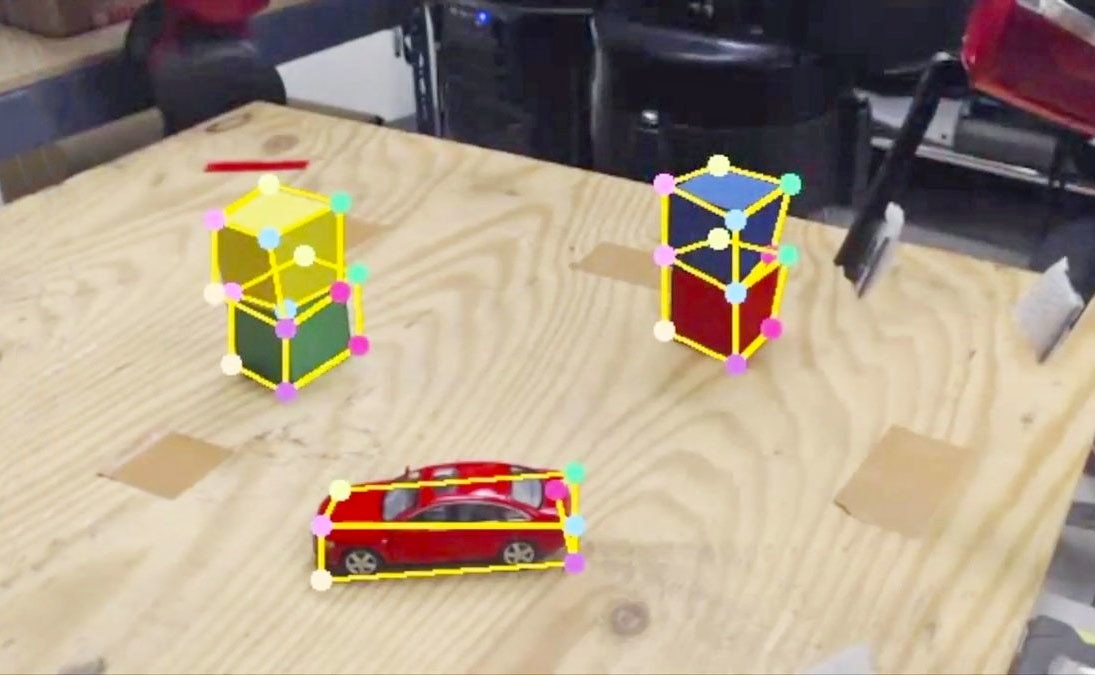
 

The researchers used NVIDIA TITAN X GPUs to train a series of neural networks to perform specific duties involving perception, program generation and execution.


The way it works is, the robot observes what is happening in relation to a task then it comes up with a list of steps required to complete the task. Afterward, a human would verify the validity of the list to confirm the correctness of it before the robot implements the steps it created. Researchers were able to correctly establish and test this out with cubes - which the robot was required to stack in the correct order. This can be seen in the video below:


You don't have permission to edit metadata of this video.
Edit media
x
image
Upload Preview
image


A benefit of this is that it doesn't require an overly large amount of training data to be inputted into the system. What happens instead is the system produces the data synthetically - which allows the robot to come up with the training data it needs to come up with, learn and complete the task. It requires very little effort to achieve something like this, as a result. The team also uses an image-centric domain randomization approach - which is the first time this has ever been done on robots - and that allows the system to use synthetic data. The data has a large amount of variety for what it can read via image perception neural networks and doesn't need to rely on the environment it's in or a camera to perform its duties.


The perception network being used and identified with these objects is applied to any real-world object, and that can be used by its 3D bounding cuboids. The robot never observes a real image under training, but it can detect cuboids of objects in real images even where it may be difficult to see it.


The researchers will present their findings this week at the International Conference of Robotics and Automation. They will use this opportunity use their data in other areas to improve their research - specifically for synthetic data to use these methods in many different scenarios.


Have a story tip? Message me at: cabe(at)element14(dot)com

http://twitter.com/Cabe_Atwell

  • Sign in to reply

Top Comments

  • DAB
    DAB over 7 years ago +1
    I have seen this approach before. The good news is that you will get new and unique interpretations of the data provided. The Bad news is that you have no way to do verification and validation on the resulting…
  • DAB
    DAB over 7 years ago

    I have seen this approach before.

    The good news is that you will get new and unique interpretations of the data provided.

    The Bad news is that you have no way to do verification and validation on the resulting network.

    That means that under certain data sequences, the system may do something completely unpredictable. The result might be very good or very bad, but no one will know until after the event occurs.  Sort of like the Uber car incident a few weeks ago.


    As an experienced data analysis engineer, I can appreciate the value of this approach to using "AI" to find new ways to solve problems.

    As an experienced system design, I see this approach as incredibly high risk for any system associated with humans or animals.

    Risk analysis requires explicit understanding of what the system will do under what conditions.

    Using self developing algorithms removes that level of visibility into the system. Therefore you have unknown response which equates to high risk that something WILL go wrong.


    DAB

    • Cancel
    • Vote Up +1 Vote Down
    • Sign in to reply
    • More
    • Cancel
element14 Community

element14 is the first online community specifically for engineers. Connect with your peers and get expert answers to your questions.

  • Members
  • Learn
  • Technologies
  • Challenges & Projects
  • Products
  • Store
  • About Us
  • Feedback & Support
  • FAQs
  • Terms of Use
  • Privacy Policy
  • Legal and Copyright Notices
  • Sitemap
  • Cookies

An Avnet Company © 2025 Premier Farnell Limited. All Rights Reserved.

Premier Farnell Ltd, registered in England and Wales (no 00876412), registered office: Farnell House, Forge Lane, Leeds LS12 2NE.

ICP 备案号 10220084.

Follow element14

  • X
  • Facebook
  • linkedin
  • YouTube