element14 Community
element14 Community
    Register Log In
  • Site
  • Search
  • Log In Register
  • Community Hub
    Community Hub
    • What's New on element14
    • Feedback and Support
    • Benefits of Membership
    • Personal Blogs
    • Members Area
    • Achievement Levels
  • Learn
    Learn
    • Ask an Expert
    • eBooks
    • element14 presents
    • Learning Center
    • Tech Spotlight
    • STEM Academy
    • Webinars, Training and Events
    • Learning Groups
  • Technologies
    Technologies
    • 3D Printing
    • FPGA
    • Industrial Automation
    • Internet of Things
    • Power & Energy
    • Sensors
    • Technology Groups
  • Challenges & Projects
    Challenges & Projects
    • Design Challenges
    • element14 presents Projects
    • Project14
    • Arduino Projects
    • Raspberry Pi Projects
    • Project Groups
  • Products
    Products
    • Arduino
    • Avnet & Tria Boards Community
    • Dev Tools
    • Manufacturers
    • Multicomp Pro
    • Product Groups
    • Raspberry Pi
    • RoadTests & Reviews
  • About Us
    About the element14 Community
  • Store
    Store
    • Visit Your Store
    • Choose another store...
      • Europe
      •  Austria (German)
      •  Belgium (Dutch, French)
      •  Bulgaria (Bulgarian)
      •  Czech Republic (Czech)
      •  Denmark (Danish)
      •  Estonia (Estonian)
      •  Finland (Finnish)
      •  France (French)
      •  Germany (German)
      •  Hungary (Hungarian)
      •  Ireland
      •  Israel
      •  Italy (Italian)
      •  Latvia (Latvian)
      •  
      •  Lithuania (Lithuanian)
      •  Netherlands (Dutch)
      •  Norway (Norwegian)
      •  Poland (Polish)
      •  Portugal (Portuguese)
      •  Romania (Romanian)
      •  Russia (Russian)
      •  Slovakia (Slovak)
      •  Slovenia (Slovenian)
      •  Spain (Spanish)
      •  Sweden (Swedish)
      •  Switzerland(German, French)
      •  Turkey (Turkish)
      •  United Kingdom
      • Asia Pacific
      •  Australia
      •  China
      •  Hong Kong
      •  India
      •  Japan
      •  Korea (Korean)
      •  Malaysia
      •  New Zealand
      •  Philippines
      •  Singapore
      •  Taiwan
      •  Thailand (Thai)
      •  Vietnam
      • Americas
      •  Brazil (Portuguese)
      •  Canada
      •  Mexico (Spanish)
      •  United States
      Can't find the country/region you're looking for? Visit our export site or find a local distributor.
  • Translate
  • Profile
  • Settings
Industrial Automation
  • Technologies
  • More
Industrial Automation
Blog Army Researchers May Have Just Brought Life To The Hydrogen Economy
  • Blog
  • Forum
  • Documents
  • Quiz
  • Events
  • Polls
  • Files
  • Members
  • Mentions
  • Sub-Groups
  • Tags
  • More
  • Cancel
  • New
Join Industrial Automation to participate - click to join for free!
  • Share
  • More
  • Cancel
Group Actions
  • Group RSS
  • More
  • Cancel
Engagement
  • Author Author: Catwell
  • Date Created: 9 Aug 2017 7:35 PM Date Created
  • Views 1116 views
  • Likes 5 likes
  • Comments 3 comments
  • research
  • design challenge
  • army
  • iot on wheels
  • Design
  • cabeatwell
  • automotive
  • iot
  • energy
  • alternative eneergy
Related
Recommended

Army Researchers May Have Just Brought Life To The Hydrogen Economy

Catwell
Catwell
9 Aug 2017

image

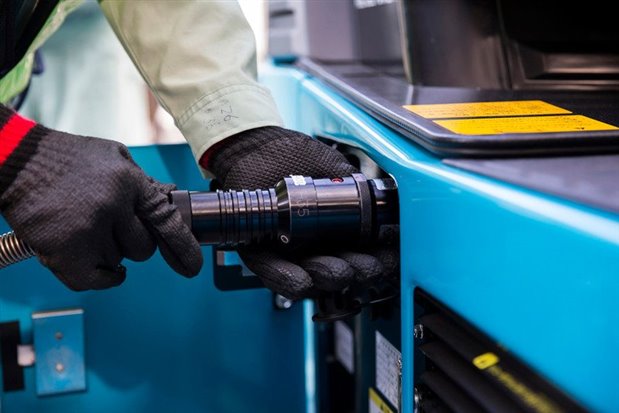
Hydrogen is a very attractive prospect for alternative energy sources, and prior obstacles to the utilization of hydrogen power are being overcome through the introduction of a new aluminum alloy material and its unique reaction to water. Recent developments give greater credibility to the notion that hydrogen power could replace battery power appliances and products, ranging from laptops to cars and buses. (Photo via Tomohiro Ohsumi/Getty)


The automotive industry is still a powerhouse, even in this day and age. Innovation on wheels is still needed, like in the IoT on Wheel Design Challenge. You'll be surprised what comes from that contest...


But this innovation is out of the blue:


In the last decade or so, the viability of alternative sources of energy has been explored more and more due to the rising concerns about the threatening consequences of pollution and climate change. The issue of climate change may be up for debate for some, but pollution is undeniably dangerous, and while fossil fuels are the probably the dirtiest and most environmentally hazardous source of energy, even greener options like solar energy and lithium-ion batteries. The Washington Post recently published a story exposing the cobalt-mining industry in Congo that is ruining the health and livelihoods of tens of thousands of children for the sake of the cobalt needed for lithium-ion batteries, which are in increasingly high demand for smartphones and electric cars, among many other things. So, in seeking environmentally-friendly sources of energy, a resource, and more importantly, a nation and its people are being exploited for the sake of a growing industry and its economic demands. The accidental discovery made by Army researchers at the Research Laboratory at Aberdeen Proving Ground in Maryland may be able to provide a path forward for a hydrogen-powered society, which will hopefully also lead to a decline in the exploitative, destructive practices that are byproducts of the industries for other energy sources.


A 2008 study by the U.S. Department of Energy (DOE) describes the issue of obtaining hydrogen using aluminum-water reactions, saying that, “a coherent and adherent layer of aluminum oxide... prevents water from coming into direct contact with the aluminum metal,” and that the key to maintaining this reaction to yield hydrogen necessitates, “...the continual removal and/or disruption of this coherent/adherent aluminum oxide layer.” The issue of the aluminum-oxide layer was approached in a number of different ways, but the 2008 report ultimately concludes that none were commercially viable.


According to David Hambling of New Scientist, the recent discovery was made during the routine testing of a high-strength aluminum alloy, and when water was poured onto the material, it immediately started reacting and producing hydrogen gas. It’s a promising sign, given that “previous attempts to drive the reaction [referring to 2008 DOE study] required high temperatures or catalysts, and were slow: obtaining the hydrogen took hours and was around 50 per cent efficient.” The leader of the Army research team, Scott Grendahl, says that the new approach operates at near one-hundred percent efficiency, and occurs in less than three minutes. These are staggering improvements, and while the team has only tried using this technique to power a small, radio-controlled tank, Grendahl believes it can be scaled-up for powering larger vehicles like hydrogen-powered cars and buses. More research needs to be performed and possible applications explored, but this advancement is encouraging for environmentalists and human rights activists alike.


Have a story tip? Message me at: cabe(at)element14(dot)com

http://twitter.com/Cabe_Atwell

  • Sign in to reply

Top Comments

  • DAB
    DAB over 8 years ago +3
    Hi Cabe, Hydrogen is the only logical fuel for the future as it is supper abundant and readily available. The issue has always been about how to store Hydrogen in a non explosive container. Take a look…
  • michaelkellett
    michaelkellett over 8 years ago in reply to DAB +2
    Hydrogen and aluminium are not viable as fuels - since neither occurs naturally other than locked up in compounds with other elements, and energy is required to break these compounds up to extract hydrogen…
  • DAB
    DAB over 8 years ago in reply to michaelkellett +1
    Agreed. The whole thing with electric cars just demonstrates people's failure to understand math. Politicians have NEVER understood math. They keep making insane promises and spending money like it is…
  • DAB
    DAB over 8 years ago in reply to michaelkellett

    Agreed.


    The whole thing with electric cars just demonstrates people's failure to understand math.


    Politicians have NEVER understood math.  They keep making insane promises and spending money like it is free.


    Eventually reality will hit.


    And don't even get me started about the carbon capture mafia.  Talk about people with no math skills!


    DAB

    • Cancel
    • Vote Up +1 Vote Down
    • Sign in to reply
    • More
    • Cancel
  • michaelkellett
    michaelkellett over 8 years ago in reply to DAB

    Hydrogen and aluminium are not viable as fuels - since neither occurs naturally other than locked up in compounds with other elements, and energy is required to break these compounds up to extract hydrogen or aluminium. Hydrogen could be used as an energy carrier but it has limited value being difficult to safely store and transfer from one container to another.

    Methanol and ethanol also have energy carrier potential, since they would work with our existing fuel distribution system and in many case with IC engines similar to those we use now or even in fuel cells to generate electricity. Alcohols can be made from energy, CO2 and water releasing oxygen to the atmosphere and when they are burnt they release water and CO2 to the atmosphere and energy to the application. The  overall effect of such a cycle is carbon neutral.

    We've had the technology to make alcohol from sunlight, water and CO2 for several thousand years - it needs a bit of development to replace fuel from oil but it could well be viable.


    The really important thing is not to let silly politicians decide, based on whim and fashion, to go for battery powered electric cars and legislate all the other technologies out of the running (which is what is happening in the UK and EU right now).


    MK

    • Cancel
    • Vote Up +2 Vote Down
    • Sign in to reply
    • More
    • Cancel
  • DAB
    DAB over 8 years ago

    Hi Cabe,


    Hydrogen is the only logical fuel for the future as it is supper abundant and readily available.

    The issue has always been about how to store Hydrogen in a non explosive container.


    Take a look at the HOH solutions.  It turns out if you separate H2O, but keep the gasses together, they remain separate and stable for a long time.

    The mixture is easy to use for a source of power and produces pure clean water as a combustion output.


    In pure hydrogen storage, the small hydrogen atoms have a tendency to pass through most containment material and escape into the atmosphere.

    Such leakage can lead to explosive concentrations and make long term storage very difficult.


    DAB

    • Cancel
    • Vote Up +3 Vote Down
    • Sign in to reply
    • More
    • Cancel
element14 Community

element14 is the first online community specifically for engineers. Connect with your peers and get expert answers to your questions.

  • Members
  • Learn
  • Technologies
  • Challenges & Projects
  • Products
  • Store
  • About Us
  • Feedback & Support
  • FAQs
  • Terms of Use
  • Privacy Policy
  • Legal and Copyright Notices
  • Sitemap
  • Cookies

An Avnet Company © 2026 Premier Farnell Limited. All Rights Reserved.

Premier Farnell Ltd, registered in England and Wales (no 00876412), registered office: Farnell House, Forge Lane, Leeds LS12 2NE.

ICP 备案号 10220084.

Follow element14

  • X
  • Facebook
  • linkedin
  • YouTube