


The field of robotics has come really far, with humanoids robots behaving more and more like humans. Take Sophia 2020, for example; she would impress anyone with the many facial expressions and body language she possesses. Thanks to the renowned Hanson Robotics’ technology, Sophia is autonomous enough to be useful in various environments, both professional and social. However, it only takes one glance for anyone to tell that Sophia 2020 is a robot. Everyday human interactions involve other movements that robots have not been able to reproduce. For example, humans have a natural rhythm in blinking their eyes and can adjust their head movements based on the various inputs of the environment. In addition, robots cannot think for themselves and make decisions to adjust quickly to their environment. To make robots-human interactions more intuitive, researchers around the world have been working on a few concepts.
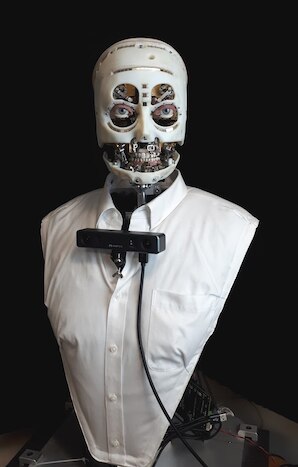
Robot Bust with a sensor on the chest to read environment.
Anyone who has encountered a humanoid robot knows that they usually have a blank stare in their gaze, and that can be unsettling. Thanks to Matthew Pan and his colleagues, Disney Research is creating a robot with a more natural gaze. In their paper, “Realistic and Interactive Robot Gaze,” published on Disney’s website, the researchers revealed that they had developed a new approach to “robot gaze” that encompasses various human behaviors in order to give robots a genuine gaze. They built a robot bust with a sensor that allows the robot to detect the position of the person it is interacting with and adjust its face and head movements accordingly. In addition to blinking, the researchers incorporated saccades and attention habituation to make the robot even more lifelike. Attention habituation allows the robot to react to external stimulus like an unexpected sound by temporarily shifting its gaze, just as humans do when new elements are introduced in their environment. Saccades are rapid and subtle movements of the eyes in an attempt to assess facial expressions, number of faces, etc. Overall, Disney’s robot can perceive its environment and interact naturally with multiple people at a time. Possible applications of that technology include the creation of more realistic Disney characters at Disneyland.
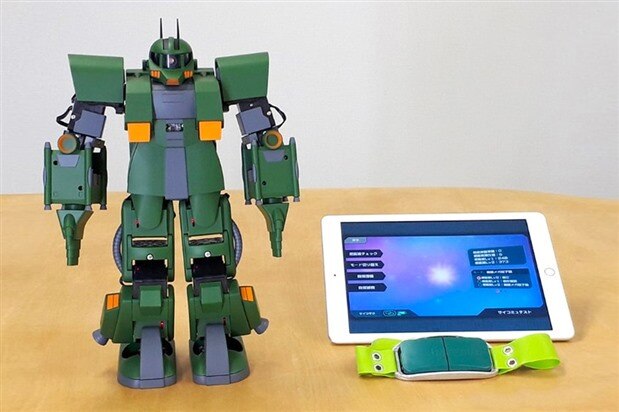
Gundam Robot with headband and app displayed on iPad.
Another solution that researchers have thought of to create more realistic movements in robots is the use of human brain waves. A joint team made of researchers of Tohoku University and Hitachi led to creating a Gundam robot-toy that can be manipulated using brain waves. The Japanese team created a new technology to make the movements of the robot more lifelike by allowing the user to communicate his/her thoughts directly to the robot. Using a headband worn by the user of the robot, brain activities are recorded and sent to an app, which in turn converts the brain waves into commands that are transmitted to the robot. Although the goal was to simulate the telepathic abilities of the anime character Gundam, the concept could be used in other areas of robotics to make interactions between humans and robots more intuitive.
Both technologies combined might be the key to robots that look and behave naturally like humans.
Have a story tip? Message me at: http://twitter.com/Cabe_Atwell