element14 Community
element14 Community
    Register Log In
  • Site
  • Search
  • Log In Register
  • Community Hub
    Community Hub
    • What's New on element14
    • Feedback and Support
    • Benefits of Membership
    • Personal Blogs
    • Members Area
    • Achievement Levels
  • Learn
    Learn
    • Ask an Expert
    • eBooks
    • element14 presents
    • Learning Center
    • Tech Spotlight
    • STEM Academy
    • Webinars, Training and Events
    • Learning Groups
  • Technologies
    Technologies
    • 3D Printing
    • FPGA
    • Industrial Automation
    • Internet of Things
    • Power & Energy
    • Sensors
    • Technology Groups
  • Challenges & Projects
    Challenges & Projects
    • Design Challenges
    • element14 presents Projects
    • Project14
    • Arduino Projects
    • Raspberry Pi Projects
    • Project Groups
  • Products
    Products
    • Arduino
    • Avnet & Tria Boards Community
    • Dev Tools
    • Manufacturers
    • Multicomp Pro
    • Product Groups
    • Raspberry Pi
    • RoadTests & Reviews
  • About Us
  • Store
    Store
    • Visit Your Store
    • Choose another store...
      • Europe
      •  Austria (German)
      •  Belgium (Dutch, French)
      •  Bulgaria (Bulgarian)
      •  Czech Republic (Czech)
      •  Denmark (Danish)
      •  Estonia (Estonian)
      •  Finland (Finnish)
      •  France (French)
      •  Germany (German)
      •  Hungary (Hungarian)
      •  Ireland
      •  Israel
      •  Italy (Italian)
      •  Latvia (Latvian)
      •  
      •  Lithuania (Lithuanian)
      •  Netherlands (Dutch)
      •  Norway (Norwegian)
      •  Poland (Polish)
      •  Portugal (Portuguese)
      •  Romania (Romanian)
      •  Russia (Russian)
      •  Slovakia (Slovak)
      •  Slovenia (Slovenian)
      •  Spain (Spanish)
      •  Sweden (Swedish)
      •  Switzerland(German, French)
      •  Turkey (Turkish)
      •  United Kingdom
      • Asia Pacific
      •  Australia
      •  China
      •  Hong Kong
      •  India
      • Japan
      •  Korea (Korean)
      •  Malaysia
      •  New Zealand
      •  Philippines
      •  Singapore
      •  Taiwan
      •  Thailand (Thai)
      • Vietnam
      • Americas
      •  Brazil (Portuguese)
      •  Canada
      •  Mexico (Spanish)
      •  United States
      Can't find the country/region you're looking for? Visit our export site or find a local distributor.
  • Translate
  • Profile
  • Settings
Industrial Automation
  • Technologies
  • More
Industrial Automation
Blog Breakthrough Brings Biocompatible Ion Battery
  • Blog
  • Forum
  • Documents
  • Quiz
  • Events
  • Polls
  • Files
  • Members
  • Mentions
  • Sub-Groups
  • Tags
  • More
  • Cancel
  • New
Join Industrial Automation to participate - click to join for free!
  • Share
  • More
  • Cancel
Group Actions
  • Group RSS
  • More
  • Cancel
Engagement
  • Author Author: Catwell
  • Date Created: 30 Aug 2017 8:00 PM Date Created
  • Views 559 views
  • Likes 1 like
  • Comments 0 comments
  • research
  • hmi
  • on_campus
  • battery
  • cabeatwell
  • bio
  • power management
  • interface
  • university
  • power
  • biobattery
Related
Recommended

Breakthrough Brings Biocompatible Ion Battery

Catwell
Catwell
30 Aug 2017

image

UMD engineers develop first biocompatible ion current battery. (Image credit UMD)


UMD engineers have designed a new type of ion current battery that’s completely biocompatible. The new battery produces the same ion-based energy used by humans and other living organisms, and those ions (in the form of sodium, potassium and other electrolytes) are the electrical signals that do everything from powering the brain to flexing muscles.

To get a better sense of what’s going on here we need to look at how a traditional (electrochemical) battery functions- in this case, chemical reactions from an electrolyte causes a buildup of electrons on the anode (negative), resulting in a difference between the cathode (positive). Think of it as an unstable buildup of electrons, which want to rearrange themselves to get rid of said difference but the only place to go is the cathode. That electrolyte keeps those electrons from doing so until the gap between the anode and cathode is bridged, thereby completing an electrical circuit. The new biocompatible battery, on the other hand, uses electron movement to produce a flow of ions to generate power.
 

image

The new battery using grass as the ionic cable. (Image credit UMD)


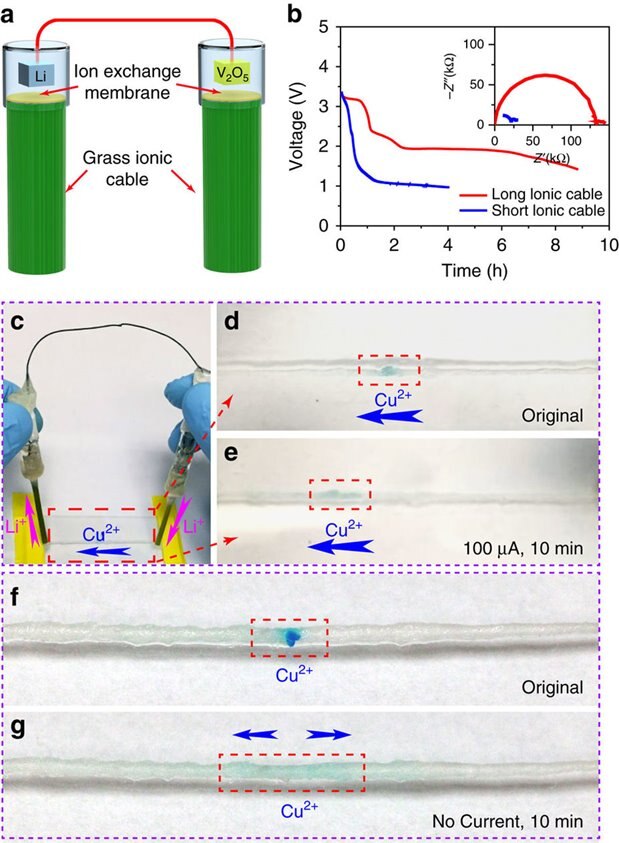
UMD’s professor of materials Liangbing Hu, who headed the battery’s development describes how it functions compared to a traditional electrochemical battery, stating, “In our reverse design, a traditional battery is electronically shorted (that means electrons are flowing through the metal wires). Then ions have to flow through the outside ionic cables. In this case, the ions in the ionic cable - here, grass fibers -- can interface with living systems." (Cited here)


Yes, you read that right, the new battery uses grass as the medium to store energy rather than an electrolyte. More accurately, it uses Kentucky bluegrass coated with a lithium-salt solution, as the channels normally used to move plant nutrients up and down were ideal in holding the ion-producing solution.
 

image

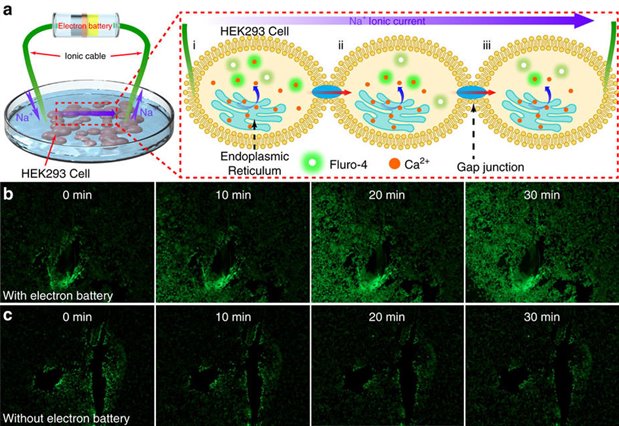
Demonstration of the new battery in a biosystem. (Image credit UMD)


The team’s demonstration battery features two glass tubes packed with ion exchange membranes and a blade of solution-soaked grass with both connected together using a thin wire. That wire is where the electrons flow, moving from one end to the other while slowly dissipating energy while a pair of metal tips on the other end of the glass tubes are where the ion current flows.

To prove that ionic flow, the researchers connected the glass tubes at the ends of a lithium-soaked cotton string with a deposition of blue-dyed copper ions placed in the middle. When the current started flowing, that deposition began moving toward the negative charged glass pole, thus proving the ionic current.


The team has high hopes for their new battery and envision them being used for a number of applications, including the micro-manipulation of neural activities to prevent or treat people with Alzheimer's disease and depression. They also plan to diversify the types of ion batteries they can produce by using different ionic conductors including cellulose, hydrogels, and polymers. 


Have a story tip? Message me at: cabe(at)element14(dot)com

http://twitter.com/Cabe_Atwell

  • Sign in to reply
element14 Community

element14 is the first online community specifically for engineers. Connect with your peers and get expert answers to your questions.

  • Members
  • Learn
  • Technologies
  • Challenges & Projects
  • Products
  • Store
  • About Us
  • Feedback & Support
  • FAQs
  • Terms of Use
  • Privacy Policy
  • Legal and Copyright Notices
  • Sitemap
  • Cookies

An Avnet Company © 2025 Premier Farnell Limited. All Rights Reserved.

Premier Farnell Ltd, registered in England and Wales (no 00876412), registered office: Farnell House, Forge Lane, Leeds LS12 2NE.

ICP 备案号 10220084.

Follow element14

  • X
  • Facebook
  • linkedin
  • YouTube