


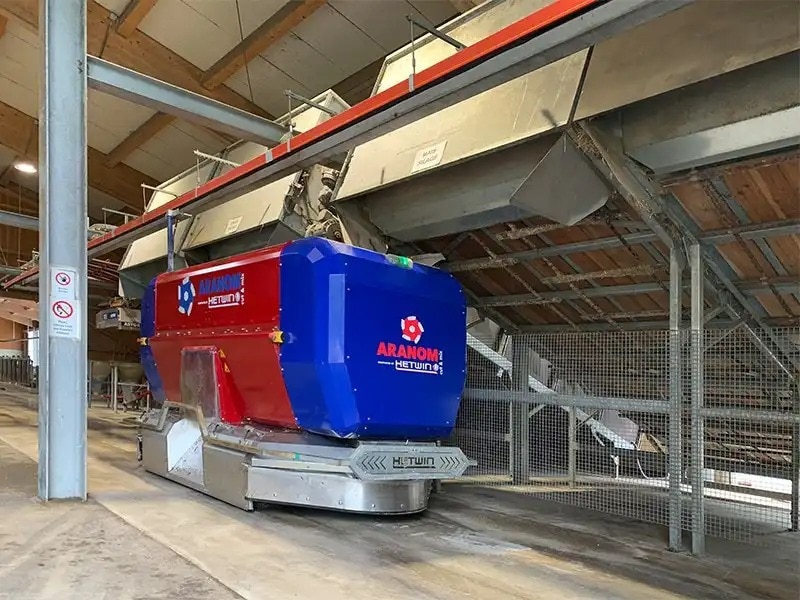
Technology such as robotic feeders can help farmers run their dairy farms more efficiently. (Image Credit: amsGalaxyUSA)
Quietly, in the background, the farming industry is going through significant changes that’ll affect us all.
On January 3rd, U.S. President Joe Biden hosted a virtual meeting with farmers to come up with a solution for rising meat prices. Larger farms currently dominate the market, but smaller dairy farms must adapt to different approaches or quit. To help overcome this issue, farmers could deploy robots to help with the workload that employees would otherwise face.
According to the National Agriculture Statistical Service Farm Labor Survey (NASS FLS), self-employed and family farmworkers saw a 73% decline from 1950 to 2000. Meanwhile, hired help declined 52% in that same time. Overall, the dramatic decline translates to increased labor wages. In 2018, the agriculture industry saw a 7% decline in hired help, with labor wages seeing a 5$ increase.
Dairy farms, such as the one in Clark County, Wisconsin, owned by Dennis and Suzie Roehl, have struggled to hire employees because the job involves long hours and extra-hard work. Now they want to adapt to changes by installing robotic milkers for 500 cows. These robots are expected to be fully operational at their farm in early 2022.
Meanwhile, Kristyn Naigon, daughter of a farmer who wants to introduce changes to his family farm, studied dairy science in college and helped run the dairy operation by milking 72 cows. That farm also has a robotic feeder, costing $21,000 to install two years ago, which runs for 24 hours a day and pushes the feed up to the cows every two hours.
Robots are becoming more common in dairy farming. Robotic milkers are also being deployed on other farming sites. For example, Max Malm installed two robotic milkers to milk 350 dairy cows at his Clark County farm. In this case, cows need to be milked every day, so he ultimately decided to use robots instead of hiring workers.
It costs anywhere from $200,000 to $250,000 to add just one robot to a farm. Even then, farmers need to construct a barn around it. So a two-robot barn could cost approximately a million dollars. The Malms farm is only a small part of the 1% of the 31,000 dairy farms using robotic milkers to reduce labor costs.
According to the U.S. Department of Agriculture, robots can help farmers save 30% of costs aimed toward milking cows. Farmers would also be able to direct their attention toward other income sources, which include raising beef, alternative crops, and off-the-farm jobs.
In the future, farms could see hundreds of automated tractors. Satellites could also keep an eye on farm fields for crop growth identification purposes, providing farmers with an idea of how much water, pesticide, or herbicide they should apply to their crops.
Have a story tip? Message me at: http://twitter.com/Cabe_Atwell
-

robogary
-
Cancel
-
Vote Up
0
Vote Down
-
-
Sign in to reply
-
More
-
Cancel
Comment-

robogary
-
Cancel
-
Vote Up
0
Vote Down
-
-
Sign in to reply
-
More
-
Cancel
Children