


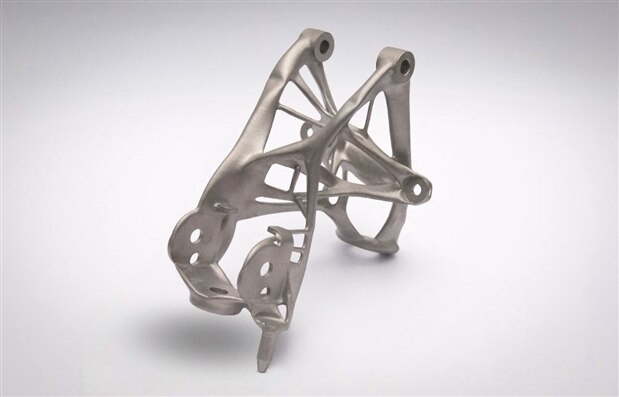
The technique will allow for a lighter weight and less fuel consumption. General Motors 3-D Prototype. (Image Credit: General Motors)
3-D printing has been in the industry for a good amount of time in various shapes and forms for the manufacturers. To benefit from this new development, both General Motors and the software company, Autodesk Inc. have teamed up to create 3-D car parts that will help with its proposed plan to add 20 new electric battery and fuel cell batteries worldwide by the year 2023. The company has plans to set out its electric cars by that year and has introduced the SURUS (Super Universal Rover Utility Superstructure) fuel cell as a means to make the 3-D printing technology possible and enhanced to fit these car parts. General Motors has developed some new ideas for this technology - hoping that it will be sufficient enough to be used in all vehicle segments of the electrical battery.
The lighter car parts developed from the 3-D printing technology would help with the overall weight of the vehicle while providing a lightness to the fuel efficiency it provides. Both General Motors and the Autodesk software company have already developed a stainless steel seat bracket. It's usually made in eight parts coming from separate suppliers, but with the printing technology the entire seat bracket just comes in one piece and is 40% lighter and 20% stronger.
This isn't something new for GM or Ford, either. Ford has teamed up with a different 3-D printing company called Carbon3D, who are fairly new but have also developed a quick and effective printing technique. Using inspiration from the Terminator movies, the method consists of objects emerging from a pool of resin within minutes. The new printing technique will allow the company to quickly produce high qualitative automotive parts as prototypes only. However, the company hopes to use these products more in the future as fully-functional car parts.
Both General Motors and Ford have been using the technology as prototypes for years with 3-D printing. They believe the technology is now ready for the next step in further production and further use. These parts could also be seen being put to use in motorsport vehicles in as little as a year and GM thinks they can produce tens of thousands of these parts in five years at scale.
Have a story tip? Message me at: cabe(at)element14(dot)com
Top Comments