element14 Community
element14 Community
    Register Log In
  • Site
  • Search
  • Log In Register
  • Community Hub
    Community Hub
    • What's New on element14
    • Feedback and Support
    • Benefits of Membership
    • Personal Blogs
    • Members Area
    • Achievement Levels
  • Learn
    Learn
    • Ask an Expert
    • eBooks
    • element14 presents
    • Learning Center
    • Tech Spotlight
    • STEM Academy
    • Webinars, Training and Events
    • Learning Groups
  • Technologies
    Technologies
    • 3D Printing
    • FPGA
    • Industrial Automation
    • Internet of Things
    • Power & Energy
    • Sensors
    • Technology Groups
  • Challenges & Projects
    Challenges & Projects
    • Design Challenges
    • element14 presents Projects
    • Project14
    • Arduino Projects
    • Raspberry Pi Projects
    • Project Groups
  • Products
    Products
    • Arduino
    • Avnet & Tria Boards Community
    • Dev Tools
    • Manufacturers
    • Multicomp Pro
    • Product Groups
    • Raspberry Pi
    • RoadTests & Reviews
  • About Us
  • Store
    Store
    • Visit Your Store
    • Choose another store...
      • Europe
      •  Austria (German)
      •  Belgium (Dutch, French)
      •  Bulgaria (Bulgarian)
      •  Czech Republic (Czech)
      •  Denmark (Danish)
      •  Estonia (Estonian)
      •  Finland (Finnish)
      •  France (French)
      •  Germany (German)
      •  Hungary (Hungarian)
      •  Ireland
      •  Israel
      •  Italy (Italian)
      •  Latvia (Latvian)
      •  
      •  Lithuania (Lithuanian)
      •  Netherlands (Dutch)
      •  Norway (Norwegian)
      •  Poland (Polish)
      •  Portugal (Portuguese)
      •  Romania (Romanian)
      •  Russia (Russian)
      •  Slovakia (Slovak)
      •  Slovenia (Slovenian)
      •  Spain (Spanish)
      •  Sweden (Swedish)
      •  Switzerland(German, French)
      •  Turkey (Turkish)
      •  United Kingdom
      • Asia Pacific
      •  Australia
      •  China
      •  Hong Kong
      •  India
      •  Korea (Korean)
      •  Malaysia
      •  New Zealand
      •  Philippines
      •  Singapore
      •  Taiwan
      •  Thailand (Thai)
      • Americas
      •  Brazil (Portuguese)
      •  Canada
      •  Mexico (Spanish)
      •  United States
      Can't find the country/region you're looking for? Visit our export site or find a local distributor.
  • Translate
  • Profile
  • Settings
Industrial Automation
  • Technologies
  • More
Industrial Automation
Blog China uses drag sail technology for space junk removal
  • Blog
  • Forum
  • Documents
  • Quiz
  • Events
  • Polls
  • Files
  • Members
  • Mentions
  • Sub-Groups
  • Tags
  • More
  • Cancel
  • New
Join Industrial Automation to participate - click to join for free!
  • Share
  • More
  • Cancel
Group Actions
  • Group RSS
  • More
  • Cancel
Engagement
  • Author Author: Catwell
  • Date Created: 18 Jul 2022 5:45 PM Date Created
  • Views 27931 views
  • Likes 5 likes
  • Comments 0 comments
  • industrial
  • clean up
  • space debris
  • space
  • cabeatwell
  • china
Related
Recommended

China uses drag sail technology for space junk removal

Catwell
Catwell
18 Jul 2022

image

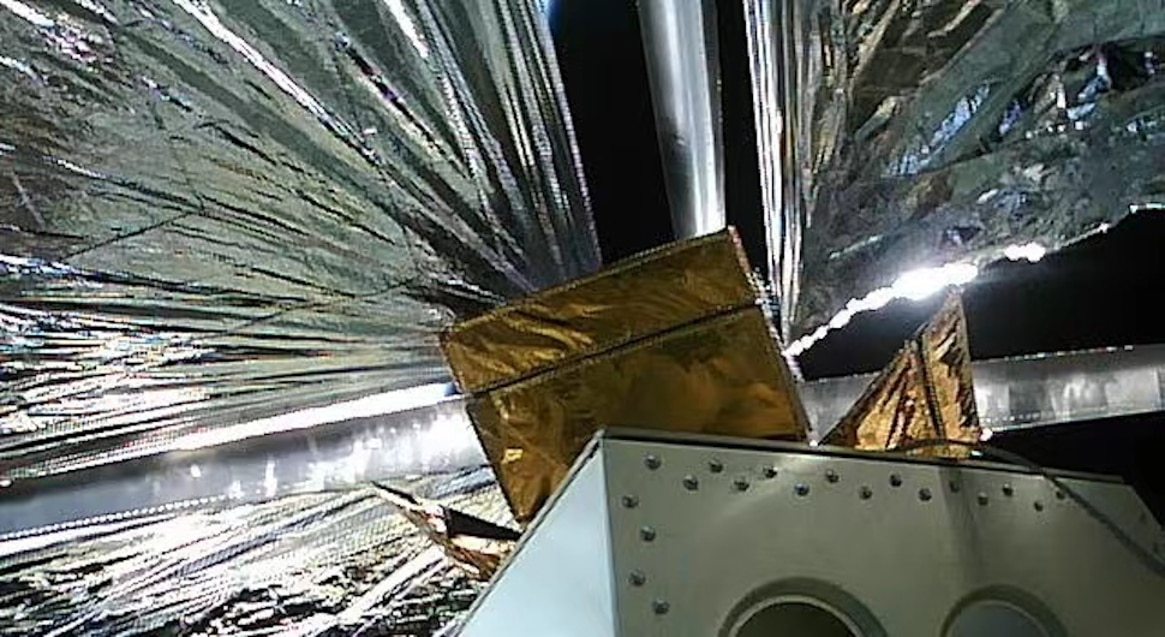
China’s drag sail is designed to help deorbit the Long March 2D rocket within two years. (Image Credit: Shanghai Academy of Spaceflight Technology)

On June 24th, China launched its Long March 2D rocket from Xichang Satellite Launch Center to deploy three Yaogan 35 series satellites in orbit. Now, the country is attempting to remove the 661-pound 2D rocket from the Earth’s orbit within two years to reduce space junk. In that case, the Shanghai Academy of Spaceflight Technology (SAST), the rocket’s maker, also deployed a 269-square foot large drag sail equipped on the rocket’s payload adapter the next day after the initial launch.

Both the adapter and kite-like sail are expected to descend faster than the rocket’s upper stage over the next few years. This sail increases atmospheric drag and accelerates the rocket’s final stage orbital decay. Removing more space junk from orbit helps to eliminate collisions that would otherwise produce even more space debris. 

Space debris has become a major issue for space activities. According to the European Space Agency’s Space Debris Office, 31,360 space junk objects being tracked by space surveillance networks currently orbit the Earth. Statistical models also estimate that approximately one million pieces of space junk ranging from 0.4 inches to 4 inches wide and 130 million objects measuring 0.04 inches to 0.4 inches currently orbit the Earth.

Due to their low cost and advanced technology, drag sails could serve as a solution for removing space debris in the long run. They could be deployed to deorbit various low-Earth satellites. Extremely flexible and lightweight, drag sails can be folded and mounted on a spacecraft. Afterward, these unfold near a mission’s end, helping to remove the object from orbit quicker than its natural process.

In such cases, a 33-pound satellite stationed 700km above the Earth may stay in place for 120 years after expiring. With a 2 square meter drag sail, that time could be reduced to under ten years.

Have a story tip? Message me at: http://twitter.com/Cabe_Atwell

  • Sign in to reply
element14 Community

element14 is the first online community specifically for engineers. Connect with your peers and get expert answers to your questions.

  • Members
  • Learn
  • Technologies
  • Challenges & Projects
  • Products
  • Store
  • About Us
  • Feedback & Support
  • FAQs
  • Terms of Use
  • Privacy Policy
  • Legal and Copyright Notices
  • Sitemap
  • Cookies

An Avnet Company © 2025 Premier Farnell Limited. All Rights Reserved.

Premier Farnell Ltd, registered in England and Wales (no 00876412), registered office: Farnell House, Forge Lane, Leeds LS12 2NE.

ICP 备案号 10220084.

Follow element14

  • X
  • Facebook
  • linkedin
  • YouTube