


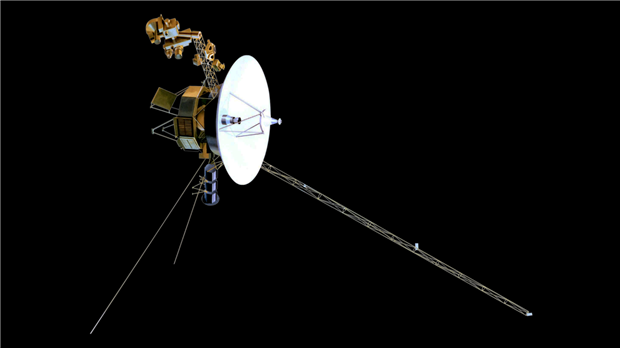
NASA’s Voyager 2 spacecraft crossed into interstellar medium on November 5, 2018. (Image Credit: NASA)
Last year, on November 5, 2018, Voyager 2 crossed the heliopause, becoming the 2nd man-made spacecraft to leave the heliosphere, the protective bubble of particles and magnetic fields created by the Sun. Located at 11 billion miles from Earth, instruments aboard Voyager 2 were able to take measurements of the particles and magnetic fields as it crossed into interstellar space. On November 4th, scientists published five new research papers (1, 2, 3, 4, 5) in the journal Nature Astronomy that describes what was observed during Voyager 2’s crossing.
Both Voyager probes had launched in 1977, with each spacecraft containing a similar set of instruments observing the outer solar system. To this day, after 40 years of space-travel, the probes are still operating well enough to measure cosmic rays from the Sun and interstellar space, properties of nearby charged particles, the local magnetic field, and only Voyager 2 can measure the energy of the local plasma. The data collected from both probes can give scientists an idea of what is going on in the interstellar medium.
It was difficult to determine when Voyager 1 had crossed the heliopause back in August 2012 because the plasma instrument aboard the probe hasn’t been functioning properly. This made it impossible for scientists to determine when the spacecraft had made the transition from the Sun’s hot plasma to the colder, denser plasma of the interstellar medium. However, based on measurements of the behavior of electrons and magnetic fields, scientists were able to determine that Voyager 1 did cross the heliopause
Meanwhile, Voyager 2’s crossing into interstellar space last year was confirmed by its plasma instruments taking measurements of the region and providing scientists with a first direct view of the transition, along with a 20-fold increase in the density of the plasma, as stated in one of the papers in Nature Astronomy. The plasma’s density is similar as the densities of the plasma inferred by Voyager 1’s team, with some slight differences due to each probe being in a different location.
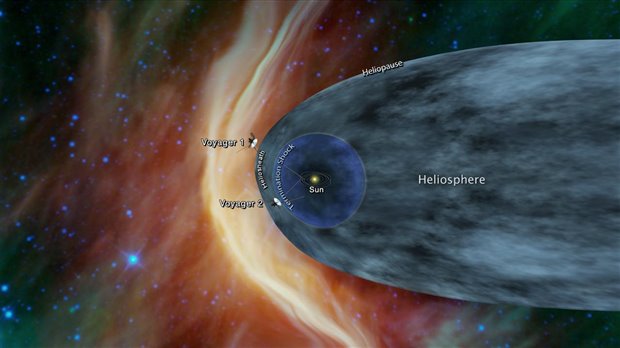
The helio chart shows where Voyager 1 and Voyager 2 are located after crossing the heliopause. (Image Credit: NASA /JPL-Caltech)
Their crossings into interstellar space took place in almost the exact same location. Voyager 1 crossed the heliopause at a location of 121.6 astronomical units, whereas Voyager 2 crossed at 119 astronomical units. It doesn’t seem like the heliopause changes much in different parts of the sky, which can be confirmed due to the plasma densities changing at similar distances, regardless of the probes being over 150 astronomical units apart from each other.
There are also differences between both probes. While Voyager 2 discovered the magnetic fields have a continuous change when crossing the heliopause, Voyager 1 didn’t find any changes. There was also an immediate increase in the amount of high-energy cosmic rays, even though Voyager 2 detected lower-energy particles from the Sun. These measurements are important to astronomers because it helps them have a better understanding of space in general, especially where other stars may have a similar heliopause between its heliosphere and the interstellar medium.
The Voyager probes only have at least 5 years left of life in them, and scientists are discussing ways to preserve the remaining power. Researchers hope to gain a better understanding of the further depths of the interstellar medium, at a distance from where solar particles escape from the heliosphere. They also want to have a better understanding of the shape of the heliopause, which is supposed to have a long comet-like tail. Evidence of such a tail has not been discovered yet.
Scientists will be working on getting everything they can out of the probes before they run out of power. An opportunity to study the interstellar medium and beyond won’t come again anytime soon, since it takes decades to reach that region of space.
Have a story tip? Message me at: cabe(at)element14(dot)com
