


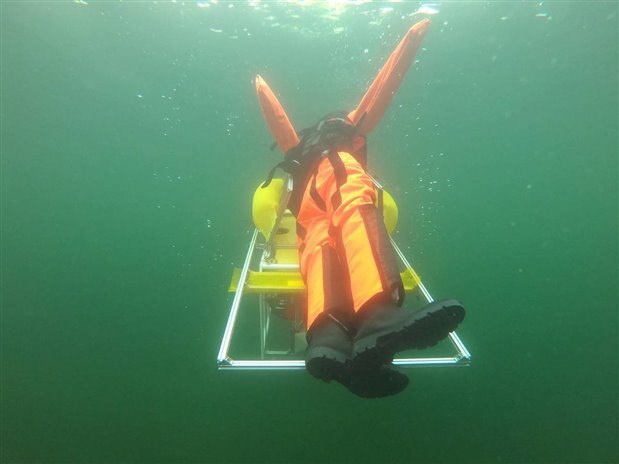
The 80-kg dummy stay secured in the bot while it was being lifted to the surface. (Image Credit: S.Thomas (Wasserwacht Halle)
Many of Germany’s swimming pools have shut down due to the shortage of lifeguards. Researchers at the Fraunhofer Institute for Optronics, System Technologies and Image Exploitation (ISOB) have developed an underwater rescue robot to prevent people from drowning. The aquatic robot, called DEDAVE, works alongside lifeguards and rescue swimmers in emergencies. This autonomous system was developed using years of underwater robotics expertise.
According to the German life-saving association, the Deutsche Lebens-Rettungsgesellschaft (DLRG), almost 420 people drowned in Germany in 2019. Most drownings occurred in freshwater lakes, while victims suffered fatal accidents in swimming pools.
“There are typical postures that you can use to recognize when someone is in danger,” says computer scientist Helge Renkewitz, who led the project in collaboration with Wasserrettungsdienst Halle e.V.
Surveillance cameras mounted on the ceiling allow the robot to recognize a person’s posture when they’re in danger. The cameras register the movement patterns and position of someone drowning. Coordinates are then sent to the robot, which is stored in a docking station floor of the swimming pool. During an emergency, the docking station opens up, and the robot locates the drowning victim. Once found, it carries them to the surface. A mechanism positions the victim in place, preventing them from sliding down as the robot surfaces. Other underwater vehicles can be equipped with this mechanism.
Drones and zeppelin systems act as surveillance cameras at swimming lakes where visibility is restricted. “These drones and advertising balloons can easily be fitted with cameras,” says Renkewitz. An underwater vehicle needs to be fitted with acoustic sensors to perform rescue operations. A person’s position and orientation can be determined from their sound wave echoes, allowing the robot to move to the target and bring them to safety.

The aquatic robot safely brings the dummy to shore, a 40-meter journey. (Image Credit: S.Thomas (Wasserwacht Halle)
Researchers tested their robot at the Hufeisensee lake in Halle (Saale). They submerged an 80-kilogram dummy at a depth of 3 meters. Afterward, the robot picked it up, secured it, resurfaced with it in one second, and carried it 40 meters to shore, where a rescue team was waiting. A signal is sent to the team when the robot is notified of an emergency. “The full rescue operation lasted just over two minutes. Casualties must be resuscitated within five minutes to avoid long-term damages of the brain. We were able to stay within this critical time frame without any problems,” says Renkewitz.
This robot is 90 centimeters long, 50 centimeters tall, and 50 centimeters wide. It’s also equipped with batteries, a motor, cameras, and optical and navigational sensors. The team wants to scale-down the current rescue system and develop different types for swimming pools and lakes. Their goal is to make the system smaller, lighter, and less costly than the prototype, which is based on a pre-existing underwater vehicle. The final version is expected to have a manta ray design.
The aquatic robot can also perform other tasks, including offshore and dam wall inspections and monitor fish health in fish farms. “Our underwater vehicles have a very broad range of applications. For example, they are also suitable for detecting and verifying archaeological artefacts at the bottom of lakes,” the researchers say.
Have a story tip? Message me at: http://twitter.com/Cabe_Atwell
Top Comments