


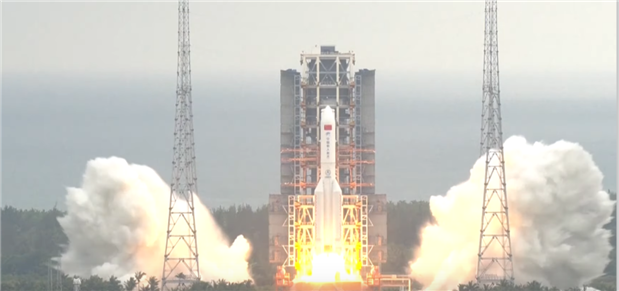
The Long March 5B rocket launched China's first core module Tianhe space station from Wenchang on Thursday local time. (Image Credit: CCTV)
After its launch of the 22.5-metric-ton Tianhe space station module from Wenchang on Thursday local time, China's 18 metric tons Long March 5B rocket is uncontrollably re-entering the Earth's atmosphere. It's unpredictably crashing in a few days. Tianhe successfully entered its planned orbit, ranging between 340km and 450km above Earth, after separating from the launcher's core stage. The US Space Command is monitoring the 30-meter long rocket, which would be the largest space debris falling to Earth.
However, nobody knows where the debris could crash. According to its orbit, some potential sites are anywhere in a band of latitudes a little farther north than New York, Madrid, and Beijing and as far south as southern Chile and Wellington, New Zealand.
The rocket, one of the newest and heaviest in the Chinese fleet, uses a core stage along with four-side boosters to put a payload into low-Earth orbit. The core booster that launched Tianhe did not perform its deorbit burn, which would have made its reentry more predictable and controlled. This incident occurred one year after Long March 5B's prototype crashed into the Atlantic Ocean while its debris landed near Côte d'Ivoire in West Africa. Had this occurred 15-30 minutes earlier, the debris could have landed in the United States.
The previous Long March 5B launch, which placed an unscrewed module into Low Earth orbit, was the biggest uncontrolled reentry in decades and the fourth biggest of all time. The rocket's core stage is seven times larger than the Falcon 9 second stage that made reentry above Seattle and dropped pressure tanks on Washington State.
There were also speculations surrounding the Long March 5B rocket having self deorbit capabilities through active maneuverability, but that didn't occur. During a Wenchang press conference, Wang Jue, Commander-in-Chief of Long March 5B launch vehicle, said that improvements were implemented on the second rocket but did not state anything about a deorbit maneuver.
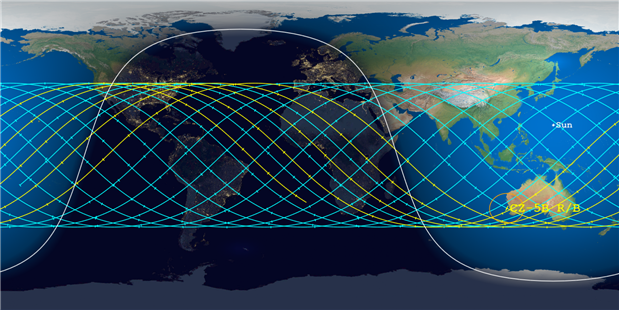
The rocket was predicted to land somewhere off the western Australia coast. This could change once more data comes in. (Image Credit: Aerospace Corporation)
At this point, it's impossible to predict where and when the Long March 5B stage lands. Upon reentry, its orbital decay increases while the atmospheric drag brings it down, making it denser. How quickly this process occurs depends on the debris's size and density. Influenced by solar activity, the atmospheric variations and fluctuations also play a role in this. The rocket travels 7 kilometers per second, making it more difficult to predict where it's heading while orbiting the Earth approximately every 90 minutes. If there is a change in reentry time by just a few minutes, it means that a reentry point takes place thousands of kilometers away. Pinpointing the rocket's exact position is thwarted by gaps in radar or telescope tracking.
Since the rocket's core stage has a 41.5-degree orbital inclination, the rocket body passes a bit farther north than New York, Madrid, Beijing, and as far south as southern Chile and Wellington, New Zealand. The debris could potentially survive the atmosphere's intense heat upon reentry and crash into oceans or uninhabited land, but it's still a danger to humans or property.
Have a story tip? Message me at: http://twitter.com/Cabe_Atwell