


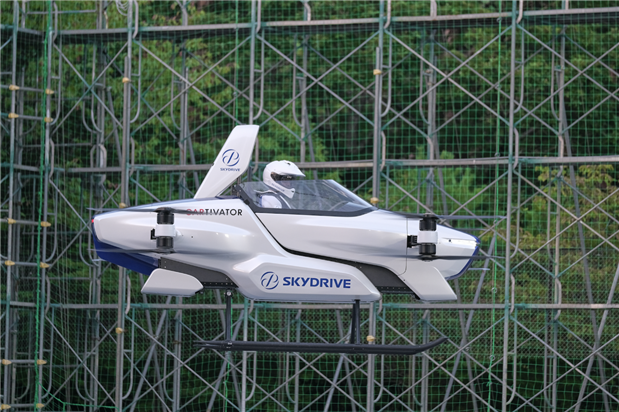
SkyDrive’s flying eVTOL car stayed airborne for 10 minutes, lifted ten feet in the air. (Image credit: SkyDrive)
It’s 2020, and we still don’t have the flying cars and hoverboards as promised to us by The Jetsons and Back to the Future. While we still don’t have hoverboards (those motorized versions don’t count), one Japanese company may get us closer to flying cars. SkyDrive recently announced it had finished a test flight using “the world’s first manned testing machine,” its SD-03 model, an electrical vertical takeoff and landing (eVTOL) vehicle.
Looking like a cross between a miniature helicopter and an airplane with only one seat. The aircraft can stay airborne for four minutes using its eight motors and two propellers on each corner. During its test flight, it flew about 10 feet into the air while operated by a pilot. According to the company, technical staff monitored conditions to ensure flight stability and safety.
“We are extremely excited to have achieved Japan’s first-ever manned flight of a flying car in the two years since we founded SkyDrive in 2018 with the goal of commercializing such an aircraft,” SkyDrive CEO Tomohiro Fukuzawa said.
“We want to realize a society where flying cars are an accessible and convenient means of transportation in the skies, and people are able to experience a safe, secure, and comfortable new way of life,” he added.
Currently, the aircraft can only fly for 10 minutes, but according to Fukuzawa, if the time can be increased to 30 minutes, it will have greater potential. Though they’re not ready for the masses just yet, the company believes consumers will love the new mode of transportation as it offers quick personal travel. If you’re interested in one, hopefully, you have deep pockets. SkyDrive plans to sell a two-seat version for about $300,000 to $500,000. Fukuzawa projects the price will drop by 2030.
But before the SD-03 starts overcrowding the skies, there are still several challenges to overcome. Issues concerning battery sizes, air traffic control, safety, and design prevent the aircraft from being commercialized. The company didn’t specify how they will address these issues, but they hope the SD-03 will be operating with “full autonomy” by 2030.
Have a story tip? Message me at: cabe(at)element14(dot)com