


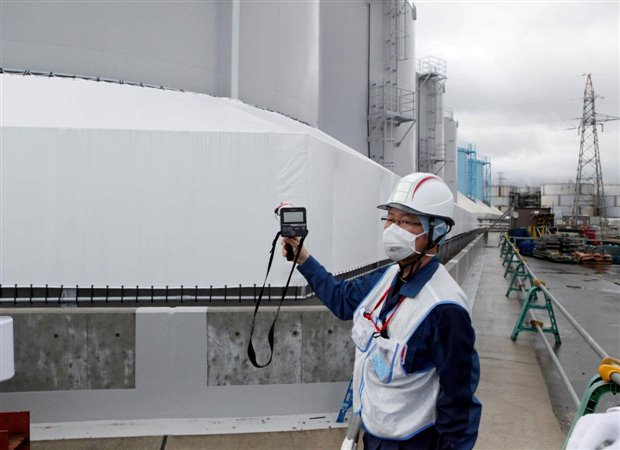
The Japanese government is expected to make a decision on disposing of the wastewater from the storage tanks at the Fukushima Daiichi nuclear power plant. (Image Credit: Reuters)
Japanese fish industry representatives recently opposed releasing Fukushima radioactive tritium wastewater into the ocean. The water is stored in tanks at the Tokyo Electric Power Fukushima Daiichi nuclear plant, which is expected to run out of extra storage space by October 2022. It usually requires two years of preparation to release radioactive water.
"We are dead against a release of contaminated water to the ocean as it could have a catastrophic impact on the future of Japan's fishing industry," Hiroshi Kishi, president of JF Zengyoren, said at a government hearing in Tokyo.
Earlier this year, experts advised Japan's government to release the radioactive water into the ocean. Discussions with local governments and businesses on this issue were held since April. The seventh hearing, involving the Ministry of Economy, Trade and Industry, took place on October 8th and has received feedback from JF Zengyoren, the federation of fisherman cooperatives.
The water underwent treatment to eliminate major radioactive substances. However, it still has some tritium in it. Water contaminated with tritium is often released into the ocean by nuclear plants around the world. The International Atomic Energy Agency stated that discharging it into the ocean is one of two options. It's also frequently used by operating nuclear power plants and fuel cycle facilities in Japan and worldwide.
The problem at the Fukushima nuclear power plant is that the water flowed through a contaminated reactor. To prevent it from further harming the community's reputation damaged by the 2011 accident, the wastewater is stored on-site. If water contaminated with tritium gets released into the ocean, it could significantly harm the community, and all the efforts the fishing industry has made wouldn't amount to anything.
Fishermen who operate along the coast of Fukushima have to deal with fishing restrictions, resulting in an annual catch of 3,600 tonnes in 2019, which is 14% of the levels prior to the accident. Fukushima Prefectural Federation of Fisheries Cooperative Associations aims to continue full-scale operations in April 2021.
Currently, 1.23 million tonnes of wastewater is being stored in 1,000 tanks on the nuclear plant site. Additional tanks arriving this year are expected to increase the storage capacity to 1.37 million tonnes. The government is also hoping to get support from the fishing federation and other affected parties. "We want to make a responsible decision on disposal as soon as possible," Prime Minister Yoshihide Suga said.
Alternatively, the tainted water could be evaporated into the air or released into the ocean after dilution.
Additionally, Japan is putting together plans to compensate for those suffering from reputational harm. A decision on disposing of the wastewater is expected once meetings with the affected parties are complete.
Dumping it in all the ocean seems so irresponsible. Sharing the problem with the world, I suppose.
Have a story tip? Message me at: cabe(at)element14(dot)com
