


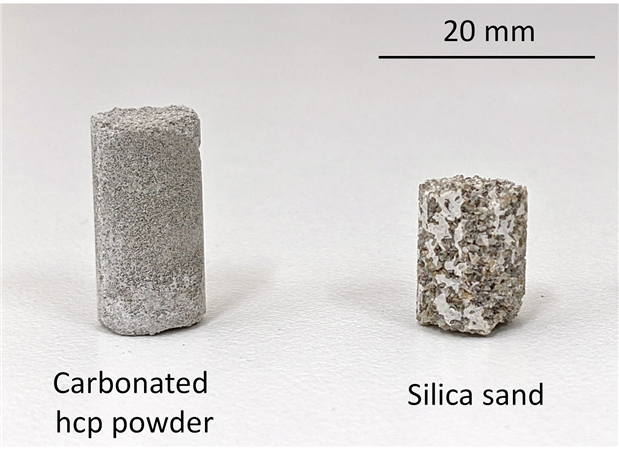
This image shows two calcium carbonate concrete samples. The left sample uses hardened cement paste, while the right sample uses silica sand. (Image Credit: Maruyama et al.)
Researchers at the University of Tokyo produced a new concrete called calcium carbonate concrete (CCC) that could reduce construction industry emissions. The team achieved this by combining concrete waste and captured carbon dioxide, forming a reusable type of concrete. The entire process was inspired by aquatic organisms hardening into fossils over time.
“Our concept is to acquire calcium from discarded concrete, which is otherwise going to waste,” said Professor Ippei Maruyama Maruyama. “We combine this with carbon dioxide from industrial exhaust or even from the air. And we do this at much lower temperatures than those used to extract calcium from limestone at present.”
Around 7% of the world’s CO2 emissions are sourced from manufacturing and using cement, concrete’s main ingredient. Additionally, most of these emissions come from essentially using calcium, which is retrieved by burning limestone. Since CCC is permanently carbon-neutral, it can be recycled for production and utilization, and it significantly contributes to solving global warming and resource depletion issues.
Also, CCC doesn’t cause damage to the environment because it’s made of resources collected from nature. This results in a sustainable material that can be produced forever.
According to the team’s report, Japan has accumulated an estimated 100 billion tons of concrete. The country produces approximately 40 to 100 million tons of concrete waste per year.
Calcium carbonate rocks and calcium-containing industrial waste, including gypsum, were also mentioned in the study as sources of calcium. Although calcium carbonate concrete could be a stable and ecologically friendly material, it cannot replace conventional concrete at this time. That’s because it’s not as strong as ordinary concrete, and the team produced only a few blocks measuring a few centimeters in diameter. Currently, CCC has a compressive strength of less than 10MPa, which is 1/4 to 1/3 of conventional concrete’s compressive strength. This means that CCC can be used for small housing. The team is also exploring ways for CCC to obtain a 15 to 20 MPa compressive strength after one year.
"It is exciting to make progress in this area, but there are still many challenges to overcome," said Professor Takafumi Noguchi. "As well as increasing the strength and size limits of calcium carbonate concrete, it would be even better if we could further reduce the energy use of the production process. However, we hope that in the coming decades, carbon-neutral calcium carbonate concrete will become the mainstream type of concrete and will be one of the solutions to climate change."
There are still some challenges the team needs to overcome before using CCC. For example, they need to increase the material’s size and strength. Furthermore, traditional cement concrete is alkaline, which means that internal steel bars are protected from corrosion. Since CCC is neutral, reinforcing steel bars need protection against corrosion. Otherwise, other materials rather than steel will need to be utilized for reinforcement. CCC structures need to provide the same structural safety and functions as traditional concrete structures.
Have a story tip? Message me at: http://twitter.com/Cabe_Atwell