


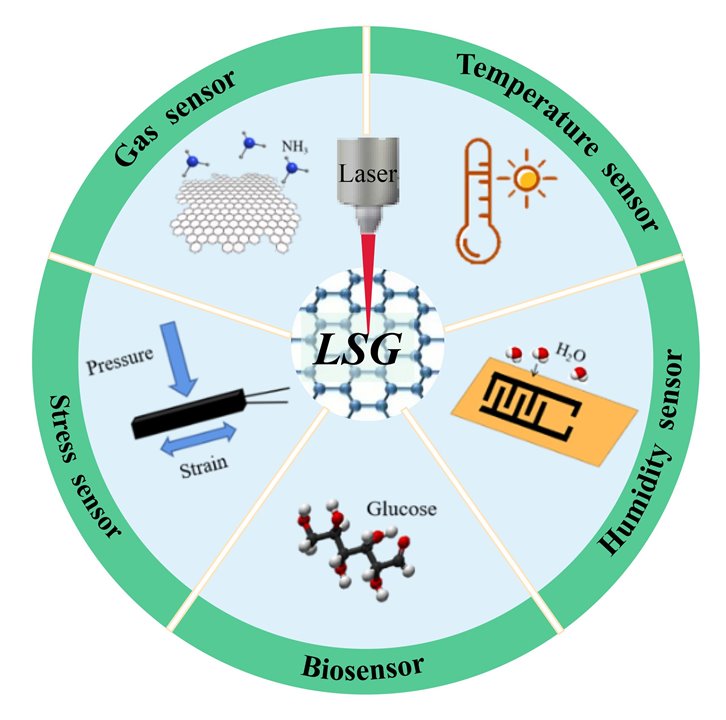
Laser graphene can be used to fabricate bio, gas, temperature, and humidity sensors. (Image Credit: TranSpread)
Graphene is usually prepared via different techniques such as chemical vapor deposition (CVD), epitaxial growth, mechanical exfoliation, and graphene oxide chemical reduction. CVD is more promising for large areas and high-quality graphene preparation. However, it's limited due to the high energy consumption and cost involved. Scientists at the University of Shanghai for Science and Technology introduced laser-scribed graphene (LSG) for sensor fabrication.
Graphene materials have excellent electrical conductivity and optical, physical, thermal, and structural properties. That makes them useful for detecting physical properties like pressure and mechanical strain, chemical substances, and sensing gas, temperature, and humidity.
With its selective/localized reduction, lack of masks and other chemicals, and quick/precise patterning, the laser direct writing method is practical for research applications across various fields. By using a laser, this technique irradiates the carbon precursors and produces graphene via in-situ scribing. It only takes minutes to perform this laser scribing process, making the graphene preparation more efficient.
We often see LSG films used in energy storage, memristors, photodetectors, sensing holography, antennas, and antibacterial applications. That's because it has excellent properties of high thermal stability, high electrical conductivity, and high surface area.
The team believes the LSG preparation and modification can be achieved through different laser light sources and precursors. That includes carbon precursors like GO and PI. Meanwhile, preparing graphene is expensive, energy-intensive, and environmentally harmful. Thankfully, those drawbacks are non-existent with the laser scribing technique. Changing the laser parameters, doping, and atmosphere allows the LSG to undergo modifications in one step. It's even suitable for sensor applications since it has a high surface area, good electrical conductivity, and a simple/efficient fabrication process.
More specifically, the LSG could have applications for biosensors, stress sensors, temperature sensors, gas sensors, and humidity sensors. Those sensors' performance can be optimized by using the appropriate scan speed, laser power, scan spacing, and doping during the LSG preparation. Structural designs and patterning can reduce the crosstalk between varying signals in multifunctional sensors. "In particular, the flexible patterned preparation and various flexible substrates make LSG also promising for wearable sensor applications."
Have a story tip? Message me at: http://twitter.com/Cabe_Atwell