


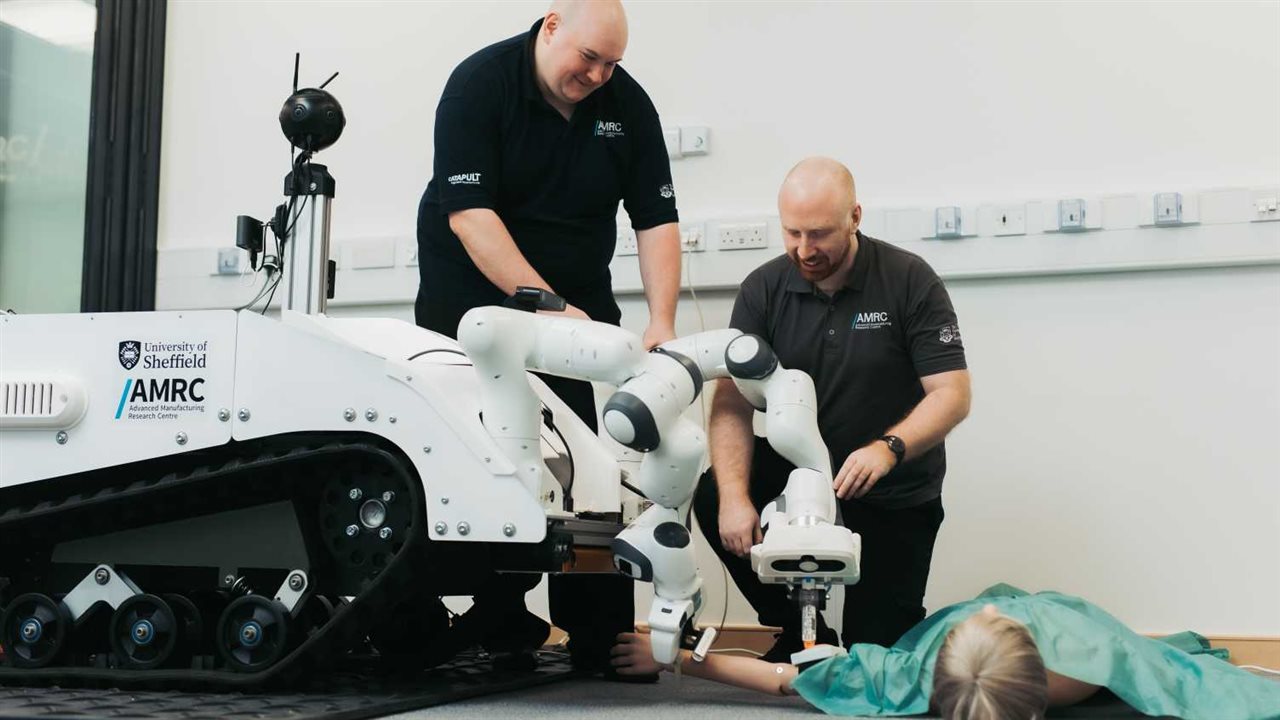
The medical robot developed by Sheffield University has two robotic arms to treat casualties in dangerous places. (Image Credit: SHEFFIELD UNIVERSITY/SWNS)
The University of Sheffield researchers used medical telexistence (MediTel) technology to develop a robot medic for performing procedures on humans where it’s too dangerous for doctors to access, like war zones and humanitarian disasters. The robotic-controlled unscrewed ground vehicle (UGV) features virtual reality so doctors can determine the casualty’s blood pressure, temperature, and heart rate and provide treatments without putting themselves in harm’s way.
It took nine months for the team to build this first-ever medical telexistene system. The two robotic arms are remotely controlled by a medic or doctor to use medical tools to assess a casualty’s heart rate, blood pressure, and temperature in just 20 minutes. It’s also capable of using an auto-injector to deliver pain relief medication and perform abdominal palpation while transmitting real-time data back to the remote operator.
“Developing and field testing a state-of-the-art, complex system such as MediTel in just nine months has been an incredible achievement and a testament to the skills and capabilities of the entire project team,” said David King, Head of Digital Design at the AMRC. “MediTel combined existing medical devices with state-of-the-art robotics systems to develop a platform capable of allowing a remote operator to navigate through potentially difficult terrain and provide critical diagnoses of high-risk casualties.”

The robot comes with virtual reality, allowing doctors to look at a casualty’s blood pressure, temperature, and heart rate and provide treatments. (Image Credit: SHEFFIELD UNIVERSITY/SWNS)
“This project has allowed us the opportunity to develop a platform that could be used by multiple emergency response services,” said Sanja Dogramadzi, Professor of Medical Robotics and Intelligent Health Technologies at the University’s Department of Automatic Control and Systems Engineering and Director of Sheffield Robotics. “It now serves us with the basis for our research to be extended and look into enabling resilient autonomy and integrating other sensing modalities to assist patient triage in other remote settings.”
MediTel received funds via a two-phase $3 million innovation competition hosted by the Defence and Security Accelerator (DASA) on behalf of joint funders, the Defence Science and Technology Laboratory (Dstl) and the Nuclear Decommissioning Authority (NDA).
“Telexistence technologies have the potential to remove end users from harmful environments and/or rapidly insert specialists as required,” said Dr. Nicky Armstrong, technical lead at Dstl. “The prototype technologies developed under the Dstl Telexistence project have enabled us to demonstrate the art of the possible to end users so that we can better understand where telexistence could add value to [defense] and security environments.”
The researchers are hoping to acquire additional funds and partners for the MediTel technology to help realize its potential as a solution to treat people in hazardous areas. Their goal is to explore developing the technology into a large-scale medical emergency platform that can be quickly deployed to humanitarian disasters with multiple causalities, allowing remote medics to deliver treatment.
Have a story tip? Message me at: http://twitter.com/Cabe_Atwell