
element14 Community
element14 Community
    Register Log In
  • Site
  • Search
  • Log In Register
  • Community Hub
    Community Hub
    • What's New on element14
    • Feedback and Support
    • Benefits of Membership
    • Personal Blogs
    • Members Area
    • Achievement Levels
  • Learn
    Learn
    • Ask an Expert
    • eBooks
    • element14 presents
    • Learning Center
    • Tech Spotlight
    • STEM Academy
    • Webinars, Training and Events
    • Learning Groups
  • Technologies
    Technologies
    • 3D Printing
    • FPGA
    • Industrial Automation
    • Internet of Things
    • Power & Energy
    • Sensors
    • Technology Groups
  • Challenges & Projects
    Challenges & Projects
    • Design Challenges
    • element14 presents Projects
    • Project14
    • Arduino Projects
    • Raspberry Pi Projects
    • Project Groups
  • Products
    Products
    • Arduino
    • Avnet & Tria Boards Community
    • Dev Tools
    • Manufacturers
    • Multicomp Pro
    • Product Groups
    • Raspberry Pi
    • RoadTests & Reviews
  • About Us
  • Store
    Store
    • Visit Your Store
    • Choose another store...
      • Europe
      •  Austria (German)
      •  Belgium (Dutch, French)
      •  Bulgaria (Bulgarian)
      •  Czech Republic (Czech)
      •  Denmark (Danish)
      •  Estonia (Estonian)
      •  Finland (Finnish)
      •  France (French)
      •  Germany (German)
      •  Hungary (Hungarian)
      •  Ireland
      •  Israel
      •  Italy (Italian)
      •  Latvia (Latvian)
      •  
      •  Lithuania (Lithuanian)
      •  Netherlands (Dutch)
      •  Norway (Norwegian)
      •  Poland (Polish)
      •  Portugal (Portuguese)
      •  Romania (Romanian)
      •  Russia (Russian)
      •  Slovakia (Slovak)
      •  Slovenia (Slovenian)
      •  Spain (Spanish)
      •  Sweden (Swedish)
      •  Switzerland(German, French)
      •  Turkey (Turkish)
      •  United Kingdom
      • Asia Pacific
      •  Australia
      •  China
      •  Hong Kong
      •  India
      •  Korea (Korean)
      •  Malaysia
      •  New Zealand
      •  Philippines
      •  Singapore
      •  Taiwan
      •  Thailand (Thai)
      • Americas
      •  Brazil (Portuguese)
      •  Canada
      •  Mexico (Spanish)
      •  United States
      Can't find the country/region you're looking for? Visit our export site or find a local distributor.
  • Translate
  • Profile
  • Settings
Industrial Automation
  • Technologies
  • More
Industrial Automation
Blog Metal scrapping through wastewater?
  • Blog
  • Forum
  • Documents
  • Quiz
  • Events
  • Polls
  • Files
  • Members
  • Mentions
  • Sub-Groups
  • Tags
  • More
  • Cancel
  • New
Join Industrial Automation to participate - click to join for free!
  • Share
  • More
  • Cancel
Group Actions
  • Group RSS
  • More
  • Cancel
Engagement
  • Author Author: Catwell
  • Date Created: 7 Dec 2020 7:10 PM Date Created
  • Views 708 views
  • Likes 2 likes
  • Comments 1 comment
  • recovery
  • metal scrapping
  • on_campus
  • recycle
  • cabeatwell
  • metal
  • university
  • innovation
Related
Recommended

Metal scrapping through wastewater?

Catwell
Catwell
7 Dec 2020

image

Researchers have developed a new technology that targets and captures copper in contaminated wastewater.


Decontaminating wastewater polluted with heavy metals is complex, expensive, and usually involves a slow-paced process.  Scientists at the Department of Energy’s Lawrence Berkeley National Laboratory have developed a material that targets and captures copper ions from wastewater with unmatched precision and speed. Their prototype exhibits how metals could be sourced from water while providing a more affordable water treatment solution.


“Today’s water treatment systems are ‘bulk separation technologies’ – they pull out all solutes, irrespective of their hazard or value,” says Peter Fiske, co-author of the research. “Highly selective, durable materials that can capture specific trace constituents without becoming loaded down with other solutes, or falling apart with time, will be critically important in lowering the cost and energy of water treatment. They may also enable us to ‘mine’ wastewater for valuable metals or other trace constituents.”


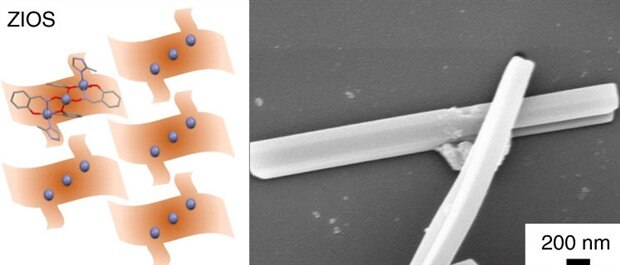
Called ZIOS (zinc imidazole salicylaldoxmine), the crystalline material is inspired by how bacterial cells select specific metals to regulate their metabolism. The material’s durability allows it to be used in acidic water sourced from a copper mine. The copper can be removed once it fills up the material, which can be reused. Scientists chose copper because it’s easier to target.


A schematic diagram (left) shows a ZIOS network and an SEM (scanning electron microscopy) image of a ZIOS-copper sample on a silicon wafer. (Image Credit: Berkeley Lab)image
 

“It’s kind of like a crystal sponge,” says Jeff Urban, senior author of the journal article. “When you put it into water, it opens up. Instead of grabbing everything, this is a sponge that’s very specific to copper because of the size of the pores and the stickiness of the pores for copper.”


ZIOS consists of tiny channels that expand when the material is submerged in water. When these channels widen, water molecules can flow through the structure. From there, a chemical reaction occurs, which binds the material with copper ions that are present in the liquid.


In their X-ray experiments, the scientists discovered that the material is extremely selective when it binds to copper ions in water that has the same pH levels as mining wastewater. It does this with remarkable efficiency. “ZIOS has a high adsorption capacity and the fastest copper adsorption kinetics of any material known so far – all in one,” Jeff Urban, senior author, said.


The team says ZIOS is capable of selectively trapping copper ions at 30 to 50 times the speed of existing state-of-the-art solutions. It also stays incredibly stable after being immersed in water for up to 52 days. When it’s removed from the water, it returns to its original size in one nanosecond.


According to the team, ZIOS is a type of blueprint for wastewater treatment. This is the first technology that’s capable of removing heavy metal ions with atomic-level precision. It can also be designed to capture other metals in water.


“We view this as kind of a template for an overall strategy for doing targeted and precision separations,” Urban says. Eventually, wastewater treatment plants could use filters to capture various materials at the same time, putting each material in a different channel. It could also become the source for new materials without the environmental impacts of mining.


This new technology is quicker and less expensive than other techniques that remove pollutants.  “The starting materials are cheap,” he says. “And it has a good lifetime, so you’re not paying to replace it.”


Have a story tip? Message me at: http://twitter.com/Cabe_Atwell

  • Sign in to reply

Top Comments

  • 14rhb
    14rhb over 4 years ago +1
    Interesting. I wonder if this could rejuvenate Ferric Chloride used in PCB etching by removing the spent copper ?
  • 14rhb
    14rhb over 4 years ago

    Interesting. I wonder if this could rejuvenate Ferric Chloride used in PCB etching by removing the spent copper ?

    • Cancel
    • Vote Up +1 Vote Down
    • Sign in to reply
    • More
    • Cancel
element14 Community

element14 is the first online community specifically for engineers. Connect with your peers and get expert answers to your questions.

  • Members
  • Learn
  • Technologies
  • Challenges & Projects
  • Products
  • Store
  • About Us
  • Feedback & Support
  • FAQs
  • Terms of Use
  • Privacy Policy
  • Legal and Copyright Notices
  • Sitemap
  • Cookies

An Avnet Company © 2025 Premier Farnell Limited. All Rights Reserved.

Premier Farnell Ltd, registered in England and Wales (no 00876412), registered office: Farnell House, Forge Lane, Leeds LS12 2NE.

ICP 备案号 10220084.

Follow element14

  • X
  • Facebook
  • linkedin
  • YouTube