element14 Community
element14 Community
    Register Log In
  • Site
  • Search
  • Log In Register
  • Community Hub
    Community Hub
    • What's New on element14
    • Feedback and Support
    • Benefits of Membership
    • Personal Blogs
    • Members Area
    • Achievement Levels
  • Learn
    Learn
    • Ask an Expert
    • eBooks
    • element14 presents
    • Learning Center
    • Tech Spotlight
    • STEM Academy
    • Webinars, Training and Events
    • Learning Groups
  • Technologies
    Technologies
    • 3D Printing
    • FPGA
    • Industrial Automation
    • Internet of Things
    • Power & Energy
    • Sensors
    • Technology Groups
  • Challenges & Projects
    Challenges & Projects
    • Design Challenges
    • element14 presents Projects
    • Project14
    • Arduino Projects
    • Raspberry Pi Projects
    • Project Groups
  • Products
    Products
    • Arduino
    • Avnet & Tria Boards Community
    • Dev Tools
    • Manufacturers
    • Multicomp Pro
    • Product Groups
    • Raspberry Pi
    • RoadTests & Reviews
  • About Us
  • Store
    Store
    • Visit Your Store
    • Choose another store...
      • Europe
      •  Austria (German)
      •  Belgium (Dutch, French)
      •  Bulgaria (Bulgarian)
      •  Czech Republic (Czech)
      •  Denmark (Danish)
      •  Estonia (Estonian)
      •  Finland (Finnish)
      •  France (French)
      •  Germany (German)
      •  Hungary (Hungarian)
      •  Ireland
      •  Israel
      •  Italy (Italian)
      •  Latvia (Latvian)
      •  
      •  Lithuania (Lithuanian)
      •  Netherlands (Dutch)
      •  Norway (Norwegian)
      •  Poland (Polish)
      •  Portugal (Portuguese)
      •  Romania (Romanian)
      •  Russia (Russian)
      •  Slovakia (Slovak)
      •  Slovenia (Slovenian)
      •  Spain (Spanish)
      •  Sweden (Swedish)
      •  Switzerland(German, French)
      •  Turkey (Turkish)
      •  United Kingdom
      • Asia Pacific
      •  Australia
      •  China
      •  Hong Kong
      •  India
      • Japan
      •  Korea (Korean)
      •  Malaysia
      •  New Zealand
      •  Philippines
      •  Singapore
      •  Taiwan
      •  Thailand (Thai)
      • Vietnam
      • Americas
      •  Brazil (Portuguese)
      •  Canada
      •  Mexico (Spanish)
      •  United States
      Can't find the country/region you're looking for? Visit our export site or find a local distributor.
  • Translate
  • Profile
  • Settings
Industrial Automation
  • Technologies
  • More
Industrial Automation
Blog MIT researchers develop a robot that helps people get dressed
  • Blog
  • Forum
  • Documents
  • Quiz
  • Events
  • Polls
  • Files
  • Members
  • Mentions
  • Sub-Groups
  • Tags
  • More
  • Cancel
  • New
Join Industrial Automation to participate - click to join for free!
  • Share
  • More
  • Cancel
Group Actions
  • Group RSS
  • More
  • Cancel
Engagement
  • Author Author: Catwell
  • Date Created: 14 Apr 2022 6:19 PM Date Created
  • Views 1628 views
  • Likes 5 likes
  • Comments 2 comments
  • industrial
  • hmi
  • robotics
  • robot
  • on_campus
  • cabeatwell
  • university
Related
Recommended

MIT researchers develop a robot that helps people get dressed

Catwell
Catwell
14 Apr 2022

image

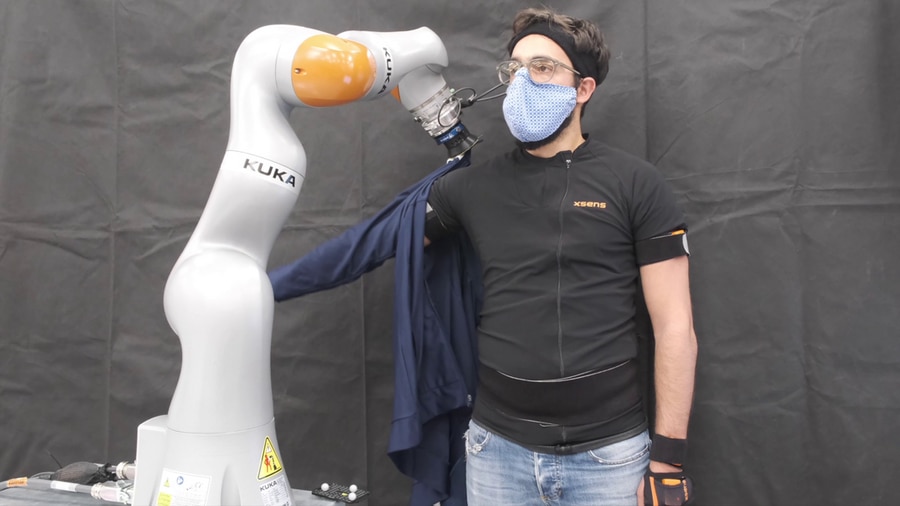
The robot can dress a human without seeing the arm during the process. (Image Credit: MIT CSAIL)

We all know robots possess excellent capabilities for everyday tasks that humans cannot perform due to limitations or difficulty. For instance, they can lift heavy objects or assemble products, such as watches requiring components too small for humans to see. MIT researchers developed a robot that can help people get dressed in sleeved clothing, building on last year’s work involving robot-assisted dressing without sleeves.

However, the main issue the robot faced was visual obstruction. “The robot cannot see the human arm during the entire dressing process,” Shen Li, a Ph.D. candidate in the MIT Department of Aeronautics and Astronautics, says. As a result, the robot cannot determine exactly how much force it should exert to pull the cloth from hand to shoulder.

To overcome the vision obstruction issue, the researchers developed a “state estimation algorithm,” which contains machine learning, allowing the robot to guess the elbow’s location and arm’s position. In this case, it can determine if it extends straight out, bends at the elbow, points upwards, downwards, or sideways. The robot’s measurement of the force applied to the cloth is fed to the algorithm, which then surrounds the elbow within a box, estimating its position.

The robot can then use this data to move safely. “If the arm is straight, then the robot will follow a straight line; if the arm is bent, the robot will have to curve around the elbow,” Theodoros Stouraitis, a visiting scientist in the Interactive Robotics Group at MIT’s Computer Science and Artificial Intelligence Laboratory (CSAIL), says. “If the elbow estimation is wrong, the robot could decide on a motion that would create an excessive, and unsafe, force.”

A dynamic model with arm movement predictability was implemented in the algorithm, which also corrects any predictions by measuring the applied force on a cloth at any given time. This state estimate prediction ensures that the elbow stays within a prescribed box. 

Participants in the project wore “Xsens” suits, which collect data to train the machine learning systems, outfitted with sensors that track and log body movements. Once trained, the robot inferred the elbow orientation while putting the jacket on a human, who moved their arm around during this task. There were instances where the participant randomly moved on his own or in response to the robot tugging on the jacket. Now, the researchers are developing a robot that adjusts its movements as the elbow or arm changes position.

The team plans to work on the personalization issue, allowing their robot to take into account the distinctive ways a person moves. They also want to develop robots capable of working with varying cloth materials, each of which exhibits different responses to pulling.

You don't have permission to edit metadata of this video.
Edit media
x
image
Upload Preview
image

Have a story tip? Message me at: http://twitter.com/Cabe_Atwell

  • Sign in to reply
  • beacon_dave
    beacon_dave over 3 years ago in reply to dougw

    Apparently most people are taught to tie their shoe laces the wrong way, often resulting in a weaker knot rather than a stronger knot. Children tend to find the granny knot version easier to tie than the reef knot version so start with that but then never learn to do it correctly and end up still tying them incorrectly 50 years later.

    So the question for some might be "can you tie your shoelaces ?"

    • Cancel
    • Vote Up 0 Vote Down
    • Sign in to reply
    • More
    • Cancel
  • dougw
    dougw over 3 years ago

    But can it tie my shoe laces?

    • Cancel
    • Vote Up 0 Vote Down
    • Sign in to reply
    • More
    • Cancel
element14 Community

element14 is the first online community specifically for engineers. Connect with your peers and get expert answers to your questions.

  • Members
  • Learn
  • Technologies
  • Challenges & Projects
  • Products
  • Store
  • About Us
  • Feedback & Support
  • FAQs
  • Terms of Use
  • Privacy Policy
  • Legal and Copyright Notices
  • Sitemap
  • Cookies

An Avnet Company © 2026 Premier Farnell Limited. All Rights Reserved.

Premier Farnell Ltd, registered in England and Wales (no 00876412), registered office: Farnell House, Forge Lane, Leeds LS12 2NE.

ICP 备案号 10220084.

Follow element14

  • X
  • Facebook
  • linkedin
  • YouTube