


You can watch live video from the Artemis I on the internet! Just click below:

Or via this URL: https://video.ibm.com/channel/24825473
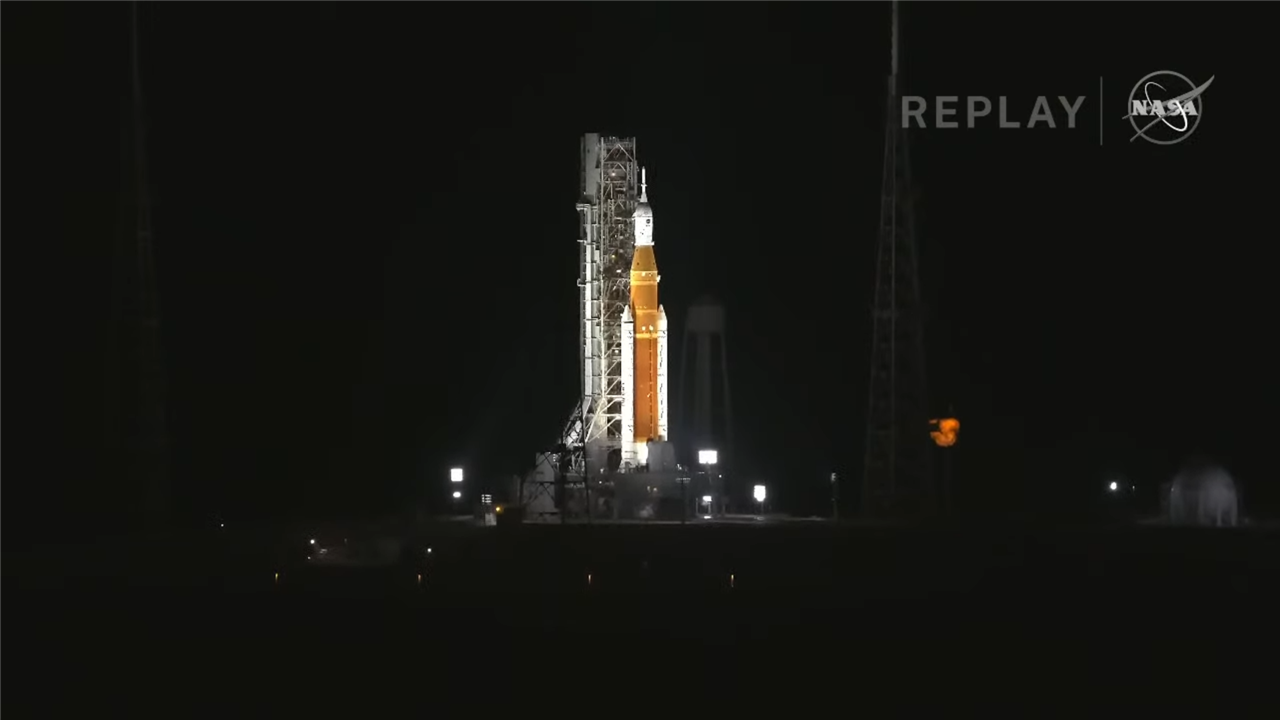
NASA launched the Space Launch Rocket with the Orion capsule perched on top. (Image Credit: NASA/YouTube)
Success!
It finally happened! After countless delays, the Artemis I program launched from Kennedy Space Center on Wednesday, November 16th, at 1:47 am EST, reaching 4 million kilograms of thrust and 160 km/h within seconds. It had the Orion capsule mounted atop the Space Launch Rocket and headed to the moon after spending less than two hours in earth's orbit. A successful three-week mission would then see the capsule reach a wide moon orbit and return to earth in December, landing in the Pacific Ocean. In 2024, NASA wants to liftoff four astronauts to a moon orbit while also landing humans on the surface one year later.
This blastoff occurred after problematic hydrogen fuel leaks over three months, preventing the 322-foot rocket from launching sooner as it continually moved back and forth from the hanger to the pad. It also didn't help that Hurricane Ian made landfall at the end of September, forcing NASA to send the rocket back indoors. However, it remained standing as a weak Hurricane Nicole passed through last week with over 80mph wind gusts. Some damage occurred, but the launch went according to plan.
On Tuesday, NASA discovered a new leak during the fuelling process. Thankfully, an emergency team fixed the leak, but that wasn't the only problem. A U.S. Space Force radar station unexpectedly crashed, leading to a quick ethernet switch replacement.
The interim cryogenic propulsion stage finished the 18-minute-long trans-lunar injection burn, and the spacecraft separated from the stage. Orion's auxiliary thrusters fired up, allowing the spacecraft to move at a safe distance away from the expended stage. Now, Orion is flying to the moon. The Orion capsule expects to reach the moon on November 21st, where it will begin orbiting 40,000 miles beyond once it's within an 80-mile range. Overall, the entire flight is planned to last 25 days, the same amount of time astronauts will be aboard the next flight. NASA also hopes to find potential issues by pushing the spacecraft to its limits before astronauts take flight. The space agency took this Artemis I one step further by strapping in three mannequins, otherwise called moonequins according to NASA, with sensors attached for vibration, acceleration, and cosmic radiation measurements.
NASA's goal is to form a moon base and transport astronauts to Mars by the late 2030s or early 2040s. However, it still needs to overcome some challenges. The plan is to fly astronauts to lunar orbit and not land on the surface. Instead, SpaceX's starship will transport astronauts to and from Orion and the lunar surface during the first 2025 trip. Starship and other companies' landers will orbit the moon for the Orion crew members.
Once the test flight is complete, NASA plans to announce the next flight's astronauts and those landing on the lunar surface.
Watch the launch below. It's at the halfway mark...
Have a story tip? Message me at: http://twitter.com/Cabe_Atwell