element14 Community
element14 Community
    Register Log In
  • Site
  • Search
  • Log In Register
  • Community Hub
    Community Hub
    • What's New on element14
    • Feedback and Support
    • Benefits of Membership
    • Personal Blogs
    • Members Area
    • Achievement Levels
  • Learn
    Learn
    • Ask an Expert
    • eBooks
    • element14 presents
    • Learning Center
    • Tech Spotlight
    • STEM Academy
    • Webinars, Training and Events
    • Learning Groups
  • Technologies
    Technologies
    • 3D Printing
    • FPGA
    • Industrial Automation
    • Internet of Things
    • Power & Energy
    • Sensors
    • Technology Groups
  • Challenges & Projects
    Challenges & Projects
    • Design Challenges
    • element14 presents Projects
    • Project14
    • Arduino Projects
    • Raspberry Pi Projects
    • Project Groups
  • Products
    Products
    • Arduino
    • Avnet & Tria Boards Community
    • Dev Tools
    • Manufacturers
    • Multicomp Pro
    • Product Groups
    • Raspberry Pi
    • RoadTests & Reviews
  • About Us
  • Store
    Store
    • Visit Your Store
    • Choose another store...
      • Europe
      •  Austria (German)
      •  Belgium (Dutch, French)
      •  Bulgaria (Bulgarian)
      •  Czech Republic (Czech)
      •  Denmark (Danish)
      •  Estonia (Estonian)
      •  Finland (Finnish)
      •  France (French)
      •  Germany (German)
      •  Hungary (Hungarian)
      •  Ireland
      •  Israel
      •  Italy (Italian)
      •  Latvia (Latvian)
      •  
      •  Lithuania (Lithuanian)
      •  Netherlands (Dutch)
      •  Norway (Norwegian)
      •  Poland (Polish)
      •  Portugal (Portuguese)
      •  Romania (Romanian)
      •  Russia (Russian)
      •  Slovakia (Slovak)
      •  Slovenia (Slovenian)
      •  Spain (Spanish)
      •  Sweden (Swedish)
      •  Switzerland(German, French)
      •  Turkey (Turkish)
      •  United Kingdom
      • Asia Pacific
      •  Australia
      •  China
      •  Hong Kong
      •  India
      • Japan
      •  Korea (Korean)
      •  Malaysia
      •  New Zealand
      •  Philippines
      •  Singapore
      •  Taiwan
      •  Thailand (Thai)
      • Vietnam
      • Americas
      •  Brazil (Portuguese)
      •  Canada
      •  Mexico (Spanish)
      •  United States
      Can't find the country/region you're looking for? Visit our export site or find a local distributor.
  • Translate
  • Profile
  • Settings
Industrial Automation
  • Technologies
  • More
Industrial Automation
Blog NASA’s Astrobee, Bumble, navigates around the international space station
  • Blog
  • Forum
  • Documents
  • Quiz
  • Events
  • Polls
  • Files
  • Members
  • Mentions
  • Sub-Groups
  • Tags
  • More
  • Cancel
  • New
Join Industrial Automation to participate - click to join for free!
  • Share
  • More
  • Cancel
Group Actions
  • Group RSS
  • More
  • Cancel
Engagement
  • Author Author: Catwell
  • Date Created: 15 Aug 2019 6:12 PM Date Created
  • Views 717 views
  • Likes 3 likes
  • Comments 1 comment
  • bumbles
  • robotics
  • robot
  • nasa
  • space
  • cabeatwell
  • iss
  • innovation
  • navigation
  • astrobee
Related
Recommended

NASA’s Astrobee, Bumble, navigates around the international space station

Catwell
Catwell
15 Aug 2019

In May 2019, NASA launched two tiny robots called Astrobees to the International Space Station. Both robots started their journey on an Antares rocket, arriving to the space station just two days later, with NASA’s astronauts welcoming them aboard. The bots, respectively named “Bumble” and “Honey” are free-flying caretakers designed to help astronauts on the space station by carrying out routine tasks like basic maintenance and discovering lost objects. Those two robots aren’t alone, however. A third Astrobee named “Queen” launched on July 25, 2019, and recently joined the space crew.
 

image

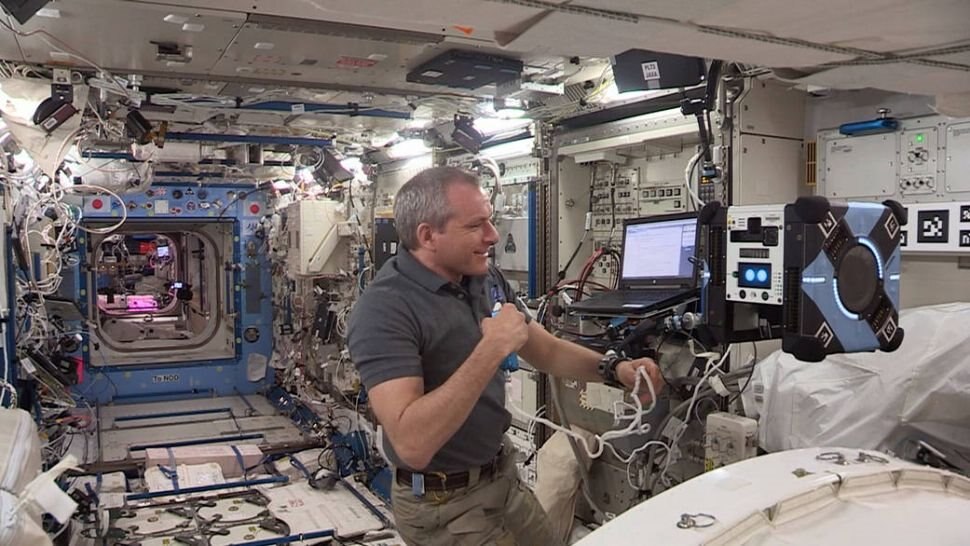
Canadian Space Agency astronaut David Saint-Jacques keeps a watchful eye on Bumble during its first flight on the International Space Station. (Image Credit: NASA)


Bumble became the first robot out of the three to start flying around on the space station on June 14, 2019. Each Astrobee comes equipped with a navigation system that uses cameras and sensors to observe their surroundings. Their view then gets compared to a digital map of the space station to verify where each bot is located and which direction they’re in. Just before Bumble’s first flight, the Astrobee team stationed at NASA’s Ames Research Center ensured the Astrobee was able to navigate around the space station while knowing about its location.


Canadian Space Agency astronaut David Saint-Jacques assisted with Bumble’s pre-flight tests by manually moving the robot around in Japan’s Kibo laboratory module. This enabled Bumble to observe and calibrate its surroundings, helping to ensure successful navigation.


All three of the Astrobees can fly on their own or with remote control. Bumble’s first flight was done via remote flight controllers at NASA’s Ames Research Center. The experiment demonstrated a few of the robot’s basic motions, such as “fly 11.8 inches forward” or “rotate 45 degrees to the right”. NASA also plans on putting the robot through a series of challenges to take on complex movements. By using test flight results, the team can adjust the robot to improve its ability to maneuver and work in the microgravity environment on the space station.


NASA astronaut Anne McClain runs a series of tests on Bumble aboard the International Space Station. (Image Credit: NASA)image
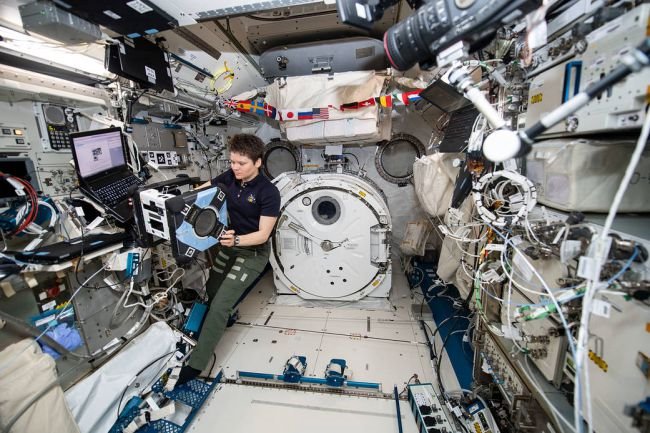
 

While in space, the 12.5-inch-wide Astrobees are propelled by electric fans. They can help the bot with navigation by turning on any axis and moving in any direction. As their battery runs low, the Astrobee can take a flight back to its docking station to charge. Even though the Astrobees don’t have any robotic hands to assist with tasks on the space station, they do have a perching arm, which allows them to grasp onto handrails, either to help with a task or to save their battery power.


Bots similar to Astrobees can help reduce the time astronauts spend on tasks. Since every second spent in space is valuable to astronauts, these bots could give them more time for spacewalk preparation or for scientific experiments. Additionally, bots like the Astrobees can also help to remotely repair and maintain structures. These tiny bots could also be used in support missions to Mars and the return to the moon with NASA’s Artemus program.


You don't have permission to edit metadata of this video.
Edit media
x
image
Upload Preview
image


Have a story tip? Message me at: cabe(at)element14(dot)com

http://twitter.com/Cabe_Atwell

  • Sign in to reply
  • dubbie
    dubbie over 6 years ago

    What great little mobile robots. I wish I had some micro gravity environment to play with so I could make something similar.


    Dubbie

    • Cancel
    • Vote Up 0 Vote Down
    • Sign in to reply
    • More
    • Cancel
element14 Community

element14 is the first online community specifically for engineers. Connect with your peers and get expert answers to your questions.

  • Members
  • Learn
  • Technologies
  • Challenges & Projects
  • Products
  • Store
  • About Us
  • Feedback & Support
  • FAQs
  • Terms of Use
  • Privacy Policy
  • Legal and Copyright Notices
  • Sitemap
  • Cookies

An Avnet Company © 2026 Premier Farnell Limited. All Rights Reserved.

Premier Farnell Ltd, registered in England and Wales (no 00876412), registered office: Farnell House, Forge Lane, Leeds LS12 2NE.

ICP 备案号 10220084.

Follow element14

  • X
  • Facebook
  • linkedin
  • YouTube