element14 Community
element14 Community
    Register Log In
  • Site
  • Search
  • Log In Register
  • Community Hub
    Community Hub
    • What's New on element14
    • Feedback and Support
    • Benefits of Membership
    • Personal Blogs
    • Members Area
    • Achievement Levels
  • Learn
    Learn
    • Ask an Expert
    • eBooks
    • element14 presents
    • Learning Center
    • Tech Spotlight
    • STEM Academy
    • Webinars, Training and Events
    • Learning Groups
  • Technologies
    Technologies
    • 3D Printing
    • FPGA
    • Industrial Automation
    • Internet of Things
    • Power & Energy
    • Sensors
    • Technology Groups
  • Challenges & Projects
    Challenges & Projects
    • Design Challenges
    • element14 presents Projects
    • Project14
    • Arduino Projects
    • Raspberry Pi Projects
    • Project Groups
  • Products
    Products
    • Arduino
    • Avnet & Tria Boards Community
    • Dev Tools
    • Manufacturers
    • Multicomp Pro
    • Product Groups
    • Raspberry Pi
    • RoadTests & Reviews
  • About Us
  • Store
    Store
    • Visit Your Store
    • Choose another store...
      • Europe
      •  Austria (German)
      •  Belgium (Dutch, French)
      •  Bulgaria (Bulgarian)
      •  Czech Republic (Czech)
      •  Denmark (Danish)
      •  Estonia (Estonian)
      •  Finland (Finnish)
      •  France (French)
      •  Germany (German)
      •  Hungary (Hungarian)
      •  Ireland
      •  Israel
      •  Italy (Italian)
      •  Latvia (Latvian)
      •  
      •  Lithuania (Lithuanian)
      •  Netherlands (Dutch)
      •  Norway (Norwegian)
      •  Poland (Polish)
      •  Portugal (Portuguese)
      •  Romania (Romanian)
      •  Russia (Russian)
      •  Slovakia (Slovak)
      •  Slovenia (Slovenian)
      •  Spain (Spanish)
      •  Sweden (Swedish)
      •  Switzerland(German, French)
      •  Turkey (Turkish)
      •  United Kingdom
      • Asia Pacific
      •  Australia
      •  China
      •  Hong Kong
      •  India
      • Japan
      •  Korea (Korean)
      •  Malaysia
      •  New Zealand
      •  Philippines
      •  Singapore
      •  Taiwan
      •  Thailand (Thai)
      • Vietnam
      • Americas
      •  Brazil (Portuguese)
      •  Canada
      •  Mexico (Spanish)
      •  United States
      Can't find the country/region you're looking for? Visit our export site or find a local distributor.
  • Translate
  • Profile
  • Settings
Industrial Automation
  • Technologies
  • More
Industrial Automation
Blog NASA's Ingenuity helicopter successfully takes flight on Mars
  • Blog
  • Forum
  • Documents
  • Quiz
  • Events
  • Polls
  • Files
  • Members
  • Mentions
  • Sub-Groups
  • Tags
  • More
  • Cancel
  • New
Join Industrial Automation to participate - click to join for free!
  • Share
  • More
  • Cancel
Group Actions
  • Group RSS
  • More
  • Cancel
Engagement
  • Author Author: Catwell
  • Date Created: 20 Apr 2021 6:42 PM Date Created
  • Views 494 views
  • Likes 2 likes
  • Comments 0 comments
  • robotics
  • robot
  • nasa
  • space
  • cabeatwell
  • perseverance
  • mars
Related
Recommended

NASA's Ingenuity helicopter successfully takes flight on Mars

Catwell
Catwell
20 Apr 2021

image

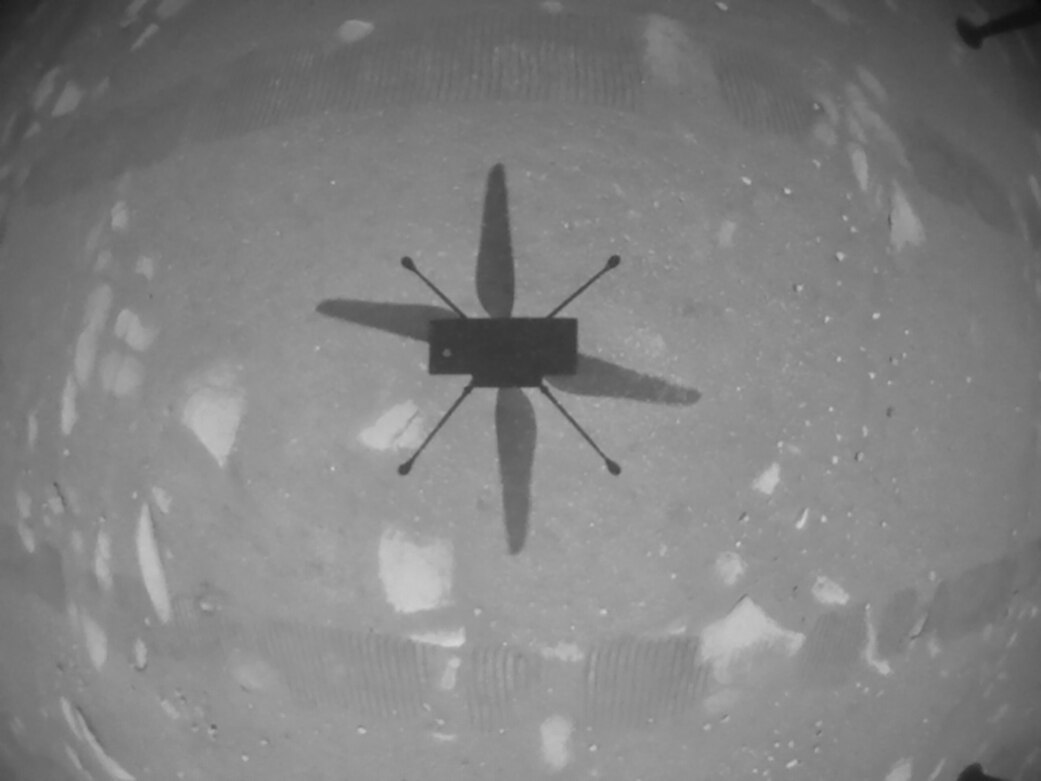
Ingenuity captured this Image of its shadow on Mar's surface. (Image Credit: NASA)


Aerial exploration of Mars is officially underway! On April 19th, NASA lifted off its Ingenuity helicopter from Mars, marking the first performance of a powered, controlled flight on another planet. The 1.8-kg rotorcraft ascended 3 meters above the Jezero Crater surface and stayed overhead for 30 seconds before landing. It had a total flight time of 39.1 seconds. At 6:15 a.m. EDT, NASA received data from a satellite confirming that Ingenuity reached its target. NASA plans to carry out more flights in the next few days. Ingenuity is expected to soar higher and further to test the technology's limits.

MiMi Aung, Ingenuity's project manager, tore up the contingency speech, which was written in case of failure, while her team cheered. "We can now say that human beings have flown a rotorcraft on another planet!" Aung said. "We've been talking so long about our Wright brothers' moment on Mars, and here it is."


Ingenuity's airfield on Mars was named the Wright Brothers Field after Orville and Wilbur Wright, who conducted the first controlled air flight on Earth in 1903. Additionally, there is a piece from one of the Flyer 1 wings aboard Ingenuity. Flyer 1 is the aircraft that took the historic flight at Kitty Hawk, North Carolina, over 117 years ago.

Taking flight on the Martian planet is not an easy task. The extremely thin atmosphere is only 1% as dense as Earth's at sea level. This means that there's very little air for the rotorcraft's blades to push against, so it can't gain much lift. Mars' lower gravitational pull, which is 38% as strong as Earth's, helps with that, but it takes a lot of effort to lift off. 


That's why Ingenuity is very lightweight. It runs on 350 watts of power to quickly rotate the blades at over 2,500 revolutions per minute for this flight. The drone doesn't rely on a joystick. Instead, it's autonomously controlled since it takes minutes for radio signals to reach Mars from Earth.
 

image

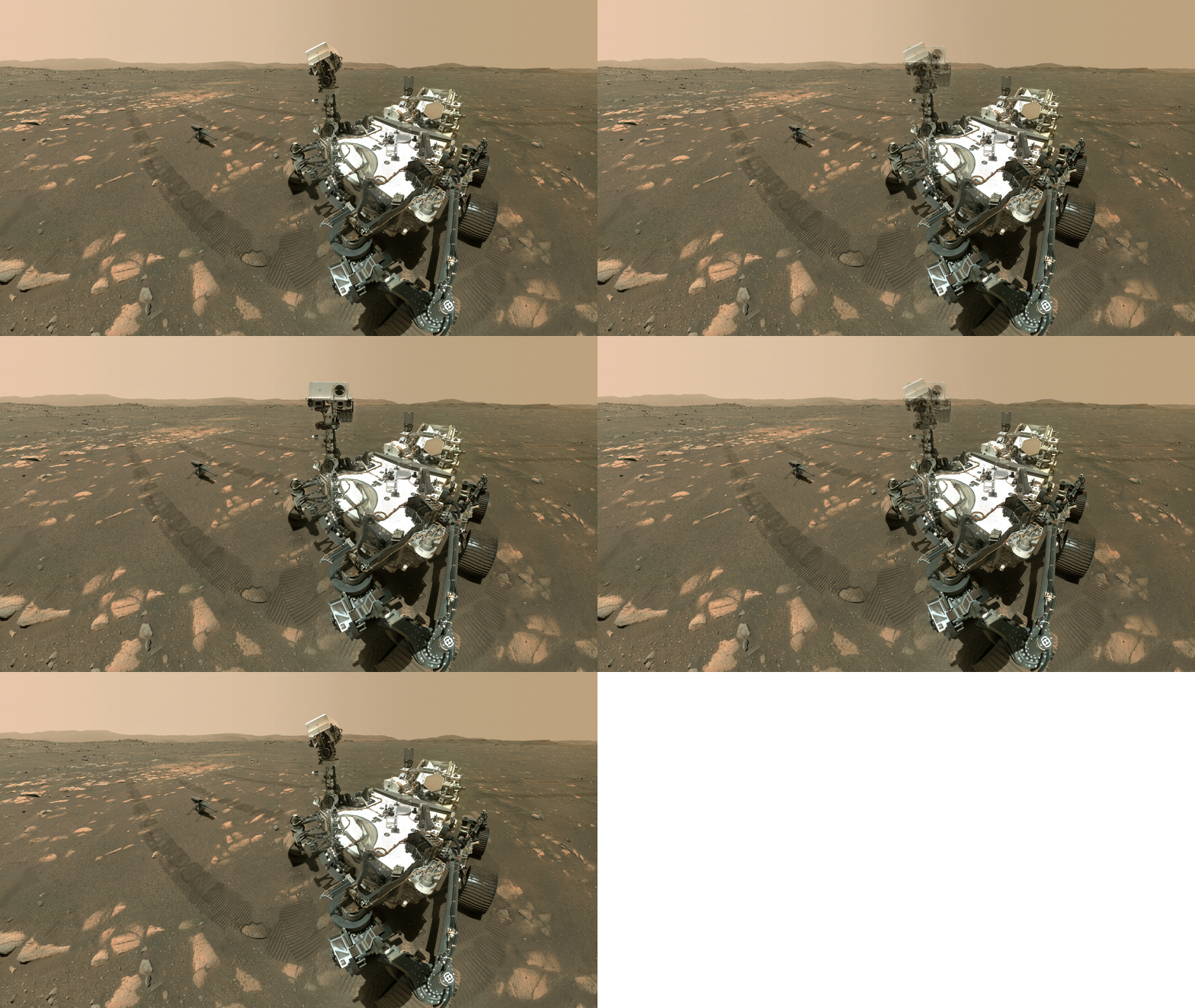
Image showing both the Perseverance rover and Ingenuity helicopter. (Image Credit: NASA/JPL-Caltech/MSSS)


There are two cameras mounted on Ingenuity. One of them is a black-and-white camera that's aimed toward the surface for navigational purposes. The other is a high-resolution color camera that's focused on the horizon. A navigation image showed the helicopter's shadow on the crater's surface as it landed. More images are expected to be taken over the next day.  Meanwhile, Perseverance captured a short video of the flight from 64.3 meters away.


Another four flights are planned. The helicopter could reach a higher ascent on the second and third flight, getting up to 5m off the surface and moving 50 meters downrange. If those two go well, flights four and five should be adventurous.


Eventually, the demonstration could alter how we explore other worlds. Drones can be used to investigate certain areas for rovers and astronauts when they reach Mars. A NASA-approved helicopter mission, called Dragonfly, is expected to land on Titan in the mid-2030s.


You don't have permission to edit metadata of this video.
Edit media
x
image
Upload Preview
image


Have a story tip? Message me at: http://twitter.com/Cabe_Atwell

  • Sign in to reply
element14 Community

element14 is the first online community specifically for engineers. Connect with your peers and get expert answers to your questions.

  • Members
  • Learn
  • Technologies
  • Challenges & Projects
  • Products
  • Store
  • About Us
  • Feedback & Support
  • FAQs
  • Terms of Use
  • Privacy Policy
  • Legal and Copyright Notices
  • Sitemap
  • Cookies

An Avnet Company © 2026 Premier Farnell Limited. All Rights Reserved.

Premier Farnell Ltd, registered in England and Wales (no 00876412), registered office: Farnell House, Forge Lane, Leeds LS12 2NE.

ICP 备案号 10220084.

Follow element14

  • X
  • Facebook
  • linkedin
  • YouTube