element14 Community
element14 Community
    Register Log In
  • Site
  • Search
  • Log In Register
  • Community Hub
    Community Hub
    • What's New on element14
    • Feedback and Support
    • Benefits of Membership
    • Personal Blogs
    • Members Area
    • Achievement Levels
  • Learn
    Learn
    • Ask an Expert
    • eBooks
    • element14 presents
    • Learning Center
    • Tech Spotlight
    • STEM Academy
    • Webinars, Training and Events
    • Learning Groups
  • Technologies
    Technologies
    • 3D Printing
    • FPGA
    • Industrial Automation
    • Internet of Things
    • Power & Energy
    • Sensors
    • Technology Groups
  • Challenges & Projects
    Challenges & Projects
    • Design Challenges
    • element14 presents Projects
    • Project14
    • Arduino Projects
    • Raspberry Pi Projects
    • Project Groups
  • Products
    Products
    • Arduino
    • Avnet & Tria Boards Community
    • Dev Tools
    • Manufacturers
    • Multicomp Pro
    • Product Groups
    • Raspberry Pi
    • RoadTests & Reviews
  • About Us
  • Store
    Store
    • Visit Your Store
    • Choose another store...
      • Europe
      •  Austria (German)
      •  Belgium (Dutch, French)
      •  Bulgaria (Bulgarian)
      •  Czech Republic (Czech)
      •  Denmark (Danish)
      •  Estonia (Estonian)
      •  Finland (Finnish)
      •  France (French)
      •  Germany (German)
      •  Hungary (Hungarian)
      •  Ireland
      •  Israel
      •  Italy (Italian)
      •  Latvia (Latvian)
      •  
      •  Lithuania (Lithuanian)
      •  Netherlands (Dutch)
      •  Norway (Norwegian)
      •  Poland (Polish)
      •  Portugal (Portuguese)
      •  Romania (Romanian)
      •  Russia (Russian)
      •  Slovakia (Slovak)
      •  Slovenia (Slovenian)
      •  Spain (Spanish)
      •  Sweden (Swedish)
      •  Switzerland(German, French)
      •  Turkey (Turkish)
      •  United Kingdom
      • Asia Pacific
      •  Australia
      •  China
      •  Hong Kong
      •  India
      • Japan
      •  Korea (Korean)
      •  Malaysia
      •  New Zealand
      •  Philippines
      •  Singapore
      •  Taiwan
      •  Thailand (Thai)
      • Vietnam
      • Americas
      •  Brazil (Portuguese)
      •  Canada
      •  Mexico (Spanish)
      •  United States
      Can't find the country/region you're looking for? Visit our export site or find a local distributor.
  • Translate
  • Profile
  • Settings
Industrial Automation
  • Technologies
  • More
Industrial Automation
Blog New soft, flexible robot arm enters the human body to 3D print cells on organs
  • Blog
  • Forum
  • Documents
  • Quiz
  • Events
  • Polls
  • Files
  • Members
  • Mentions
  • Sub-Groups
  • Tags
  • More
  • Cancel
  • New
Join Industrial Automation to participate - click to join for free!
  • Share
  • More
  • Cancel
Group Actions
  • Group RSS
  • More
  • Cancel
Engagement
  • Author Author: Catwell
  • Date Created: 6 Mar 2023 9:47 PM Date Created
  • Views 1176 views
  • Likes 5 likes
  • Comments 0 comments
  • robotics
  • robot
  • on_campus
  • cabeatwell
  • university
  • medical
  • innovation
Related
Recommended

New soft, flexible robot arm enters the human body to 3D print cells on organs

Catwell
Catwell
6 Mar 2023

image

The F3DB soft robotic arm 3D printed various materials with different shapes on a pig's kidney. (Image Credit: University of New South Wales/Dr. Thanh Do)

Engineers at the University of New South Wales built F3DB, a tiny, flexible, and soft robotic arm that goes inside a human body to 3D-print biomaterial on internal organs. This technology can help reduce health risks that may arise during surgery. Medical professionals could be using this device in five to seven years if developments continue. 

"Our flexible 3D bioprinter means biomaterials can be directly delivered into the target tissue or organs with a minimally invasive approach," Dr. Thanh Nho Do, lead researcher and a biomedical engineer at the University of New South Wales, said. 

F3DB features a mounted three-axis swivel head on the robot arm's tip, where it prints bioink. Thanks to the hydraulics, the arm can bend and twist, and its stiffness can adjust via controllers with elastic tubes. More importantly, all the components are controlled externally.

Similar to an endoscope, the robotic arm's size and maneuverability allow it to be inserted into hard-to-reach openings, including the colon. "This system offers the potential for the precise reconstruction of three-dimensional wounds inside the body, such as gastric wall injuries or damage and disease inside the colon," Do said.

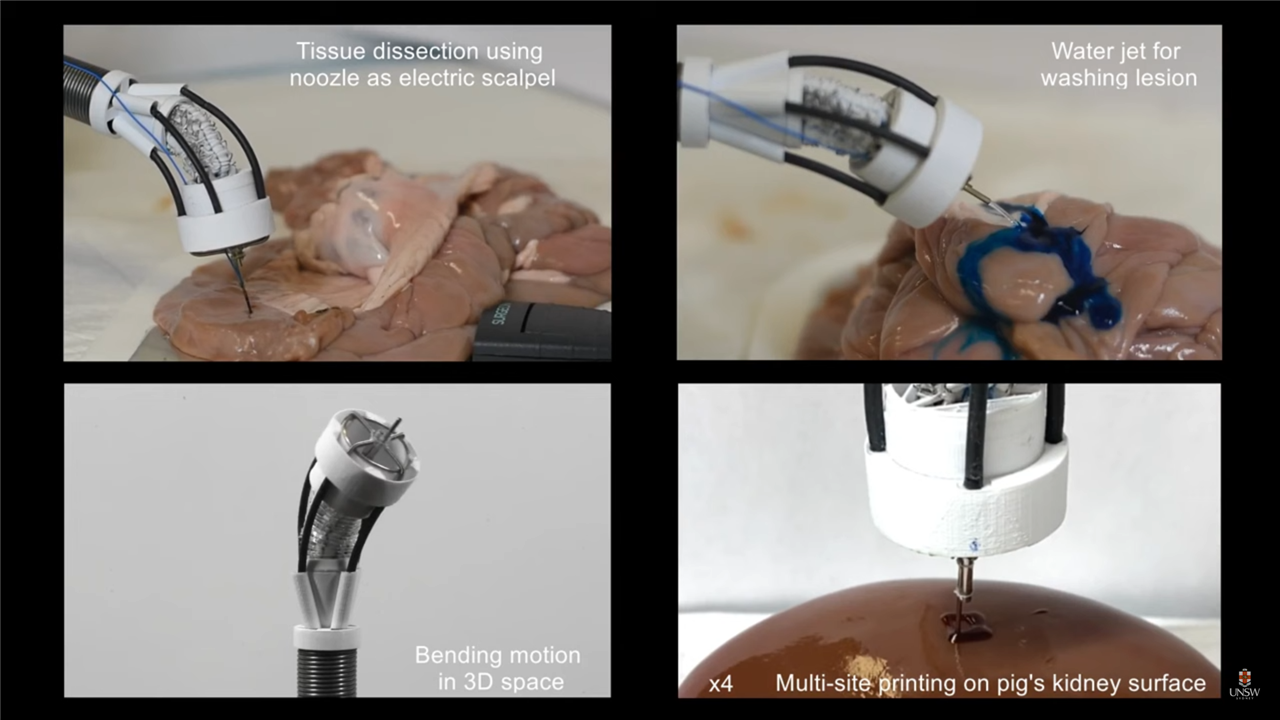
The engineers used a model colon to test the technology. They 3D printed various materials with different shapes on a pig's kidney surface. This technique could allow doctors to avoid traditional bioprinting methods requiring biomaterials to be created outside the body. "Existing 3D bioprinting techniques require biomaterials to be made outside the body, and implanting that into a person would usually require large open-field open surgery, which increases infection risks," said Do.

The team also tested out the cell viability of living biomaterial post-printing. Their results demonstrated that the cells weren't affected, with most surviving. These cells also grew throughout the week, and the team observed four times as many cells one week after printing. Additionally, the robotic arm "addresses significant limitations in existing 3D bioprinters such as surface mismatches between 3D printed biomaterials and target tissues/organs as well as structural damage during manual handling, transferring, and transportation process."
image

(Image Credit: University of New South Wales)

F3DB isn't limited to just 3D printing. It can also perform certain tasks, including removing cancerous lesions and cleaning the blood and excess tissues. Additionally, the device encourages quicker wound recovery times by deploying biomaterial on the affected area. 

The team is developing a camera and scanner, which allow operators to print the essential tissues in real-time. They also plan to perform tests with this technology on live animals to determine if there are any practical applications.

You don't have permission to edit metadata of this video.
Edit media
x
image
Upload Preview
image

Have a story tip? Message me at: http://twitter.com/Cabe_Atwell

  • Sign in to reply
element14 Community

element14 is the first online community specifically for engineers. Connect with your peers and get expert answers to your questions.

  • Members
  • Learn
  • Technologies
  • Challenges & Projects
  • Products
  • Store
  • About Us
  • Feedback & Support
  • FAQs
  • Terms of Use
  • Privacy Policy
  • Legal and Copyright Notices
  • Sitemap
  • Cookies

An Avnet Company © 2025 Premier Farnell Limited. All Rights Reserved.

Premier Farnell Ltd, registered in England and Wales (no 00876412), registered office: Farnell House, Forge Lane, Leeds LS12 2NE.

ICP 备案号 10220084.

Follow element14

  • X
  • Facebook
  • linkedin
  • YouTube