


It’s common to use printers to print out documents, but what if we could use printers to print out flexible devices, such as temporary tattoo paper, textiles, and thermoplastic? Engineers from Saarland University based in Saarbrucken, Germany, have printed soft circuits by using an inexpensive desktop inkjet printer with raw materials. Their systematic approach produces high-resolution circuits that are stretchable, ultrathin, and can be integrated with a wide range of materials used for prototyping. The team published their Soft Inkjet Circuits findings in a paper.
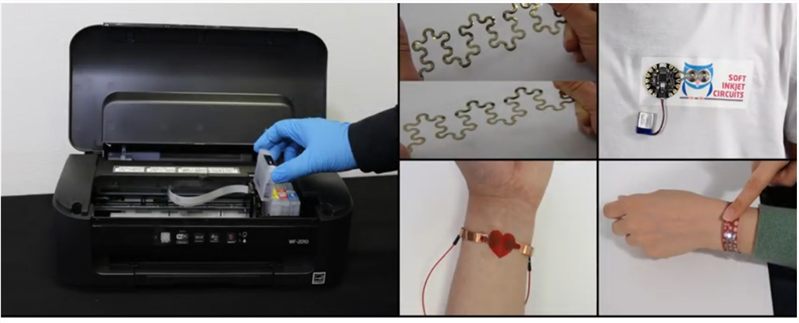
The inkjet printer prints out soft circuits that can be used as textiles, tattoos, stretchable circuits, and interfaces that can be re-shaped. (Image Credit: Saarland University, YouTube)
The team was able to achieve circuit printouts by modifying a desktop inkjet printer with multi-ink functional printing. Their technique supports multi-layer printing of various inks with different functions, which includes highly conductive silver nanoparticle ink, stretchable conductive polymer ink, and an electrically isolating ink with graphical inks. These special inks can be combined in a single printer, allowing it to be used for different purposes. According to the paper, “By printing an isolating top layer, circuits can be selectively isolated, while leaving desired elements exposed.” This gives it a quick process for creating exposed electrodes, connection pins, or VIAs that connect the circuit with an additional layer. Printing conductive and graphical inks allows full-colored designs to be printed with the circuit in one pass.
By matching the functional inks with various sets of soft substrate materials, the team was able to create advanced mechanical properties for the circuits. It includes highly stretchable Thermoplastic Urethane (TPU) foil, 1-microthin rub-on tattoo film, textile transfer film, and re-shapeable thermoplastic materials.
There are five steps required to complete the soft circuit fabrication process using an inkjet printer. They consist of creating the digital design, selecting the ink, selecting the substrate material, printer selection and post-treatment.
When creating the digital design, the designer creates a design of the circuit being printed. Adobe Illustrator was used by the team for this step. If only one ink is printed, the design comes out as a black and white graphic. If there are multiple inks, the vector element defines what cartridge it will be printed with. Once the inks are selected from the cartridge, the design is sent to the printer via the print dialog.
The second step requires the designer to select one or multiple inks from off-the-shelf that can be formulated from materials. The ink is then inserted into an empty cartridge. Numerous inks can be inserted into the same printer and combined into one design.
According to the paper, “The substrate material that the circuit is printed on defines its physical properties. Our process enables direct commodity inkjet printing of soft circuits that have a variety of desirable mechanical properties.” Various substrates the designer can choose from include stretching, ultra-slim form factor, compatibility with textiles, and a transition between soft and rigid states, allowing it to be re-shaped.
The team tested a variety of printers to determine which printer works best for circuit printing. They concluded that printers with piezoelectric technology, standard heads, small cartridges, short tubing and availability of empty cartridges will give the best performance.
Once the circuit has been printed, it goes through a post-treatment step. Curing enables the printed traces to be functional. Every functional ink used by the team is thermally curable and the printed sample is then put into an oven or ironed. Electronic components and connections can also be added to the circuit by using copper tape, sewing, vertically conductive z-tape, or even soldering.
The team found that, by using their approach for soft circuit devices, they can speed up the printing process significantly, especially with e-textiles, e-tattoos, stretchable circuits and re-shapeable interfaces.
Have a story tip? Message me at: cabe(at)element14(dot)com