


The effect of climate change has spawned concerns around the globe, particularly in the American West where the areas of concern have turned into a thirsting region. A perfect example of this can be found in Cape Town, South Africa where severe droughts have become a familiarity to those who reside in this area. This in effect, had caused water shortage to become an increased concern since 2015 when it all started.
Cape Town's taps nearly ran dry earlier this year, thus putting the city on the wall of facing a Day Zero issue on the population. Another shortage is expected to hit the city in 2019. The situation there has been so critical that city officials have considered bringing in icebergs to help increase the water supply. There are some greater alternatives that involve the use of technology to replace this idea. However, and one of those ideas is to take the humidity out of the air and use it to source water.
This could be very useful because thee Earth's atmosphere contains 13 trillion liters of water vapor which is equivalent to only ten percent of the Earth's available freshwater found on the surface. The task of doing this can be quite complex especially when factoring in what will be needed to help solve the thirst of four billion people who will be impacted in the upcoming years.
Pulling water out of the air - video (Video credit UC Berkeley and Berkeley Lab) https://www.youtube.com/watch?v=dvwmZKqPgKQ
A number of researchers and private companies have started developing water harvesting devices, and they function by lowering temperatures in the surrounding air environment below dew point and then collecting vapor from that process. As the humidity level drop below 50 percent, the efficiency of the machines drop too which requires more power to operate the devices.
A sorbent-based alternative that has just been developed shows it can take moisture out of the air even when the humidity level drops to 10 percent. It works out to 3 liters of water to 1 million liters of air in that condition. The main advantage of this is that you can operate the machine at low humidity.
This was created in collaboration with teams from MIT and UC Berkeley which uses a Metal-Organic Framework (MOF). It depends on which metal and organic chemists decide to use to allow them to control which gases will bind to the MOF and how much strength it will hold. The research team developing the device used a variant MOF-801 -- Zr6O4(OH)4(fumarate)6 - which collects more water and functions well in vastly smaller temperature swings to work over the standard sorbents like zeolite or silica gel.
Water harvester (Image via UC Berkeley and Berkeley Lab)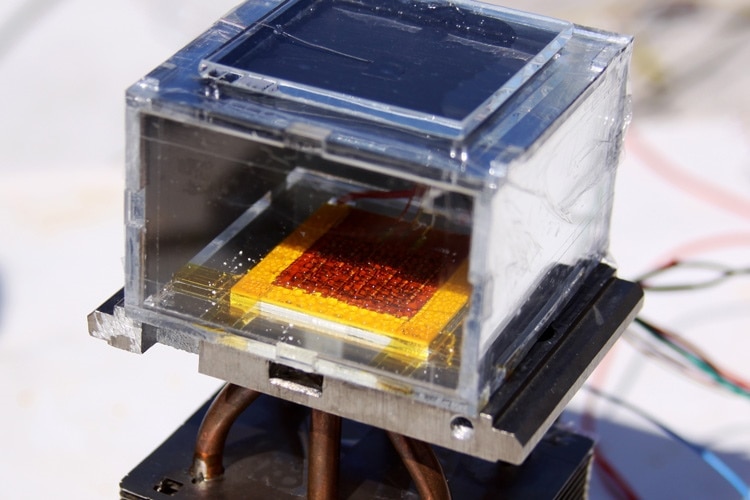
The newly designed MOF does not require an electrical grid to operate as it will only need a heat source to separate water molecules from the organic bits. The design behind the device is quite simple - it has an absorption later, and an air-cooled condenser. It is also painted black on the backside to help absorb heat.
The enclosure walls remain open at night-time to allow airflow past the MOF as it becomes saturated with vapor. Once morning arrives, the enclosure is closed up, and the black side of the MOF is covered up with an optically transparent thermal insulator. When the MOF is exposed to the sun and becomes heated, it causes the organic molecules to release their hold on water which in turn, condenses it at a suitable temperature for collection.
A year ago, the team set up the MOF device on a roof of the University of Arizona where the humidity during the day drops to 10 percent but climbs to 30 percent at night. The team was able to grab .75g of water using only 3g of MOF - which is more than enough to confirm the team's predictions.
Process behind the MOF (Image via Nature Communications)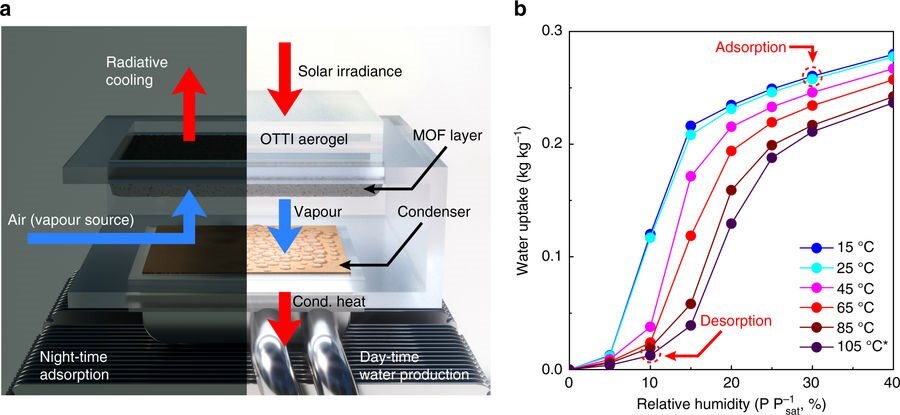
The device is still in early development and hopes are high that it will be a useful source of water in the future, especially for those in urban settings. It can be used for a family of four and give room to those in developing countries where water sources are thinned out. Before this is complete, there are certain challenges that must be met. Scalability and cost are the first factors to consider.
It is also worthy to note that it's unlikely that these devices will have a resolve on the Earth's potable water issues. With other technologies on the rise with evolving intent, there is likelihood that humanity can help to solve the world's issues with water shortages.
Have a story tip? Message me at: cabe(at)element14(dot)com