


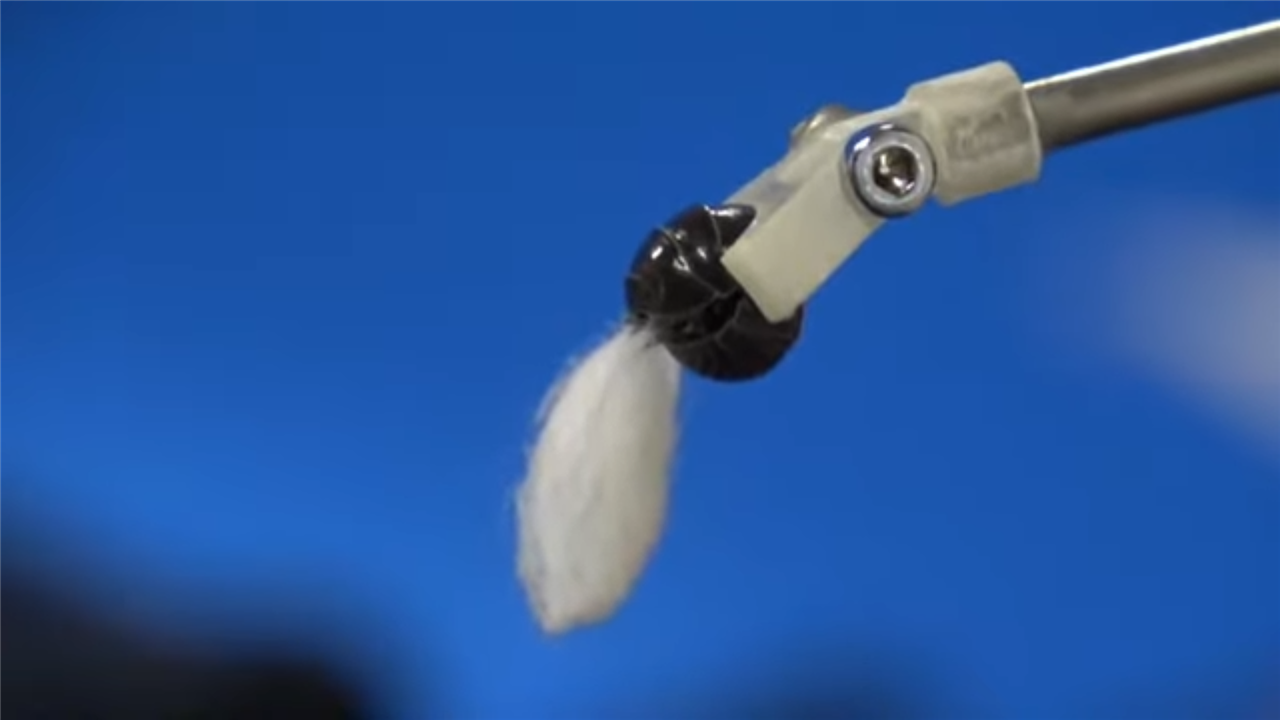
The pill bug acts as an end effector on the mechanical robot’s arm. (Image Credit: Tadakuma Mechanism Group, Tohoku University)
Animal abuse for science never ends, as I drew in cartoon over 10 years ago. What happened to biomimicry? You may not like animals, you don’t need to help them… but you should never hurt them intentionally. Despite the unspoken call to action, this happened…
Pill bugs possess the ability to roll, while chitons can grip, grabbing the attention of scientists working on biohybrid technologies in Japan. In a robotics world twist, Tohoku University researchers have used these two insects as a robot’s end effectors, allowing them to manipulate objects and control the gripping functionality. The team claims this approach doesn’t harm the insects, and after completing their task, they can return to nature.
“To our knowledge, there is no prior example of whole living organisms being used as end effectors for robotic arms,” the team wrote. “This approach departs from traditional methodologies by leveraging the structures and movements of specific body parts without disconnecting them from the organism, all the while preserving the life and integrity of the creature.”
The team took advantage of the pill bugs’ reflective closure and the chitons’ suction power in this study. Although the researchers believe these two present an effective technique, they also say that the suction power of leeches or slugs’ locomotion could be exploited in the same way. This concept may even lead to a “truly radical integration of robots and their environment.”
They also propose this method could have practical applications in areas where the surrounding environment is home to the insect. For example, a robot situated at the bottom of the ocean requiring a gripper for a specific task could rely on a chiton to perform the job. This also benefits the chiton because it would then move on to another place with potentially more food.
The chiton and pill bug end effectors effectively gripped objects. However, each insect had some delay in the reflective reaction timing. Meanwhile, the chiton couldn’t release the object but gripped it tighter after it was simulated to release. The team theorizes potential capture and release methods, which should be done in the least invasive way possible.
Additionally, they want to try other organisms to see how they could work with robots for big and small manipulation techniques. “Organisms that adhere to their environment, such as the Japanese spineless mussel or the snail are also useful for sticking to porous objects and objects with rough surfaces. At the microscopic scale, if the distance between the flagella of bacteria can be artificially controlled, it would be possible to switch between swimming and grasping modes to utilize bacteria as micro-handling devices,” they wrote in the paper.
We should also practice the best ethics with living creatures and research. To that end, the team says the insects weren’t harmed and went back into nature once the study finished. “The pill bug was released back to nature, and the chiton was well active and alive in its aquarium at the time this paper was written, which is exactly six weeks after this experiment, at which point the glued part naturally came off.”
Have a story tip? Message me at: http://twitter.com/Cabe_Atwell