


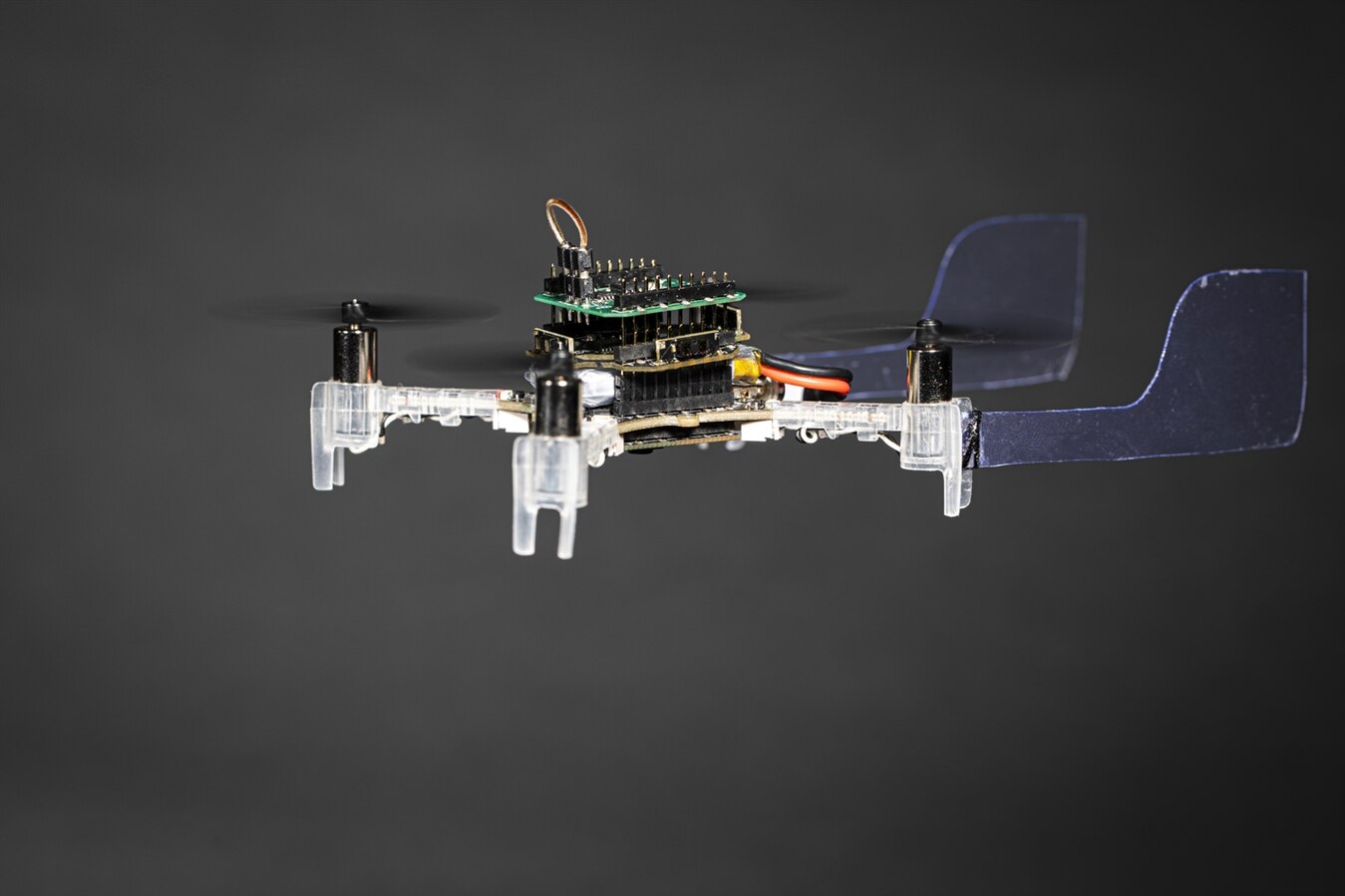
The Smellicopter mimics a real moth when it detects a scent. To stay targeted on the odor, the moth shifts its body left or right, as needed. (Image Credit: Mark Stone/University of Washington)
Meet the Smellicopter, a tiny drone that uses an onboard moth antenna to detect odors. Developed by researchers at the University of Washington, Smellicopter could one day detect odors like explosives, gas leaks, or survivors of a natural disaster. The antenna is wired directly to its electrical circuit, allowing it to navigate toward a detected scent. Thanks to the Manduca sexta hawkmoth’s antenna, it’s also capable of detecting and avoiding obstacles as it flies around.
To create the Smellicopter, the team anesthetized the moths by placing them inside a refrigerator before removing an antenna. Once removed from a live moth, the antenna stays biologically and chemically active for up to four hours. The researchers say that could be extended by storing antennae in the fridge. Cells in the moth’s antenna intensify chemical signals and trigger cellular reactions in the moth. Meanwhile, the drone is designed so that tiny wires can be added to the antenna, allowing it to be connected to an electrical circuit.
However, the disembodied moth antennae can only last for two hours. The drones can only operate for ten minutes on a charge, which means that battery life is a bigger issue.
The team added the antenna sensor to an open-source Crazyflie quadrotor, which allows users to add features to their drone. Next, the researchers added two plastic fins on the drone’s back to create drag so that it can be constantly oriented upwind.
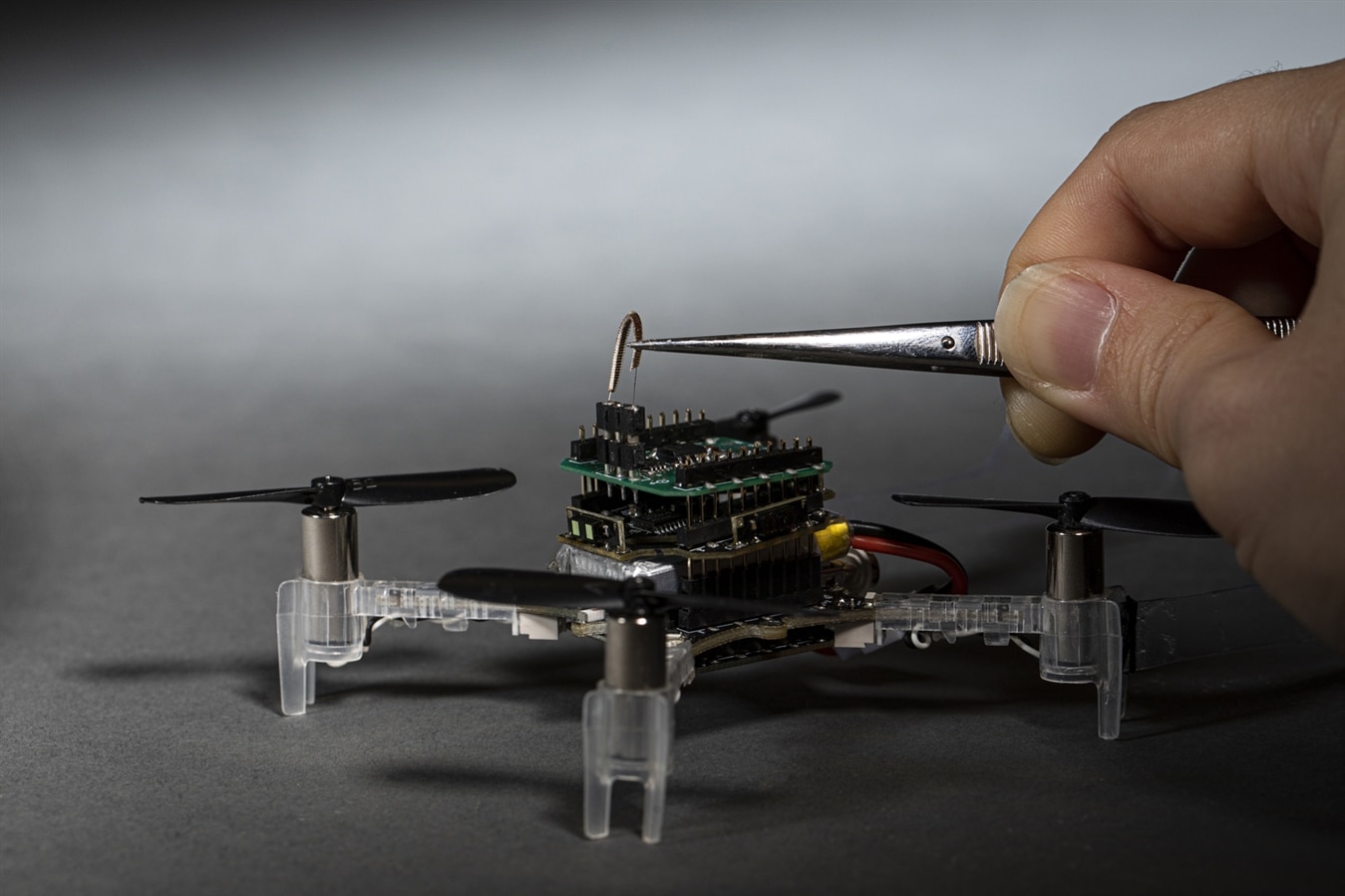
Researchers placed an antenna of a moth on the open-source drone so that it could detect scents. (Image Credit: Mark Stone/University of Washington)
“From a robotics perspective, this is genius,” said co-author and co-advisor Sawyer Fuller, a UW assistant professor of mechanical engineering. “The classic approach in robotics is to add more sensors and maybe build a fancy algorithm or use machine learning to estimate wind direction. It turns out, all you need is to add a fin.”
Additionally, the team programmed the Smellicopter to search for odors the same way a moth would. If a human can smell an odor, there’s a decent chance the source is upwind from them. This also applies to insects, such as moths, which lock on to an upwind source and navigate toward it. To stay targeted on the odor, the moth shifts its body left or right, as needed. The team trained the Smellicopter to mimic this unique behavior.
Called the “cast-and-surge” algorithm, the drone navigates toward an odor and shifts left or right if it loses the scent. It surges forward once it finds the scent again. The drone is also equipped with four infrared sensors that allow it to measure what’s around it ten times each second while avoiding obstacles. If an object comes within eight inches of the drone, it changes direction by going to the next stage of its cast-and-surge protocol.
“So if Smellicopter was casting left and now there’s an obstacle on the left, it’ll switch to casting right,” said lead author Melanie Anderson, a UW doctoral student in mechanical engineering. “And if Smellicopter smells an odor but there’s an obstacle in front of it, it’s going to continue casting left or right until it’s able to surge forward when there’s not an obstacle in its path.”
One big advantage of Smellicopter is that it doesn’t rely on GPS to observe its surroundings. Instead, it uses a camera, which is similar to insects using their eyes. This makes Smellicopter suitable for exploring mines or pipes.
While undergoing experiments in the UW lab, the team discovered that Smellicopter naturally flew toward odors that moths are normally drawn to, including floral scents. In the future, researchers are hoping that the moth antenna could detect other odors, such as a trapped human exhaling carbon dioxide underneath rubble or the chemical signature of an explosive.
“Finding plume sources is a perfect task for little robots like the Smellicopter and the Robofly,” Fuller said. “Larger robots are capable of carrying an array of different sensors around and using them to build a map of their world. We can’t really do that at the small scale. But to find the source of a plume, all a robot really needs to do is avoid obstacles and stay in the plume while it moves upwind. It doesn’t need a sophisticated sensor suite for that — it just needs to be able to smell well. And that’s what the Smellicopter is really good at.”
Have a story tip? Message me at: http://twitter.com/Cabe_Atwell
