


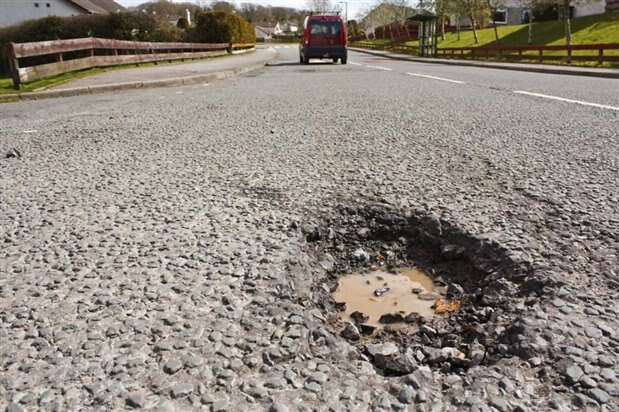
A team at the University of Waterloo is developing an AI system to speed up pothole repairs. Can an AI system really speed up pothole repairs? (Photo via StockSolutions)
Potholes are unavoidable annoyances when it comes to driving. And no matter how many times we complain about the city needs to address the issue, it’s not very easy for them either. Tactics used to keep track of them, like driving around to inspect roads or watching videos of streets to find damaged pavement, aren’t efficient enough. One group at the University of Waterloo thinks the solution lies in AI to speed up and ease the process.
The group, led by John Zelek, have developed a system that uses AI to automatically analyze photos taken by vehicle-mounted cameras to find potholes, scratches, and other defects. Originally, the AI used free images of roads from Google Street View. Since then, the team has used the AI software to images from other sources, like a company with a partially automated system to detect pavement defects.
The system, which is currently being refined at the University of Waterloo, will be more cost-effective and achieved at least comparable accuracy. It will ultimately result in more timely repairs due to more frequent monitoring, according to Zelek. It removes the human biases, who look at data differently. An AI could see a crack and could analyze how it needs to be addressed versus a human who may think the damage isn’t enough to warrant a repair.
“If governments have that information, they can better plan when to repair a particular road and do it at a lower cost,” said Zelek. “Essentially, it could mean lower taxes for residents.”
Zelek also believes the AI system could be used by small jurisdictions to analyze video taken by cellphone camera mounted in vehicles as workers go about their day. The data could then be superimposed on street maps as a tool to help officials plan and prioritize repairs.
University researchers are also looking into applying the AI system to drone images taken of bridges, buildings, and other infrastructure along with images of construction projects. The idea is to have the system catch any part of a building project that’s not coming together as planned, so it can quickly be resolved.
The system isn’t ready to be put in place, but hopefully, it will deliver. It sounds more effective than a person driving around in a car. Still, we can’t expect it to result in every pothole to be fixed. There’s still the sticky issue of money, which is why many damaged roads go unrepaired for long periods of time in the first place. Still, if this system can speed up the process, it can be a big help.
Have a story tip? Message me at: cabe(at)element14(dot)com