


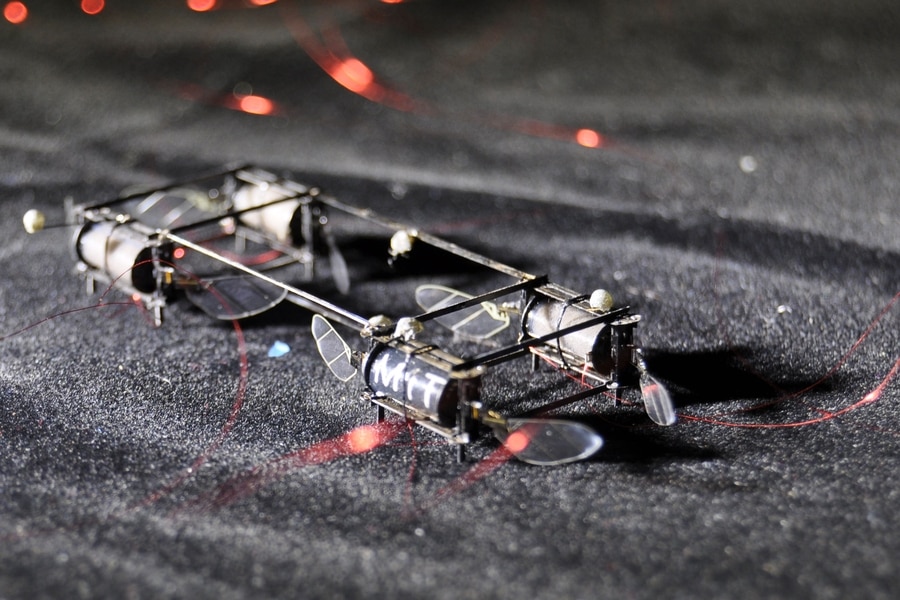
MIT researchers developed soft artificial muscles that illuminate in varying colors or patterns. (Image Credit: MIT)
Fireflies are well-known for their unique illuminating ability, which occurs during the nighttime. MIT researchers found inspiration in these light-emitting insects to develop electroluminescent soft artificial muscles for insect-like robots with flight capabilities. These artificial muscles also generate different colors and patterns while the robot flies. More importantly, this feature provides communication with these robots. For example, they could locate survivors in a collapsed building and use the lights to alert the others for assistance.
These robots are too lightweight for any sensors, so the team can't track them with this approach. Instead, they rely on three smartphone cameras that focus on the robots' emitting light.
"If you think of large-scale robots, they can communicate using a lot of different tools — Bluetooth, wireless, all those sorts of things. But for a tiny, power-constrained robot, we are forced to think about new modes of communication. This is a major step toward flying these robots in outdoor environments where we don't have a well-tuned, state-of-the-art motion tracking system," says Kevin Chen, the senior author of the paper.
This was achieved by adding mini electroluminescent particles in the artificial muscles, making it just 2.5% heavier without affecting flight performance. Previously, the team revealed a new fabrication method for soft actuators that control a robot's wings. These are created by alternating ultrathin elastomer and carbon nanotube electrode layers in a stack and rolling them in a squishy cylinder. Applying a voltage to it causes the electrodes to squeeze the elastomer, which makes the mechanical strain flap the wings.
The team integrated electroluminescent zinc sulphate particles in the elastomer to provide a glowing effect. However, they had to work around some obstacles. For starters, the electrode must not obstruct light. So they created one with extremely transparent carbon nanotubes measuring a few nanometers thick. The downside is that the zinc particles illuminate after generating a strong and high-frequency electric field, which stimulates the zinc particles' electrons. This, in turn, emits the photons. Applying high voltage produces this electric field in the soft actuator. The team then controls the robot at a high frequency, which illuminates the particles.
"Traditionally, electroluminescent materials are very energetically costly, but in a sense, we get that electroluminescence for free because we just use the electric field at the frequency we need for flying. We don't need new actuation, new wires, or anything. It only takes about 3 percent more energy to shine out light," Kevin Chen says.
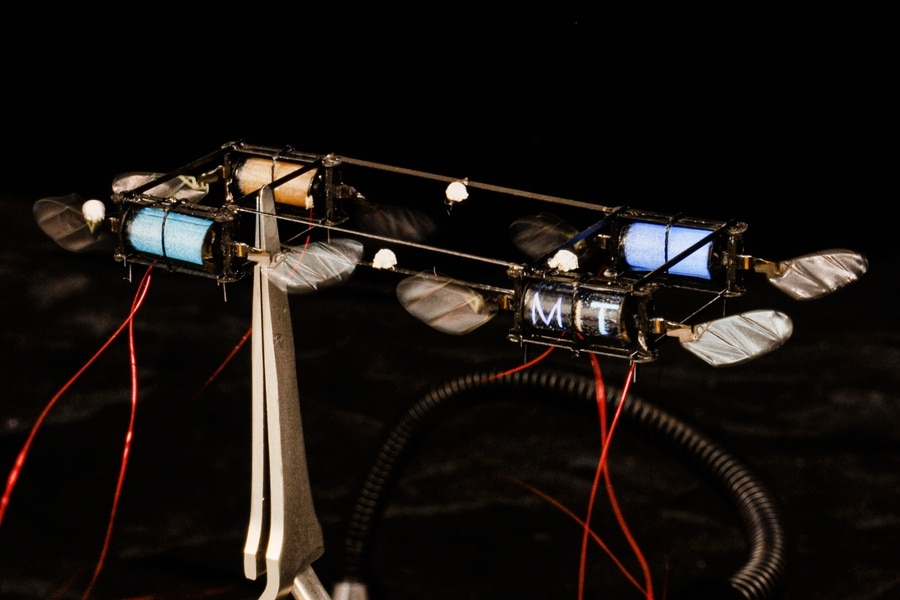
The artificial muscles light up during the robot's flight time, providing them with communication capabilities. (Image Credit: MIT)
While prototyping the actuator, the researchers discovered that incorporating zinc particles made it break apart. Combining zinc particles into the upper elastomer layer, which measured a few micrometers thicker to make up for output power loss, solved this issue.
Light colors alternate by changing the zinc particles' chemical mixture. The team produced three solid colors for each actuator: blue, green, and orange. Additionally, they fine-tuned the fabrication process, making the actuators emit multicolored and patterned light. The team covered the top layer with a tiny mask, incorporated zinc particles, and cured the actuator. This process was repeated with varying masks and colored particles to produce a light pattern spelling M-I-T.
Afterward, they tested the actuators' mechanical properties and utilized a luminescence meter to measure the light's intensity. Then, they performed flight tests with a motion-tracking system. The actuators can be tracked via iPhone cameras, which detect the colors. The team also developed software to track the robot's position.
Later on, the researchers plan to improve the motion-tracking system for real-time robot tracking. They want to add control signals, allowing the robots to communicate more like fireflies and power their lights on and off during flight.
Have a story tip? Message me at: http://twitter.com/Cabe_Atwell