element14 Community
element14 Community
    Register Log In
  • Site
  • Search
  • Log In Register
  • Community Hub
    Community Hub
    • What's New on element14
    • Feedback and Support
    • Benefits of Membership
    • Personal Blogs
    • Members Area
    • Achievement Levels
  • Learn
    Learn
    • Ask an Expert
    • eBooks
    • element14 presents
    • Learning Center
    • Tech Spotlight
    • STEM Academy
    • Webinars, Training and Events
    • Learning Groups
  • Technologies
    Technologies
    • 3D Printing
    • FPGA
    • Industrial Automation
    • Internet of Things
    • Power & Energy
    • Sensors
    • Technology Groups
  • Challenges & Projects
    Challenges & Projects
    • Design Challenges
    • element14 presents Projects
    • Project14
    • Arduino Projects
    • Raspberry Pi Projects
    • Project Groups
  • Products
    Products
    • Arduino
    • Avnet & Tria Boards Community
    • Dev Tools
    • Manufacturers
    • Multicomp Pro
    • Product Groups
    • Raspberry Pi
    • RoadTests & Reviews
  • About Us
  • Store
    Store
    • Visit Your Store
    • Choose another store...
      • Europe
      •  Austria (German)
      •  Belgium (Dutch, French)
      •  Bulgaria (Bulgarian)
      •  Czech Republic (Czech)
      •  Denmark (Danish)
      •  Estonia (Estonian)
      •  Finland (Finnish)
      •  France (French)
      •  Germany (German)
      •  Hungary (Hungarian)
      •  Ireland
      •  Israel
      •  Italy (Italian)
      •  Latvia (Latvian)
      •  
      •  Lithuania (Lithuanian)
      •  Netherlands (Dutch)
      •  Norway (Norwegian)
      •  Poland (Polish)
      •  Portugal (Portuguese)
      •  Romania (Romanian)
      •  Russia (Russian)
      •  Slovakia (Slovak)
      •  Slovenia (Slovenian)
      •  Spain (Spanish)
      •  Sweden (Swedish)
      •  Switzerland(German, French)
      •  Turkey (Turkish)
      •  United Kingdom
      • Asia Pacific
      •  Australia
      •  China
      •  Hong Kong
      •  India
      • Japan
      •  Korea (Korean)
      •  Malaysia
      •  New Zealand
      •  Philippines
      •  Singapore
      •  Taiwan
      •  Thailand (Thai)
      • Vietnam
      • Americas
      •  Brazil (Portuguese)
      •  Canada
      •  Mexico (Spanish)
      •  United States
      Can't find the country/region you're looking for? Visit our export site or find a local distributor.
  • Translate
  • Profile
  • Settings
Industrial Automation
  • Technologies
  • More
Industrial Automation
Blog Robotic fish mimic behaviors of real fish swarms
  • Blog
  • Forum
  • Documents
  • Quiz
  • Events
  • Polls
  • Files
  • Members
  • Mentions
  • Sub-Groups
  • Tags
  • More
  • Cancel
  • New
Join Industrial Automation to participate - click to join for free!
  • Share
  • More
  • Cancel
Group Actions
  • Group RSS
  • More
  • Cancel
Engagement
  • Author Author: Catwell
  • Date Created: 19 Jan 2021 7:32 PM Date Created
  • Views 1136 views
  • Likes 7 likes
  • Comments 3 comments
  • robotics
  • robot
  • on_campus
  • cabeatwell
  • biomimicry
  • university
  • innovation
Related
Recommended

Robotic fish mimic behaviors of real fish swarms

Catwell
Catwell
19 Jan 2021

image

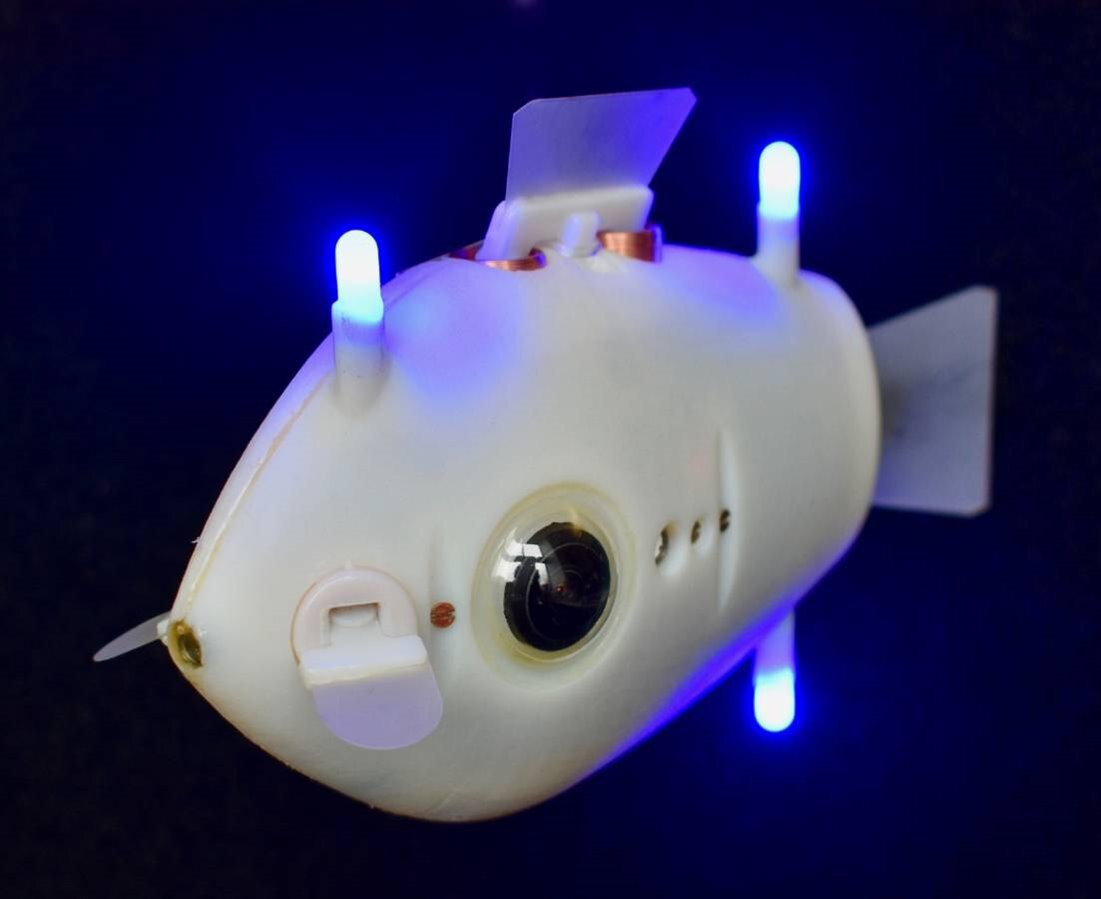
The Bluebots can autonomously synchronize their movements and can signal when to disperse, aggregate, and form a circle. The Bluebots are equipped with three LED lights and two cameras to have them navigate. (Image credit: Self-organizing Systems Research Group)


Schools of fish use synchronized behaviors to help them find food and avoid danger, like predators. Rather than follow a leader, fish use implicit coordination where individual fish make decisions based on what they see their neighbors doing. To learn more about this behavior, a team of researchers at the Harvard John A. Paulson School of Engineering and Applied Sciences (SEAS) and the Wyss Institute for Biologically Inspired Engineering developed robotic fish that can autonomously synchronize their movements like a real school of fish.


The robotic fish swarm, dubbed Blueswarm, can navigate 3D spaces, like water, unlike previous robotic swarms that operate in two-dimensional due to challenges with sensing and locomotion. To overcome these issues, the individual robotic fish, known as Bluebots, are equipped with blue LED lights that help them communicate with other bots using a vision-based coordination system developed by researchers. Each both is equipped with two cameras and three LED lights. The fish-lens camera finds the LED lights of other Bluebots and uses a custom algorithm to determine their distance, direction, and heading. With this system, the robotic fish can signal when to disperse, aggregate, and form a circle.


“Each Bluebot implicitly reacts to its neighbors’ positions,” said Florian Berlinger, a Ph.D. Candidate at SEAS and Wyss and first author of the paper.  “So, if we want the robots to be aggregate, then each Bluebot will calculate the position of each of its neighbors and move towards the center. If we want the robots to disperse, the Bluebots do the opposite. If we want them to swim as a school in a circle, they are programmed to follow lights directly in front of them in a clockwise direction.”


For testing, researchers simulated a search mission using a red light in the tank. The Bluebots used the dispersion algorithm to spread out across the tank until one came close enough to the light source to find it. Once it was detected, the bot’s LED flashed, triggering the aggregation algorithm in the rest of the Blueswarm. This causes all the robots to aggregate around the signaling robot.


Researchers believe Blueswarm will not only help them better understand the behaviors of fish schools, but it can also help them monitor and search in visually rich but fragile environments like coral reefs. These areas are hard for humans to get to, and they’re often out of reach for GPS and WiFi-based systems.


You don't have permission to edit metadata of this video.
Edit media
x
image
Upload Preview
image


Have a story tip? Message me at: http://twitter.com/Cabe_Atwell

  • Sign in to reply

Top Comments

  • genebren
    genebren over 4 years ago +1
    That is pretty cool!
  • Catwell
    Catwell over 4 years ago in reply to hugohu +1
    I think I would like these as low maintenance pets.
  • Catwell
    Catwell over 4 years ago in reply to hugohu

    I think I would like these as low maintenance pets.

    • Cancel
    • Vote Up +1 Vote Down
    • Sign in to reply
    • More
    • Cancel
  • hugohu
    hugohu over 4 years ago

    NIce. Not lying that fish is cute. Kinda, but also creepy.

    • Cancel
    • Vote Up 0 Vote Down
    • Sign in to reply
    • More
    • Cancel
  • genebren
    genebren over 4 years ago

    That is pretty cool!

    • Cancel
    • Vote Up +1 Vote Down
    • Sign in to reply
    • More
    • Cancel
element14 Community

element14 is the first online community specifically for engineers. Connect with your peers and get expert answers to your questions.

  • Members
  • Learn
  • Technologies
  • Challenges & Projects
  • Products
  • Store
  • About Us
  • Feedback & Support
  • FAQs
  • Terms of Use
  • Privacy Policy
  • Legal and Copyright Notices
  • Sitemap
  • Cookies

An Avnet Company © 2026 Premier Farnell Limited. All Rights Reserved.

Premier Farnell Ltd, registered in England and Wales (no 00876412), registered office: Farnell House, Forge Lane, Leeds LS12 2NE.

ICP 备案号 10220084.

Follow element14

  • X
  • Facebook
  • linkedin
  • YouTube