element14 Community
element14 Community
    Register Log In
  • Site
  • Search
  • Log In Register
  • Community Hub
    Community Hub
    • What's New on element14
    • Feedback and Support
    • Benefits of Membership
    • Personal Blogs
    • Members Area
    • Achievement Levels
  • Learn
    Learn
    • Ask an Expert
    • eBooks
    • element14 presents
    • Learning Center
    • Tech Spotlight
    • STEM Academy
    • Webinars, Training and Events
    • Learning Groups
  • Technologies
    Technologies
    • 3D Printing
    • FPGA
    • Industrial Automation
    • Internet of Things
    • Power & Energy
    • Sensors
    • Technology Groups
  • Challenges & Projects
    Challenges & Projects
    • Design Challenges
    • element14 presents Projects
    • Project14
    • Arduino Projects
    • Raspberry Pi Projects
    • Project Groups
  • Products
    Products
    • Arduino
    • Avnet & Tria Boards Community
    • Dev Tools
    • Manufacturers
    • Multicomp Pro
    • Product Groups
    • Raspberry Pi
    • RoadTests & Reviews
  • About Us
  • Store
    Store
    • Visit Your Store
    • Choose another store...
      • Europe
      •  Austria (German)
      •  Belgium (Dutch, French)
      •  Bulgaria (Bulgarian)
      •  Czech Republic (Czech)
      •  Denmark (Danish)
      •  Estonia (Estonian)
      •  Finland (Finnish)
      •  France (French)
      •  Germany (German)
      •  Hungary (Hungarian)
      •  Ireland
      •  Israel
      •  Italy (Italian)
      •  Latvia (Latvian)
      •  
      •  Lithuania (Lithuanian)
      •  Netherlands (Dutch)
      •  Norway (Norwegian)
      •  Poland (Polish)
      •  Portugal (Portuguese)
      •  Romania (Romanian)
      •  Russia (Russian)
      •  Slovakia (Slovak)
      •  Slovenia (Slovenian)
      •  Spain (Spanish)
      •  Sweden (Swedish)
      •  Switzerland(German, French)
      •  Turkey (Turkish)
      •  United Kingdom
      • Asia Pacific
      •  Australia
      •  China
      •  Hong Kong
      •  India
      •  Korea (Korean)
      •  Malaysia
      •  New Zealand
      •  Philippines
      •  Singapore
      •  Taiwan
      •  Thailand (Thai)
      • Americas
      •  Brazil (Portuguese)
      •  Canada
      •  Mexico (Spanish)
      •  United States
      Can't find the country/region you're looking for? Visit our export site or find a local distributor.
  • Translate
  • Profile
  • Settings
Industrial Automation
  • Technologies
  • More
Industrial Automation
Blog Robots inspired by nature can learn to swarm
  • Blog
  • Forum
  • Documents
  • Quiz
  • Events
  • Polls
  • Files
  • Members
  • Mentions
  • Sub-Groups
  • Tags
  • More
  • Cancel
  • New
Join Industrial Automation to participate - click to join for free!
  • Share
  • More
  • Cancel
Group Actions
  • Group RSS
  • More
  • Cancel
Engagement
  • Author Author: Catwell
  • Date Created: 27 Aug 2019 2:11 PM Date Created
  • Views 1035 views
  • Likes 7 likes
  • Comments 4 comments
  • research
  • robotics
  • robot
  • on_campus
  • cabeatwell
  • innovation
Related
Recommended

Robots inspired by nature can learn to swarm

Catwell
Catwell
27 Aug 2019

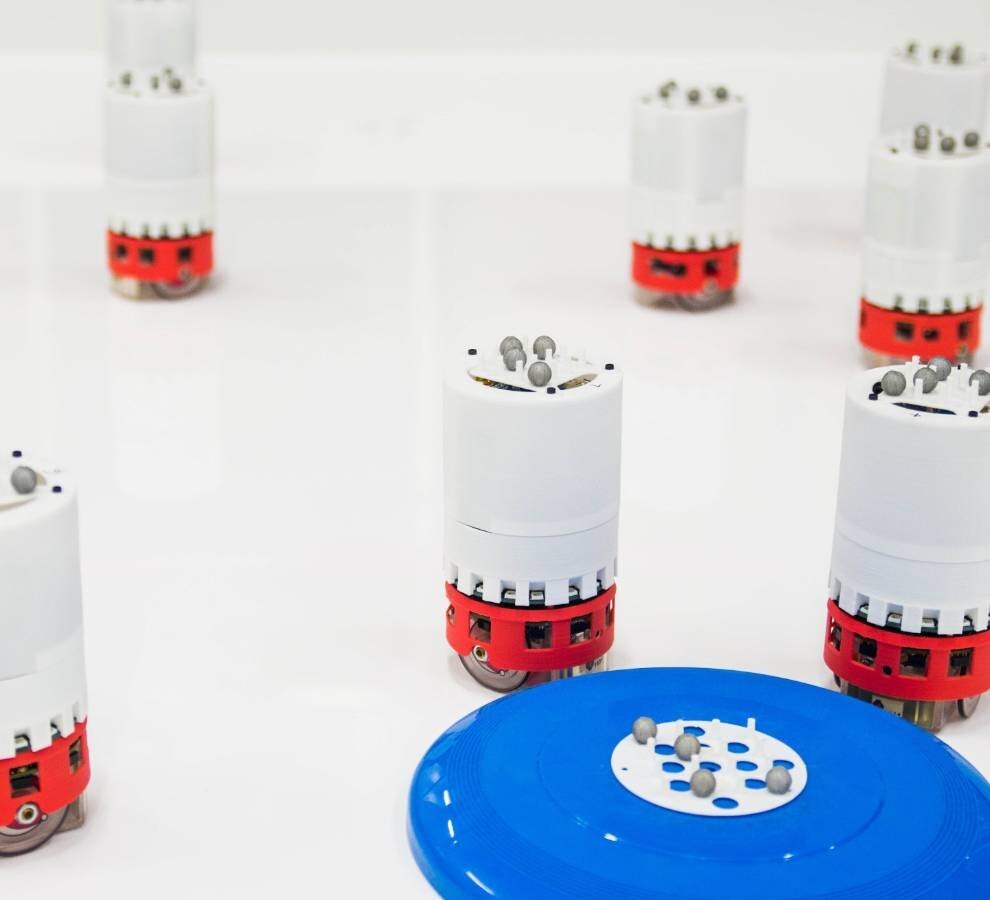
Researchers from the University of Bristol and the University of the West of England (UWE) have developed a new generation of swarming robots called “Teraflop Swarm” that can adapt to new environments and independently learn new behaviors through a process of artificial evolution. This can pave the way for developing robotic systems for environmental monitoring, disaster recovery, infrastructure maintenance, logistics and agriculture. Results are published in Advanced Intelligent Systems.
 

image

The custom-made swarm of robots can have their own rules assigned to them, giving rise to certain swarm behaviors. (Image Credit: University of Bristol)

Artificial evolution has always been run on an external computer that connects to the swarm, where the best strategies are communicated to the robots. This can be limiting because it requires a laboratory setting and an external infrastructure.


Researchers used a custom-made swarm of robots that includes high-processing power fixed within the swarm. They were then able to find appropriate rules to give rise to chosen swarm behaviors. This could allow robotic swarms to continually adapt in the wild on their own, carrying out any tasks and conditions that have been assigned to them. The advanced controllers can also be queried, clarified and improved by making them understandable to humans.


"Human-understandable controllers allow us to analyze and verify automatic designs to ensure safety for deployment in real-world applications." Simon Jones, lead author from the University of Bristol's Robotics Lab said: The team used advances in high-performance mobile computing to develop the swarm of robots, seeking inspiration from actual swarms found in nature. The teams “Teraflop Swarm” is able to run the computationally intensive automatic design process within the swarm, allowing it to function without the use of other resources. It can reach a high level of performance in just 15 minutes, which is a lot quicker than other embodied evolution methods designed in the past and without depending on external infrastructures to operate.


“This is the first step towards robot swarms that automatically discover suitable swarm strategies in the wild." Dr. Hauert, Senior Lecturer in Robotics in the Department of Engineering Mathematics and Bristol Robotics Laboratory (BRL), said: "The next step will be to get these robot swarms out of the lab and demonstrate our proposed approach in real-world applications."

Removing the swarm’s dependency from an external infrastructure and making it possible to perform analysis, understand and explain the controllers will allow researchers to develop robots with automatic design of swarm controllers in the real world. This would be useful in different scenarios like disaster recovery and environmental monitoring. 


Starting from scratch, a robotic swarm could have a suitable strategy communicated to them in situ, and have the strategy altered whenever the environment or assigned task changes.


You don't have permission to edit metadata of this video.
Edit media
x
image
Upload Preview
image


"In many modern AI systems, especially those that employ Deep Learning, it is almost impossible to understand why the system made a particular decision. This lack of transparency can be a real problem if the system makes a bad decision and causes harm. An important advantage of the system described in this paper is that it is transparent: its decision-making process is understandable by humans." said Professor Alan Winfield, BRL and Science Communication Unit, UWE.

  • Sign in to reply

Top Comments

  • 14rhb
    14rhb over 6 years ago in reply to dubbie +3
    You could as you've given me an idea dubbie ..... I too am interested to see a swarm working but for me, while the cost of making a useful single robot is affordable multiply that up to make a decent swarm…
  • dubbie
    dubbie over 6 years ago in reply to 14rhb +2
    I'm all for it! I have just bought two Boxer mobile robots with the idea of maybe using them as a mobile robot chassis to be used with my own controller. These were originally quite expensive at £70+ but…
  • 14rhb
    14rhb over 6 years ago +1
    Watching that video made me think of watching thousands of ants dragging some insect carcase over to their nest; constantly rotating it, pulling in various directions, sometime taking a while but eventually…
  • dubbie
    dubbie over 6 years ago in reply to 14rhb

    I'm all for it!


    I have just bought two Boxer mobile robots with the idea of maybe using them as a mobile robot chassis to be used with my own controller. These were originally quite expensive at £70+ but have recently come down in price to under £30 and I obtained two from Amazon for about £22 each.  Saves on all the difficult mechanical parts anyway.


    Dubbie

    • Cancel
    • Vote Up +2 Vote Down
    • Sign in to reply
    • More
    • Cancel
  • 14rhb
    14rhb over 6 years ago in reply to dubbie

    You could as you've given me an idea dubbie .....


    I too am interested to see a swarm working but for me, while the cost of making a useful single robot is affordable multiply that up to make a decent swarm becomes very expensive. Therefore how about a new Project14 or Design Challenges where there is an initial design phase: that would show the concepts, the algorithms for a single unit and a BOM for each unit. The winner(s) would be selected based on their phase one work. The challenge would then move to phase two where the winner(s) are furnished with materials and components to make, say 12 units, and then demonstrate how they work together? That will be the fun part as until then they might not actually do anything very well...and it would be for the judges to extract that possible potential following the phase one submissions.


    tariq.ahmad

    pchan

    • Cancel
    • Vote Up +3 Vote Down
    • Sign in to reply
    • More
    • Cancel
  • dubbie
    dubbie over 6 years ago

    It is when I see such exciting things like this (about mobile robots obviously) that almost makes me wish I was still working with them (Almost - but not quite). Still, one day, I may eventually make my own Project14 swarm and then the world is my oyster.


    Dubbie

    • Cancel
    • Vote Up +1 Vote Down
    • Sign in to reply
    • More
    • Cancel
  • 14rhb
    14rhb over 6 years ago

    Watching that video made me think of watching thousands of ants dragging some insect carcase over to their nest; constantly rotating it, pulling in various directions, sometime taking a while but eventually they manage it. Fascinating stuff.

    • Cancel
    • Vote Up +1 Vote Down
    • Sign in to reply
    • More
    • Cancel
element14 Community

element14 is the first online community specifically for engineers. Connect with your peers and get expert answers to your questions.

  • Members
  • Learn
  • Technologies
  • Challenges & Projects
  • Products
  • Store
  • About Us
  • Feedback & Support
  • FAQs
  • Terms of Use
  • Privacy Policy
  • Legal and Copyright Notices
  • Sitemap
  • Cookies

An Avnet Company © 2025 Premier Farnell Limited. All Rights Reserved.

Premier Farnell Ltd, registered in England and Wales (no 00876412), registered office: Farnell House, Forge Lane, Leeds LS12 2NE.

ICP 备案号 10220084.

Follow element14

  • X
  • Facebook
  • linkedin
  • YouTube