


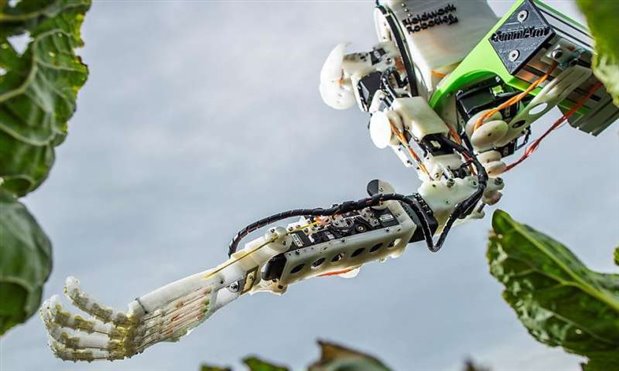
Robots are becoming an integral part of agriculture. A new type of robots will soon be helping farmers with harvesting cauliflowers and other produce. This is a "Fieldworks Robotics" harvesting robot. (Image credit: Fieldworks Robotics)
It’s only a matter of time before robots become dominant in agriculture; after all, our very survival depends on our ability to produce foods. The challenge many farmers face is in keeping produce plentiful and fresh for as long as possible. These days, one of the most coveted vegetables is cauliflower. However, it oxidizes very quickly, making it a tricky vegetable to harvest. So, if engineers could teach a robot to determine the right time to harvest cauliflower, farmers will not only be able to harvest more of it but also match the supply to the demand at reasonable prices.
To solve that puzzle, a collaboration between Bonduelle, the French canned vegetable producer, and a group of scientists was launched in the third quarter of this year. Using robots to harvest produce is not really a revolutionary idea; Fieldwork Robotics, the team of scientists partnering with Bonduelle, has already created a robot that harvests raspberry. The prototype of the cauliflower-picking robot shows that it has 2 "hands": a gripper and a cutter. For now, the prototype has only been tested in a laboratory where the robot was put in front of a row of cauliflower plants. Using its sensors, 3D cameras and machine learning capability, the robot is able to find the cauliflowers and cut them accurately.
It is important to note that engineering alone wouldn't have made this possible. Since the robot uses machine learning software, a branch of artificial intelligence, it was important to gather as much data about harvesting cauliflower, and Bonduelle has been helping with that aspect of the project. The data provided by Bonduelle will be converted into computer algorithms that will guide the arms of the robot. Fieldwork Robotics has collaborated with German company Bosch to design the robot's arms and improve its software. Although the robot is not faster than humans yet, it can work throughout the night when humans are asleep. Fieldwork Robotics is planning to later modify their current prototype to make it adaptable to the harvest of all kinds of fruits. For now, the cauliflower-picking robot will not be ready for field testing before 2022.

Fieldworks Robotics arms picking raspberries at 2.5 seconds per berry! (Image credit: Fieldworks Robotics)
Robots are slowly being introduced in agriculture in the areas of weed control, autonomous mowing/seeding/pruning/thinning/spraying, phenotyping, sorting and packing. But it is in the area of harvesting and picking that robots are the most in-demand. For example, the UK has been facing a seasonal labor shortage since the country left the European Union, and some of its farmers are already eyeing the raspberry-picking robot. In other words, it is safe to assume that robots are coming into agriculture to stay.
Have a story tip? Message me at: cabe(at)element14(dot)com
Top Comments