


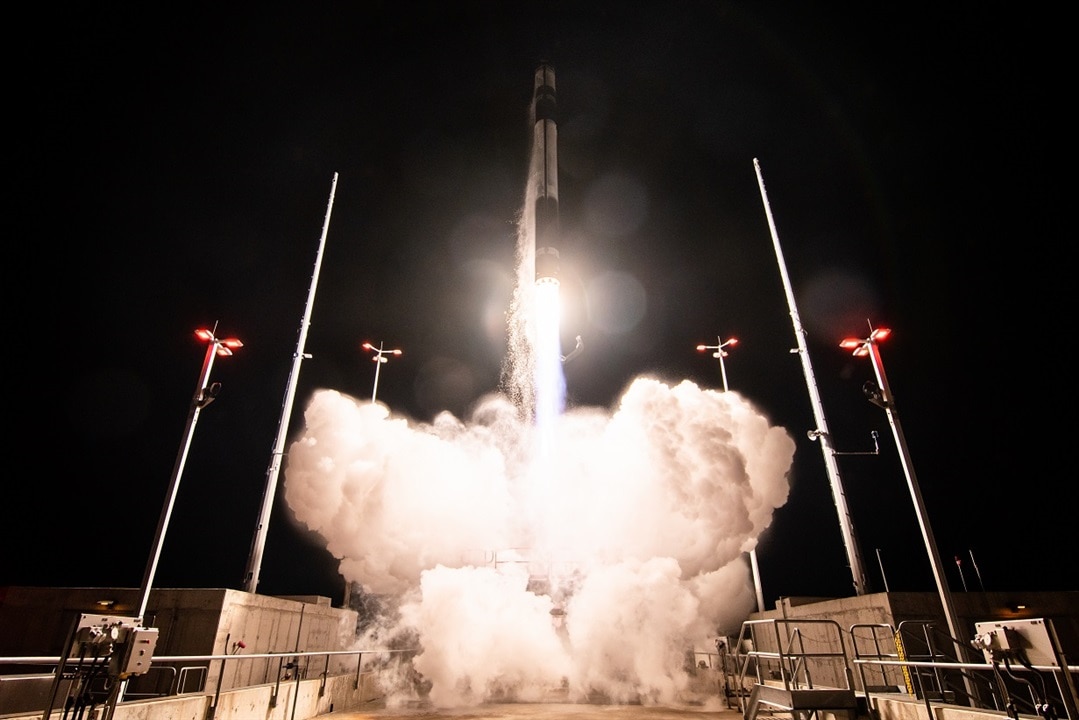
Rocket Lab successfully launched its Electron rocket on US soil for the first time on January 24th. (Image Credit: Rocket Lab)
For the first time in the US, Rocket Lab has finally launched its Electron rocket after countless delays! Electron successfully lifted off on January 24th at 6 pm EST at NASA's Wallops Flight Facility. It took nine minutes for the upper stage to reach low earth orbit (LEO), at which point the Rutherford Vacuum engine shut off. Ninety minutes later, the rocket successfully deployed three Hawkeye 360 Earth observation satellites.
This Electron rocket is one-of-a-kind! For starters, the structure consists of carbon fiber composites, and it's the only one in the world with engines featuring battery-powered pumps. Electron is the smallest rocket built, measuring 1.2 meters wide, 18 meters tall, and weighing 13 tons. The payload also varies depending on where it's headed. It carries 300 kilograms to LEO or 200 kilograms to a sun-synchronous orbit.
So far, Electron is the most affordable dedicated rocket launch option. Despite its cost ($25,000 per kilogram), customers have realized the advantages far outweigh the price. SpaceX's rideshare launch service costs $5,500 per kilogram. That may seem cheaper, but Rocket Lab allows customers to choose the timing and target orbit along with other offerings.
Rocket Lab's consumers have already paid more for a direct launch. This first-ever US soil launch also marks Electron's 30th successful launch and 33rd launch ever since its introduction in May 2017. The company launched nine times in 2022.
Now, Rocket Lab is working on making Electron's first stage reusable. The company recovered and analyzed boosters that took part in missions and even used a helicopter to pick one up out of the sky. The company plans to launch one Electron mission a month at the Wallops launchpad. It's also building a new rocket called Neutron.
Launch delays for Rocket Lab's first launch on US soil were frequent. In October 2018, the company announced it planned to build a launch site in America. Rocket Lab also hoped the first launch would occur in the third quarter of 2019 at Virginia's NASA Wallops Flight Facility. Launch Complex 2 (LC-2) construction began in February 2019, with the project finishing in 2020. Rocket Lab said the LC-2 could launch the first Electron rock in Q2 2020. The company sent its Electron to Virginia, where it underwent a wet dress rehearsal and static fire test.
That delay was because NASA instructed Rocket Lab to use its software for a flight termination system, which monitors a rocket to determine if a populated area requires protection. Rocket Lab developed its AFTS, which is used at the New Zealand site. The NASA software experienced many delays, leading to constant Electron rocket launch delays.
Have a story tip? Message me at: http://twitter.com/Cabe_Atwell