element14 Community
element14 Community
    Register Log In
  • Site
  • Search
  • Log In Register
  • Community Hub
    Community Hub
    • What's New on element14
    • Feedback and Support
    • Benefits of Membership
    • Personal Blogs
    • Members Area
    • Achievement Levels
  • Learn
    Learn
    • Ask an Expert
    • eBooks
    • element14 presents
    • Learning Center
    • Tech Spotlight
    • STEM Academy
    • Webinars, Training and Events
    • Learning Groups
  • Technologies
    Technologies
    • 3D Printing
    • FPGA
    • Industrial Automation
    • Internet of Things
    • Power & Energy
    • Sensors
    • Technology Groups
  • Challenges & Projects
    Challenges & Projects
    • Design Challenges
    • element14 presents Projects
    • Project14
    • Arduino Projects
    • Raspberry Pi Projects
    • Project Groups
  • Products
    Products
    • Arduino
    • Avnet & Tria Boards Community
    • Dev Tools
    • Manufacturers
    • Multicomp Pro
    • Product Groups
    • Raspberry Pi
    • RoadTests & Reviews
  • About Us
  • Store
    Store
    • Visit Your Store
    • Choose another store...
      • Europe
      •  Austria (German)
      •  Belgium (Dutch, French)
      •  Bulgaria (Bulgarian)
      •  Czech Republic (Czech)
      •  Denmark (Danish)
      •  Estonia (Estonian)
      •  Finland (Finnish)
      •  France (French)
      •  Germany (German)
      •  Hungary (Hungarian)
      •  Ireland
      •  Israel
      •  Italy (Italian)
      •  Latvia (Latvian)
      •  
      •  Lithuania (Lithuanian)
      •  Netherlands (Dutch)
      •  Norway (Norwegian)
      •  Poland (Polish)
      •  Portugal (Portuguese)
      •  Romania (Romanian)
      •  Russia (Russian)
      •  Slovakia (Slovak)
      •  Slovenia (Slovenian)
      •  Spain (Spanish)
      •  Sweden (Swedish)
      •  Switzerland(German, French)
      •  Turkey (Turkish)
      •  United Kingdom
      • Asia Pacific
      •  Australia
      •  China
      •  Hong Kong
      •  India
      • Japan
      •  Korea (Korean)
      •  Malaysia
      •  New Zealand
      •  Philippines
      •  Singapore
      •  Taiwan
      •  Thailand (Thai)
      • Vietnam
      • Americas
      •  Brazil (Portuguese)
      •  Canada
      •  Mexico (Spanish)
      •  United States
      Can't find the country/region you're looking for? Visit our export site or find a local distributor.
  • Translate
  • Profile
  • Settings
Industrial Automation
  • Technologies
  • More
Industrial Automation
Blog Scientists Are Working on a Tractor Beam to Remove Space Debris from Orbit
  • Blog
  • Forum
  • Documents
  • Quiz
  • Events
  • Polls
  • Files
  • Members
  • Mentions
  • Sub-Groups
  • Tags
  • More
  • Cancel
  • New
Join Industrial Automation to participate - click to join for free!
  • Share
  • More
  • Cancel
Group Actions
  • Group RSS
  • More
  • Cancel
Engagement
  • Author Author: Catwell
  • Date Created: 22 Jan 2026 8:47 PM Date Created
  • Views 551 views
  • Likes 4 likes
  • Comments 1 comment
  • space debris
  • space
  • university
  • earth
Related
Recommended

Scientists Are Working on a Tractor Beam to Remove Space Debris from Orbit

Catwell
Catwell
22 Jan 2026

image

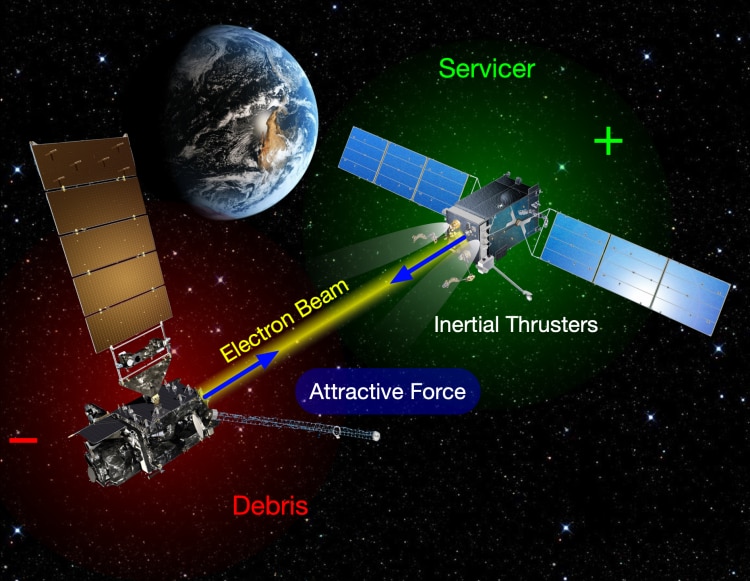
UC Boulder is working on a electrostatic beam that generates electrostatic attraction to remove space debris from Earth orbit. (Image Credit: Schaub Lab)

Scientists at the University of Colorado Boulder believe dead satellites orbiting the Earth could be removed without physically touching them. That’s where sci-fi inspiration kicks in: tractor beams. The beam uses electrostatic attraction to pull space junk away from the Earth’s orbit, drifting elsewhere. Although this concept doesn’t solve every problem involving space debris, it has the potential to work better than other techniques. Building a prototype may cost millions, with an operational, full-scale one costing even more. If they meet those costs, the tractor beam could be functional within ten years.

“We’re creating an attractive or repulsive electrostatic force,” said Schaub, chair of the Ann and H.J. Smead Department of Aerospace Engineering Sciences. “It’s similar to the tractor beam you see in Star Trek, although not nearly as powerful.”

As part of their concept, a service spacecraft featuring an electron gun works produces an electrostatic tractor beam. It beams out negatively charged electrons at a dead satellite while the spacecraft has a positive charge. This creates an electrostatic attraction, allowing the servicer spacecraft to pull the dead satellite away, even with 65 to 100 feet of space between the two. The team says the satellite can drift into a “graveyard orbit” ---further away from Earth.

However, electron gun technology limitations and the distance between the spacecraft and the target would produce a very weak electrostatic attraction. This also means the servicer moves at slow speeds, taking over a month put the target satellite out of Earth orbit. That’s a big problem when you consider how many satellites orbit the planet. An individual electrostatic tractor won’t be able to keep up with the ones reaching their end-of-life. Plus, it would be impractical to remove smaller space junk pieces from orbit as the tractor moves too slowly.

Despite those drawbacks, the tractor beam is a better alternative than other methods relying on physical docking systems, harpoons, and giant nets. It’s a completely touchless system, which doesn’t interfere with the removal process and potentially damage the spacecraft.

Although the electrostatic tractor doesn’t have a full cost report prepared yet, they expect a high price --- tens of millions of dollars. The team also says that cost-efficiency won’t be a problem when it’s in space and in operational use.

Nowadays, the team is running trials at CU Boulder using the Electrostatic Charging Laboratory for Interactions between Plasma and Spacecraft (ECLIPS) machine. Their configuration contains a bathtub-sized metal vacuum chamber equipped with an electron gun. This system allows them to carry out experiments that not many other labs can perform. The controlled environment allows them to replicate how an electron tractor behaves on a reduced scale.

Before real-world demonstrations, the team must obtain the money for a mission, which they haven’t started. The majority of the expense would be tied to designing, building, and launching the servicer spacecraft. Ideally, they’d put two satellites into orbit: a servicer and a separate target satellite they can actively steer. Doing this gives them more flexibility during tests, but it would double the price.

If they secure the funding, the team predicts it could take ten years to build and launch an operational prototype.

You don't have permission to edit metadata of this video.
Edit media
x
image
Upload Preview
image

Have a story tip? Message me here at element14.

  • Sign in to reply
  • DAB
    DAB 27 days ago

    The science is very sketchy.

    I think they will waste a lot of money before everyone realizes that this approach will not work.

    Electrostatic is a repulsive force. You can make it appear to be an attractive force on the small scale, but that is just using smoke and mirrors.

    • Cancel
    • Vote Up 0 Vote Down
    • Sign in to reply
    • More
    • Cancel
element14 Community

element14 is the first online community specifically for engineers. Connect with your peers and get expert answers to your questions.

  • Members
  • Learn
  • Technologies
  • Challenges & Projects
  • Products
  • Store
  • About Us
  • Feedback & Support
  • FAQs
  • Terms of Use
  • Privacy Policy
  • Legal and Copyright Notices
  • Sitemap
  • Cookies

An Avnet Company © 2026 Premier Farnell Limited. All Rights Reserved.

Premier Farnell Ltd, registered in England and Wales (no 00876412), registered office: Farnell House, Forge Lane, Leeds LS12 2NE.

ICP 备案号 10220084.

Follow element14

  • X
  • Facebook
  • linkedin
  • YouTube