


The journey of the self-driving car started in 1925 when the inventor Francis Houdina put on the streets of Manhattan a radio-controlled car with no driver. People at the time really thought it was a trick from the famous illusionist Houdini, especially since both names are similar. Needless to say, the invention was not accepted at the time; but Houdina would be pleased to know he was on to something. Today, almost 100 years later, self-driving cars are not just an idea, not even a prototype, but a reality. Google has been testing non-commercial rides in Phoenix, AZ with its self-driving car Waymo. Meanwhile, other companies have been testing doing delivery with all kind of autonomous vehicles. However, the technology is not perfect yet.
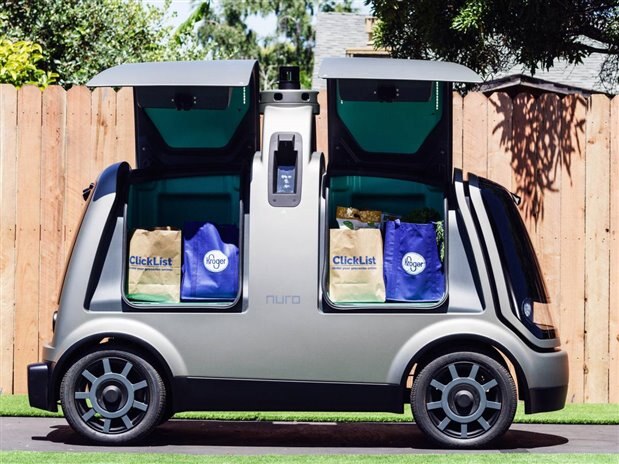
R1, Nuro’s self-driving car with Kroger’s groceries on their way to be delivered. (Image via Kroger)
Earlier last year, the US grocery store Kroger launched a delivery service in partnership with the startup NURO. Kroger started tested the Nuro’s self-driving car in Arizona since the state is more open to the idea of driverless car on its roads. Kroger was not new to using self-driving cars for its grocery delivery; before Nuro, the grocer was using a self-driving Toyota Prius with a driver inside as a backup. With the new partnership, there will not be any driver in the car, not even for back up. Nuro’s car will carry only groceries to be delivered in Scottsdale, AZ for now. Customers would place their orders in-store or online and would have the option of receiving it the same day of the next day. Since Kroger and Nuro are not the only companies in Arizona testing autonomous vehicles, the state has set up a facility to conduct more research on how to improve customers’ experience and safety when interacting with a self-driving vehicle.
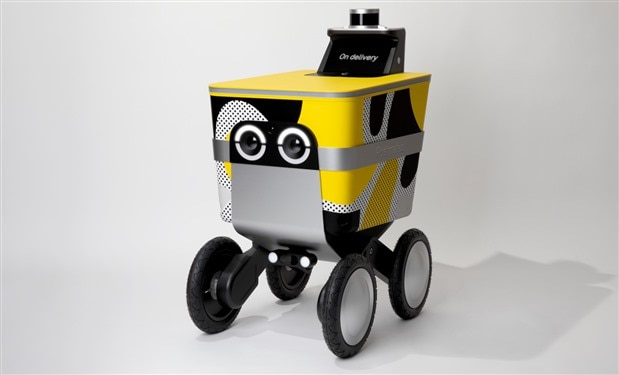
Serve the delivery robot. (Image via Postmates)
In California, another autonomous vehicle is being tested. The meal delivery company Postmates is introducing a new way of fulfilling customers’ orders: Serve, a box-like robot meant to carry the food customers ordered to them. Serve can carry up to 50 pounds of meals and run 30 miles after every charge. When Serve reaches the delivery address, the customer will use a code on his/her phone to unlock Serve and collect the order. When Serve is on the way to the delivery address, it uses cameras and Velodyne’s LiDar (a technology to help autonomous vehicle process better the details on a high traffic road) to navigate. Even with such advanced technology, Postmates reassures the public that Serve moves at the same speed as pedestrians and will safely avoid obstacles such as fire hydrants. Serve also is equipped with turning signals to allows other people on the road know where it is turning. But for more safety, there is always a person around Serve in case the robot hits a snag. The robot is also equipped with a help button and an option to video chat if necessary. After all, autonomous vehicles could disturb the lifestyle of the people they operate around.
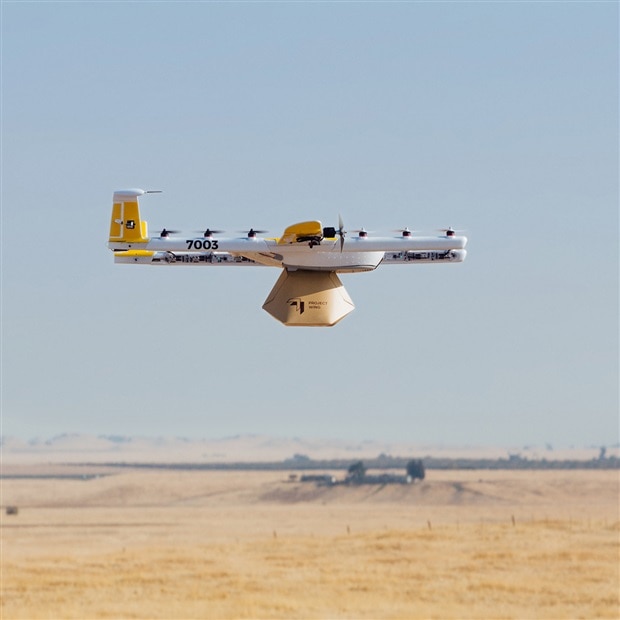
Wing’s delivery drone carrying a package - brown box at the bottom of the drone. (Image via Alphabet, https://x.company/projects/wing/)
Talking about the trouble that autonomous vehicles can create, Wing -- one of the subsidiaries of Alphabet, Google’s parent company – is experiencing a few complaints regarding how noisy its delivery drones are. Wing has bee testing the self-driving drones in Australia for a few years now, and their customers are really satisfied with the convenience the drones bring. Wing offers same-day delivery services to businesses mainly. Even though it seems that they have progressed considerably since their inception, many inhabitants of the neighborhood the drones fly through seem to think that the machines could be improved. To be precise, they complained that the drones make too much noise, to the point that many of the locals had to change their habits to avoid the ruckus. Some people even noticed that the noise is also unsettling for their pets. There is also a concern that the noise could cause post-traumatic stress disorder in war veterans. As a result, the government of Australia refused to allow the drones in urban areas.
As a response, Wing is already working on a much quieter version of the drones. However, it will take a while before those new drones are available for use. The company could only modify their current drones to lessen the noise. They reduced the speed of the vehicles and modified their paths to give a break to the people living in neighborhoods the drones used to travel through.
All that is sure for now is that autonomous vehicles will continue to evolve until every delivery job is taken by them.
Have a story tip? Message me at: cabe(at)element14(dot)com