element14 Community
element14 Community
    Register Log In
  • Site
  • Search
  • Log In Register
  • Community Hub
    Community Hub
    • What's New on element14
    • Feedback and Support
    • Benefits of Membership
    • Personal Blogs
    • Members Area
    • Achievement Levels
  • Learn
    Learn
    • Ask an Expert
    • eBooks
    • element14 presents
    • Learning Center
    • Tech Spotlight
    • STEM Academy
    • Webinars, Training and Events
    • Learning Groups
  • Technologies
    Technologies
    • 3D Printing
    • FPGA
    • Industrial Automation
    • Internet of Things
    • Power & Energy
    • Sensors
    • Technology Groups
  • Challenges & Projects
    Challenges & Projects
    • Design Challenges
    • element14 presents Projects
    • Project14
    • Arduino Projects
    • Raspberry Pi Projects
    • Project Groups
  • Products
    Products
    • Arduino
    • Avnet & Tria Boards Community
    • Dev Tools
    • Manufacturers
    • Multicomp Pro
    • Product Groups
    • Raspberry Pi
    • RoadTests & Reviews
  • About Us
    About the element14 Community
  • Store
    Store
    • Visit Your Store
    • Choose another store...
      • Europe
      •  Austria (German)
      •  Belgium (Dutch, French)
      •  Bulgaria (Bulgarian)
      •  Czech Republic (Czech)
      •  Denmark (Danish)
      •  Estonia (Estonian)
      •  Finland (Finnish)
      •  France (French)
      •  Germany (German)
      •  Hungary (Hungarian)
      •  Ireland
      •  Israel
      •  Italy (Italian)
      •  Latvia (Latvian)
      •  
      •  Lithuania (Lithuanian)
      •  Netherlands (Dutch)
      •  Norway (Norwegian)
      •  Poland (Polish)
      •  Portugal (Portuguese)
      •  Romania (Romanian)
      •  Russia (Russian)
      •  Slovakia (Slovak)
      •  Slovenia (Slovenian)
      •  Spain (Spanish)
      •  Sweden (Swedish)
      •  Switzerland(German, French)
      •  Turkey (Turkish)
      •  United Kingdom
      • Asia Pacific
      •  Australia
      •  China
      •  Hong Kong
      •  India
      •  Japan
      •  Korea (Korean)
      •  Malaysia
      •  New Zealand
      •  Philippines
      •  Singapore
      •  Taiwan
      •  Thailand (Thai)
      •  Vietnam
      • Americas
      •  Brazil (Portuguese)
      •  Canada
      •  Mexico (Spanish)
      •  United States
      Can't find the country/region you're looking for? Visit our export site or find a local distributor.
  • Translate
  • Profile
  • Settings
Industrial Automation
  • Technologies
  • More
Industrial Automation
Blog Sloths Inspired A Breakthrough in Environmental Study
  • Blog
  • Forum
  • Documents
  • Quiz
  • Events
  • Polls
  • Files
  • Members
  • Mentions
  • Sub-Groups
  • Tags
  • More
  • Cancel
  • New
Join Industrial Automation to participate - click to join for free!
  • Share
  • More
  • Cancel
Group Actions
  • Group RSS
  • More
  • Cancel
Engagement
  • Author Author: Catwell
  • Date Created: 18 Sep 2020 7:20 PM Date Created
  • Views 1208 views
  • Likes 4 likes
  • Comments 0 comments
  • robotics
  • robot
  • on_campus
  • cabeatwell
  • environmental sensor
  • university
  • sensor
  • innovation
Related
Recommended

Sloths Inspired A Breakthrough in Environmental Study

Catwell
Catwell
18 Sep 2020

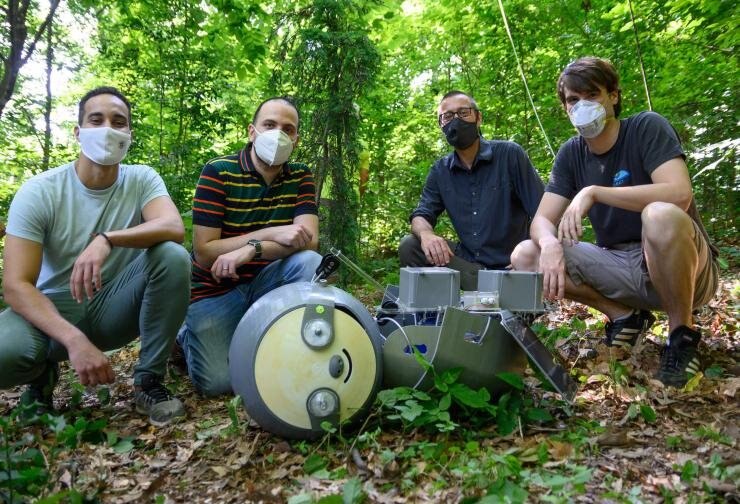
imageAnother robot was built to help scientists deepen their study of climate change, and this time they want to slow down the process. Team of researchers surrounding the Slothbot. (image credit: Georgia Tech)

Most people believe that global warming is real and that something needs to be done to fight it. While some go the “zero waste” route to reduce their carbon footprint, others turn to science for solutions. But whether one believes in climate change or not, and no matter what one chooses to do about it, we need accurate data and the only ones who can provide that are scientists. The main challenge that scientists have been encountering is the inaccessibility of certain areas of the globe or the inability of humans to collect real-time data from certain places. So, scientists turned to robots to overcome those challenges. The main goal here is to have robots live and collect data in natural habitats.

For example, a Swiss research team built the Envirobot, a robot with movements inspired by lampreys and eels, tasked with collecting water samples to test water pollution levels and create pollution maps. With the information collected by the Envirobot, scientists can evaluate the damages global warming has on water supplies and appropriately advise policymakers. And, eels are not the only water creatures to inspire the making of robots; there have been robotic jellyfishes tasked with collecting ocean data. Scientists even built robots plants to help roots to grow and study the soil. Stanford Robotics Lab built a humanoid, “Ocean One,” to explore and study the coral reefs and how global warming has been affecting them and the ocean ecosystem. It is clear that robots can be very useful, but the latest one on the market made us review the value we place on certain animals.

Engineers at Georgia Tech created a sloth-inspired robot that they name the Slothbot. Everyone knows the sloth is not the most exciting animal in nature, so why did it inspire a breakthrough in science. The truth, as explained by the research team, is that the very thing that makes sloth “not interesting” is the feature that makes the Slothbot interesting. The urgency of global warming might have pushed scientists to move faster, but when one considers that climate changes with time, it makes sense why scientists would need a tool that will allow patience. Hence the Slothbot. However, its slow pace doesn’t affect its efficiency. In fact, the  Slothbot is loaded with high-efficiency sensors that read the temperature, the air quality, the humidity and carbon dioxide levels. The Slothbot is also energy efficient. The advantage of having a robot with qualities of the sloth is that it can reach places that other robots can’t reach, such as the tree canopy. Like the real-life sloth, the Slothbot conserves energy by moving as slow as the sloth while doing its assigned job. Therefore, it doesn’t need to be recharged often, and when it is time to be recharged, the robot knows to crawl along with the cables it is suspended with to a sunlit spot in the canopy in order to expose its built-in solar panels and collect the sunlight.

With its independence and features, Slothbot seems to have a bright future in helping scientists study environmental changes, especially in areas like the rainforest, which can be hard to access. For now, the team of researchers is still trying to improve by adding more sensors to increase its versatility. Once finished, we can expect an army of slothbots around the world saving time, money and lives.

You don't have permission to edit metadata of this video.
Edit media
x
image
Upload Preview
image

Have a story tip? Message me at: cabe(at)element14(dot)com

http://twitter.com/Cabe_Atwell

  • Sign in to reply
element14 Community

element14 is the first online community specifically for engineers. Connect with your peers and get expert answers to your questions.

  • Members
  • Learn
  • Technologies
  • Challenges & Projects
  • Products
  • Store
  • About Us
  • Feedback & Support
  • FAQs
  • Terms of Use
  • Privacy Policy
  • Legal and Copyright Notices
  • Sitemap
  • Cookies

An Avnet Company © 2026 Premier Farnell Limited. All Rights Reserved.

Premier Farnell Ltd, registered in England and Wales (no 00876412), registered office: Farnell House, Forge Lane, Leeds LS12 2NE.

ICP 备案号 10220084.

Follow element14

  • X
  • Facebook
  • linkedin
  • YouTube